




You Just Moved Into a New Build in Katy, Sugar Land, or The Woodlands — Here's What Your Yard Actually Needs
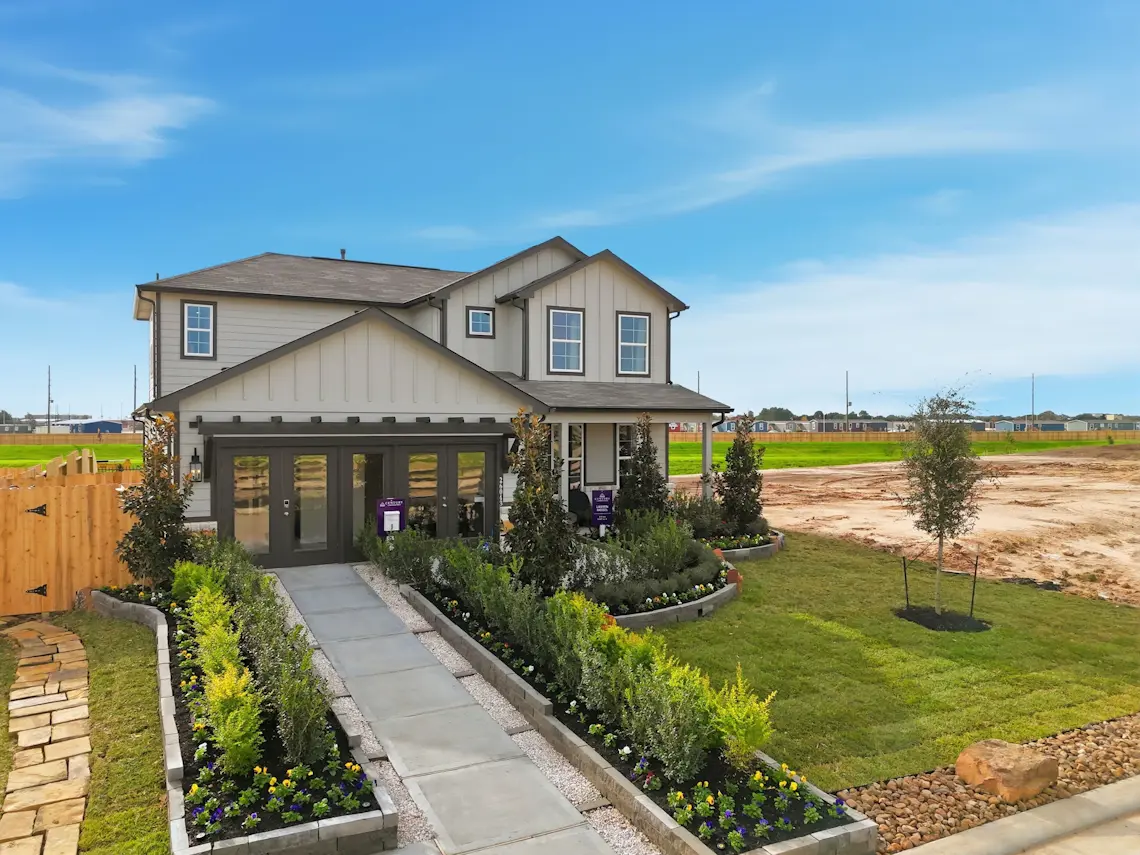
The landscaping that comes with a new construction home in Houston's suburbs is designed to satisfy one requirement — it needs to look acceptable on closing day. Beyond that, the builder's landscape package is not designed for longevity, performance, or the specific soil conditions of your lot. It is designed for speed and cost efficiency at scale, which means the decisions that determine whether your yard actually thrives over the next decade were almost certainly not made in your favor.
This is not a criticism of any specific builder. It is a structural reality of how large-scale residential development works in Houston's suburban markets. When a builder is installing landscaping across hundreds of homes simultaneously in Katy, Sugar Land, Pearland, or The Woodlands, the approach is standardized. The same sod variety goes on every lot regardless of sun exposure. The same minimal soil preparation happens on every property regardless of what the fill material is doing. The irrigation system, if one is included, is programmed to a generic schedule that may have nothing to do with what your specific lawn actually needs.
At Gulf Reserve Landscape & Pools, new construction landscape assessment and improvement is one of the most common projects we handle across Houston's suburban markets. Here is an honest picture of what new build landscaping in Houston's suburbs is typically working with — and what the first year of intentional landscape investment looks like on these properties.
What Builder Landscaping in Houston Suburbs Actually Gives You
Understanding the baseline your new Houston suburban property is starting from is the first step toward improving it intelligently.
The soil situation on new Houston suburban builds is almost universally poor. During construction, heavy equipment strips native topsoil from the lot and operates across the subgrade repeatedly, compacting it to a density that is hostile to root growth. When construction is complete, the lot is rough-graded with fill material — often sourced from elsewhere on the development site — and a thin layer of topsoil or compost may or may not be applied before sod goes down. In many cases, particularly in the faster-moving phases of large Houston suburban developments, that topsoil layer is minimal to nonexistent. The sod is laid directly on compacted fill over compacted native clay.
The fill material itself varies enormously in Houston suburban developments. Some fill is reasonable — a sandy loam blend that provides adequate drainage. More commonly in Houston's suburban expansion zones, fill is whatever was available during site grading — which can mean heavy clay subsoil with poor structure, construction debris mixed into fill layers, or material with pH levels that are even more extreme than Houston's already alkaline native clay. pH readings of 8.0 to 8.5 are not unusual on new construction lots in Katy, Sugar Land, and Pearland.
Builder sod on Houston suburban lots is typically Floratam St. Augustine — the most vigorous, fastest-growing, and least expensive St. Augustine variety. Floratam covers ground quickly, which is what a builder needs. It is also the variety most susceptible to chinch bug damage, least tolerant of shade, and most demanding of water during establishment. On a new construction lot in Houston's suburbs where soil preparation was minimal and irrigation scheduling is generic, Floratam can look acceptable for the first season and begin declining in year two as the shallow root system encounters the compaction layer just below the surface.
Builder irrigation systems on new Houston suburban homes are installed to cover the lot — not to water it intelligently. Zone layout typically reflects what was efficient to pipe rather than what reflects the actual watering needs of different areas of the property. Controllers are programmed to generic schedules. Rain sensors may or may not be installed or functioning. The system satisfies the contract requirement of having irrigation, but it may not be delivering water where the lawn needs it or in the right amounts for Houston's clay soil infiltration rate.
Drainage on new Houston suburban lots is graded to meet minimum code requirements — water needs to flow away from the foundation. Beyond that baseline, subtle low spots, inconsistent grade across the lawn, and the inevitable settlement that occurs as fill material consolidates over the first few years means most new Houston suburban lots develop drainage problems within the first two to three years of occupancy. These problems are often misread as irrigation failures or grass quality issues when they are fundamentally drainage and grading challenges.
The First Year — What to Address and When on a New Houston Suburban Property
The first year in a new Houston suburban home is the most important window for landscape intervention. Decisions made in the first growing season establish the trajectory of the entire yard. Here is how to approach that year intelligently.
Months one through three — assessment before action. The single most valuable thing a new Houston suburban homeowner can do before spending any significant money on landscaping is understand what they are actually working with. A soil test through the Texas A&M AgriLife Extension lab — a modest investment — reveals the pH, nutrient profile, and organic matter content of your specific lot. This information tells you exactly what amendments are needed rather than applying generic products to an unknown baseline.
During this period, observe how the yard drains during and after Houston rain events. Walk the property 30 minutes after a significant rain and identify where water pools, where it flows, and where it disappears quickly. This drainage map is the foundation for any grading or drainage work that needs to happen. Trying to fix drainage problems after ornamental plantings and hardscape are installed is significantly more disruptive and expensive than addressing them before the landscape is developed.
Also during this period, assess sun exposure across the entire lot through the day and across seasons. New construction lots in Houston's suburbs often have minimal tree canopy, which means sun exposure is high and consistent — but the relationship between the home's shadow, neighboring structures, and planned tree locations matters for plant selection decisions that will define the yard for decades.
Months three through six — soil amendment and drainage corrections. With the soil test results and drainage observations in hand, this is the window to address foundational soil conditions before investing in ornamental plantings or lawn improvement. Elemental sulfur applications to begin pH reduction, compost incorporation into planting bed areas, and grading corrections for drainage problems identified in the observation period are all appropriate interventions at this stage.
For new Houston suburban lots where soil compaction is severe — identifiable by water ponding on the lawn surface for extended periods after rain, poor grass color despite irrigation, and difficulty pushing a screwdriver more than a few inches into the turf — core aeration followed by top-dressing with quality compost begins the multi-year process of improving soil structure without complete soil replacement.
Drainage corrections on new Houston suburban lots at this stage typically involve adding or extending downspout discharge pipes, addressing specific low spots with fill and regrade, and installing channel drains or French drains in areas where topography makes surface drainage corrections insufficient on their own.
Months six through twelve — lawn renovation and ornamental installation. With soil amendments underway and drainage addressed, the second half of the first year is the right window to invest in lawn renovation and ornamental planting. For Houston suburban lots where the builder sod is declining due to soil compaction and pH problems, this may involve overseeding thin areas, targeted sod replacement in severely damaged zones, or a more comprehensive sod renovation depending on the condition of the existing lawn.
Ornamental planting in Houston's suburban markets benefits from a phased approach. Trees and large shrubs — the structural elements of the landscape that take the longest to establish — should be installed first. Ornamental groundcovers, perennials, and seasonal color can follow as the overall design takes shape. Rushing to install a complete ornamental landscape in the first year often results in plant losses as Houston's conditions reveal the soil and drainage issues that weren't fully resolved before planting.
Irrigation System Assessment and Correction on New Houston Builds
Before investing significantly in lawn and landscape improvement on a new Houston suburban property, the irrigation system needs to be assessed and corrected to support that investment.
The most common irrigation issues Gulf Reserve identifies on new Houston suburban build assessments are head coverage gaps where zones don't achieve true head-to-head coverage, controller programming that runs the same schedule across all zones regardless of sun exposure or plant type differences, missing or non-functional rain sensors, and zones that mix turf and ornamental bed areas on the same valve — making it impossible to water either appropriately.
A thorough irrigation audit on a new Houston suburban property involves running each zone and observing actual head operation, coverage pattern, and application uniformity. Heads that are tilted, sinking into the turf, or delivering inconsistent spray patterns are adjusted or replaced. Coverage gaps identified in the audit inform head additions or relocations that bring the system to true head-to-head coverage for Houston's wind conditions.
Controller reprogramming for Houston's seasonal variation — appropriate summer run times, reduced fall and winter schedules, and rain delay configuration — converts a generic builder-programmed system into one that actually responds to Houston's climate demands. For Houston suburban homeowners planning a significant landscape investment, upgrading the controller to a smart ET-based system at this stage protects that investment by ensuring the irrigation responds dynamically to actual Houston weather conditions rather than a fixed schedule.
Tree Selection and Placement for Houston Suburban Properties
New construction lots in Katy, Sugar Land, Pearland, and The Woodlands typically arrive with minimal to no canopy tree coverage. The trees planted in the first few years of ownership are the most important long-term landscape decisions a Houston suburban homeowner makes — they define the character, shade, and scale of the property for the next 30 to 50 years.
Live oak is the correct answer for primary canopy on most Houston suburban lots. It is native to the Gulf Coast region, tolerates Houston's alkaline clay with appropriate establishment care, and develops into the kind of dramatically spreading, deeply beautiful canopy tree that defines the character of Houston's most admired neighborhoods. On a Katy or Sugar Land lot that currently has no canopy, two to three well-placed live oaks installed in the first year begin building toward a property that will look genuinely exceptional in 15 to 20 years.
Shumard red oak offers a deciduous alternative for Houston suburban properties where fall color interest is a priority. It establishes well in Houston's soil conditions with appropriate pH amendment and provides a more upright, formal canopy form compared to live oak's spreading habit.
For intermediate-scale trees, Texas redbud delivers exceptional late winter and early spring bloom — one of the earliest flowering trees in Houston's calendar — and performs reliably in Houston's alkaline clay. Eve's necklace and Mexican plum are native Texas understory trees that provide ornamental interest at a scale appropriate for Houston suburban lot sizes without overwhelming the space.
The most important tree placement decision on a new Houston suburban lot is positioning relative to the house, hardscape, and property lines. Trees planted too close to concrete driveways, patios, or foundation walls create the root intrusion and clay heaving problems that damage hardscape over time. Canopy trees on Houston suburban lots should be sited a minimum of 15 to 20 feet from any concrete flatwork — further for species with aggressive surface root systems.
Hardscape Planning on New Houston Suburban Properties
Most new construction homes in Katy, Sugar Land, Pearland, and The Woodlands arrive with a builder-standard concrete patio — typically a basic 10 by 12 or 12 by 16 foot slab at the rear door — and a driveway. For homeowners planning to develop their outdoor living space, this is the starting point for a hardscape plan that needs to be designed correctly from the beginning rather than added to incrementally without a coherent plan.
The most common hardscape mistake on new Houston suburban properties is adding components without a drainage plan. A patio extension, pergola pad, fire pit area, and outdoor kitchen added in separate projects over several years without a coordinated drainage design creates a complex hardscape system with water flowing between elements in ways that weren't anticipated. Pooling at the junction between the original builder slab and a new extension, water running along a fence line that a new patio redirected, and saturation at a planting bed that is now surrounded on three sides by impervious surface are all problems Gulf Reserve regularly addresses on Houston suburban properties where hardscape was added without drainage coordination.
Designing the full hardscape vision — even if it will be executed in phases — before beginning the first phase ensures that drainage, grade, and material choices are consistent across the finished project. It also ensures that underground utilities, irrigation lines, and drainage pipes installed during phase one are positioned to accommodate phase two and three additions rather than being cut through or worked around later.
What a First-Year Houston Suburban Landscape Investment Looks Like
To make this concrete, here is what a realistic first-year landscape investment plan looks like for a new build Houston suburban home in the 300,000 to 600,000 dollar price range.
Soil testing and amendment program to begin pH correction and improve soil structure across the lawn and planned planting bed areas. This is the foundation that makes every other investment perform better and should be the first dollar spent.
Drainage assessment and targeted corrections — downspout extensions, grading corrections at identified low spots, and a channel drain or French drain at the primary problem area if one exists. Doing this before any ornamental planting or hardscape prevents the disruption of fixing drainage problems through an established landscape later.
Irrigation system audit and correction — zone assessment, head adjustments, coverage gap corrections, and controller reprogramming for Houston's seasonal variation. This protects the sod and plant material investment that follows.
Two to three canopy trees installed in permanent positions with appropriate soil amendment at the planting hole, proper staking for Houston's wind conditions, and an establishment watering plan for the first growing season. These are the highest long-term value plants on the property.
Ornamental planting in the primary visual areas — entry approach, patio perimeter, and foundation beds — with plant selection calibrated to Houston's soil pH, shade conditions, and climate demands. Native and adapted species that are established correctly perform far better over time than non-adapted species that require ongoing intervention to survive Houston's conditions.

Gulf Reserve Landscape & Pools works with new construction homeowners across Katy, Sugar Land, Pearland, The Woodlands, League City, Missouri City, and the greater Houston area. We start with an honest assessment of what your builder left you with and build a clear, phased plan for getting your property to where it should be.
Request your free estimate at gulfreservelandscaping.com — and let's build your new Houston property the right way from the ground up.


