




Standing Water, Soggy Lawns, and Flooded Patios — How to Fix Backyard Drainage in Houston for Good
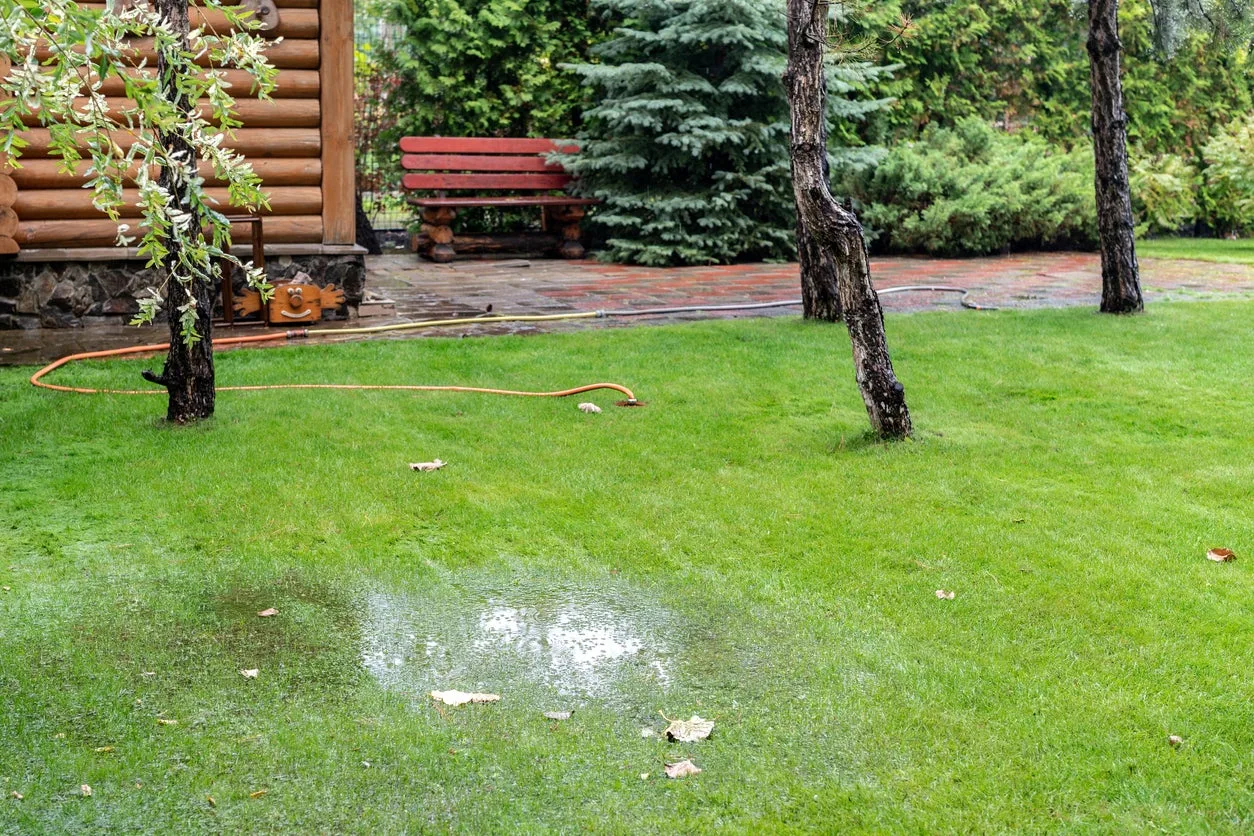
If your Houston backyard collects standing water after every significant rain, you are not dealing with bad luck or an unusually wet season. You are dealing with a drainage problem that is structural — meaning it will not fix itself, it will not get better over time, and every heavy rain event is quietly doing more damage to your soil, your lawn, your hardscape, and potentially your foundation.
Houston is one of the most drainage-challenged cities in the country. The metro sits on flat, clay-heavy land just slightly above sea level, with a network of bayous that were never designed to handle the rainfall volumes that modern Houston generates. The city averages more than 50 inches of rain annually, and a significant portion of that total falls in intense, short-duration events that overwhelm both municipal drainage infrastructure and residential yard drainage simultaneously.
When your backyard holds water, the clay soil beneath it is staying saturated for extended periods. Saturated clay expands and shifts, which damages concrete flatwork, undermines hardscape, suffocates grass root systems, and in severe cases, creates hydrostatic pressure against foundation walls. Fixing backyard drainage in Houston is not a cosmetic improvement. It is a structural investment that protects everything else on your property.
At Gulf Reserve Landscape & Pools, drainage assessment and design is a core part of how we approach every Houston landscape project. Here is a ground-level look at why Houston drainage problems occur and what the solutions that actually work look like.
Why Houston Backyards Drain So Poorly — The Root Causes
Understanding why your Houston backyard doesn't drain properly requires looking at three factors that almost always work together.
Houston's clay soil is the foundation of the problem. Clay particles are extremely fine and pack tightly together, leaving very little pore space for water to move through. While healthy loam or sandy soil might absorb an inch of water per hour, Houston's heavy clay absorbs a fraction of that — often less than 0.2 inches per hour in compacted residential lots. When Houston receives 3 to 5 inches of rain in a single storm event, the soil is overwhelmed almost immediately and water has nowhere to go but sit on the surface.
Flat topography is the second factor. Houston's landscape has almost no natural slope to move surface water away from residential properties. In areas where yards were graded during construction — particularly in newer suburbs like Katy, Pearland, and Sugar Land — the grading is often minimal and degrades further as soil settles over time. Without deliberate slope, water pools in low spots rather than flowing toward drainage outlets.
Compaction from construction makes the problem worse on many Houston properties. Home construction strips topsoil, runs heavy equipment across the subgrade, and backfills with material that is poorly compacted and settles unevenly. The result is a yard with inconsistent elevation — subtle low spots that collect water after every rain — sitting on soil that is even less permeable than native Houston clay because of construction compaction.
Impervious surfaces around Houston homes — concrete driveways, patios, pool decks, walkways — shed water rapidly toward adjacent lawn areas and against the soil around foundation walls. A 1,000-square-foot concrete patio sheds an enormous volume of water during a Houston rainstorm, and if that water has nowhere designed to go, it goes wherever the path of least resistance leads — which is usually into your lawn, against your house, or pooling in the low corner of your yard.
Grading — The First and Most Important Drainage Fix
Before any drainage structure is installed, the yard needs to drain correctly at the surface. Proper grading is the foundation of every successful Houston drainage project, and it is frequently the most impactful single intervention available.
The standard for residential grading in Houston is a minimum slope of 2 percent — meaning 2 inches of drop for every 10 feet of horizontal distance — moving water away from the house foundation and toward the street, alley, or a defined drainage outlet. Many Houston yards fall below this standard, either because they were never graded properly or because settlement has created low spots over time.
Regrading a Houston backyard involves carefully moving soil to eliminate low spots, establish consistent positive slope across the lawn area, and ensure that water from all areas of the yard has a clear path to an outlet. This is not simply adding fill dirt to low areas — random fill in Houston clay creates new compaction problems and often makes drainage worse. Proper regrading involves assessment of the entire yard's topography, thoughtful soil movement, and compaction of any fill material to match surrounding grades.
For Houston properties where the grade drains toward the house rather than away from it — a condition called negative grade, and it is extremely common in Houston's older Inner Loop neighborhoods — regrading is one of the most important investments a homeowner can make. Water consistently draining toward a foundation in Houston's expansive clay soil is a slow-motion foundation problem.
French Drains — The Workhorse of Houston Backyard Drainage
A French drain is a subsurface drainage system that collects water from saturated soil and moves it away from problem areas through a perforated pipe buried in a gravel-filled trench. In Houston's drainage environment, French drains are one of the most versatile and effective tools available.
A properly installed Houston French drain consists of a trench dug to the appropriate depth — typically 18 to 24 inches for residential applications in Houston clay — lined with a geotextile fabric to prevent clay migration into the gravel, filled with clean crushed stone, and centered on a perforated pipe that carries collected water to a daylight outlet, a drainage swale, or a connection to the municipal storm drain system where permitted.
The key variables that determine whether a French drain works in Houston are outlet location, pipe slope, and fabric quality. A French drain with inadequate slope on the perforated pipe moves water slowly and can back up during heavy Houston rain events. A French drain installed without geotextile fabric in Houston clay will migrate fine clay particles into the gravel over time, reducing drainage capacity until the system fails entirely. These are the two most common reasons French drains in Houston stop working within a few years of installation.
For Houston backyards with large areas of persistent standing water, a network of French drains connected to a single outlet pipe is often more effective than a single trench drain. Water table depth in Houston — which is quite shallow in many areas, particularly near bayous — affects how deep French drains can be installed and where outlets can be positioned, making site-specific design important.
Channel Drains and Area Drains — Surface Water Collection in Houston
Where surface water collects rapidly and in large volumes — at the base of slopes, along fence lines, across patio areas, or at the transition between hardscape and lawn — channel drains and area drains capture water at the surface before it has a chance to saturate the soil or pond on the lawn.
Channel drains, also called trench drains, are linear drainage structures set flush with the ground or hardscape surface. They are particularly effective along the edge of Houston patios and pool decks, where they intercept water running off the impervious surface before it reaches the lawn or foundation. In Houston's high-rainfall environment, channel drains at the perimeter of large concrete areas significantly reduce the volume of water that the adjacent soil has to absorb during storm events.
Area drains — single-point drains with grated covers — collect water from specific low spots in Houston yards where grading corrections alone cannot fully address the topography. They are connected to underground pipes that carry collected water to an appropriate outlet. Area drains are a cost-effective solution for isolated low spots in Houston backyards that collect water after every rain.
Both channel drains and area drains require regular maintenance in Houston. Houston's wind-driven debris, oak leaf drop, and grass clippings can clog drain grates quickly. A clogged drain in a Houston backyard during a heavy rain event is effectively no drain at all. Keeping grates clear and inspecting drain capacity at the beginning of each wet season is standard maintenance for Houston homeowners with these systems.
Drainage Swales — Working With Houston's Topography
A drainage swale is a shallow, gently sloped channel — typically vegetated — that moves surface water across a landscape toward a defined outlet. Swales work with the natural topography of a Houston yard rather than relying entirely on underground pipe systems, and they are one of the most cost-effective drainage solutions for Houston properties with enough space to accommodate them.
In Houston, swales are most effective along property lines, at the back of lots that slope toward the house, and in transition zones between elevated hardscape areas and lower lawn areas. A properly designed swale in a Houston backyard moves water efficiently during heavy rain events, supports healthy grass growth along its edges, and requires minimal maintenance compared to underground drainage systems.
Swale design for Houston conditions requires attention to two factors that are often overlooked. First, the swale needs enough slope to move water — in Houston's flat landscape, even 1 percent slope is functional, but the swale channel needs to be wide enough that this gentle slope moves adequate volume during intense rain events. Second, the vegetation in a Houston swale needs to be selected for erosion resistance during high-flow events — turf grass works well for moderate flow swales, while native sedges and rushes handle higher-velocity flow and recover faster after Houston storm events.
Permeable Hardscape — Reducing Runoff at the Source in Houston
One of the most effective long-term drainage strategies for Houston backyards is reducing the amount of impervious surface that sheds water onto the landscape in the first place. Permeable pavers, decomposed granite, and gravel pathways allow rainfall to infiltrate through the surface rather than running off as sheet flow.
For Houston patios, permeable paver systems installed over a properly designed aggregate base allow rainwater to pass through joint spacing into a reservoir layer beneath the surface, where it infiltrates into the subgrade over time. This is particularly valuable in Houston's high-rainfall environment because it distributes the water infiltration load across a large surface area rather than concentrating it at the edge of a traditional concrete slab.
The limitation of permeable systems in Houston's clay soil is that infiltration into the subgrade is inherently slow due to clay's low permeability. Permeable hardscape in Houston works best when the aggregate base layer is deep enough to provide meaningful storage volume during intense rain events, buying time for the water to infiltrate slowly into the clay beneath. Without adequate base depth, the system fills during heavy Houston rains and the excess water surfaces through the joints — still better than a solid concrete slab, but not as effective as a properly designed system.
Downspout Management — The Drainage Problem Houston Homeowners Overlook Most
In Houston, a 2,000-square-foot roof sheds approximately 1,200 gallons of water per inch of rainfall. During a 3-inch Houston rain event, that is nearly 3,600 gallons discharged from your downspouts — concentrated at 4 to 6 specific points around your foundation.
Most Houston homes discharge this volume directly onto the ground adjacent to the foundation or into splash blocks that move the water only a foot or two away. In Houston's clay soil, which is already struggling to absorb rainfall from the sky, adding concentrated downspout discharge against the foundation significantly accelerates the soil saturation that leads to foundation movement, basement seepage, and persistent landscape drainage failure.
Extending downspouts a minimum of 6 to 10 feet from the foundation using solid discharge pipe — not flexible corrugated pipe, which collapses and clogs — is one of the highest-value drainage improvements available to Houston homeowners relative to cost. For properties with persistent foundation area drainage problems, connecting downspouts to underground drainage pipes that carry discharge to a remote outlet or dry well eliminates the problem at the source.
Designing a Houston Backyard Drainage System — Where to Start
Every Houston drainage project starts with an honest assessment of what is causing the water to accumulate. The most common mistake Houston homeowners make is addressing the symptom — adding a French drain in the lowest spot — without understanding the full picture of where water is coming from and where it needs to go.
A proper Houston drainage assessment walks the property during or immediately after a significant rain event, identifies all sources of water input including roof discharge, surface runoff from neighboring properties, and water migrating from hardscape areas, maps the flow paths and collection points across the yard, and evaluates outlet options for where collected water will ultimately go.
From that assessment, a drainage solution is designed that addresses the full system — grading corrections, surface collection, subsurface drainage, downspout management, and outlet design — rather than adding isolated components that move water from one problem area to another.

Drainage problems in Houston do not resolve themselves. Every rain event that leaves standing water in your backyard is compounding soil saturation, damaging your lawn, stressing your hardscape, and potentially working against your foundation. The right drainage system, properly designed for Houston's specific conditions, solves the problem structurally — not temporarily.
Request your free estimate at gulfreservelandscaping.com — and let's get your Houston backyard draining the way it should.


