




Security Lighting vs. Landscape Lighting in Houston — How to Design a System That Delivers Both
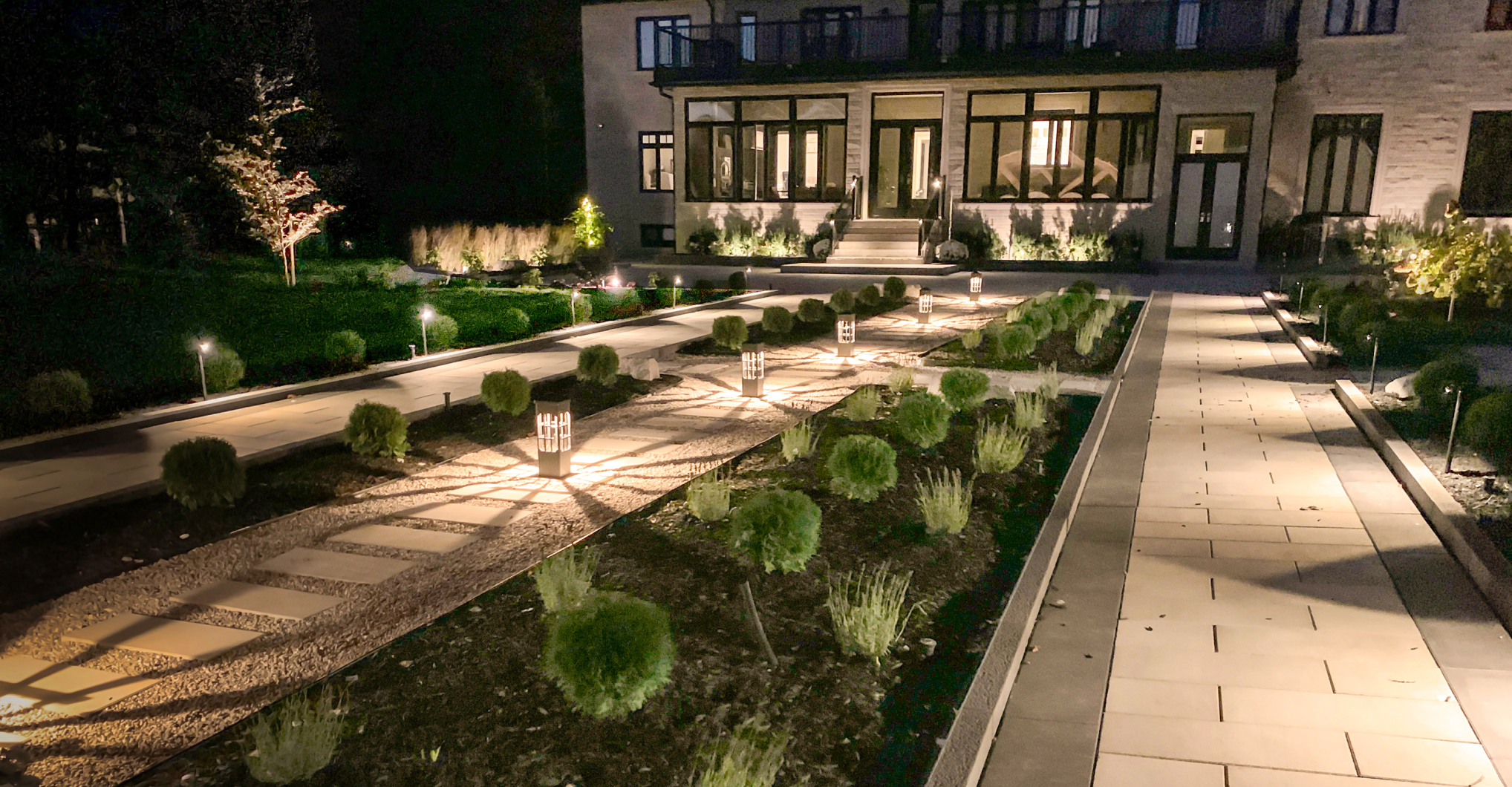
The typical Houston homeowner approaches outdoor lighting from one of two directions. The first is security — motion-activated floodlights at the corners of the house, a bright fixture over the garage door, and enough illumination around the perimeter to deter the property crime that is a real concern across Houston's residential neighborhoods. The second is aesthetics — uplighting the live oaks, defining the pathway to the front entry, creating the warm nighttime presence that makes a Houston property look considered and welcoming rather than simply occupied.
These two approaches produce dramatically different results — and in most Houston residential installations, only one of them is present. Properties with security-first lighting have bright, harsh floodlights that illuminate the driveway and entry areas but leave the landscape invisible and produce a commercial rather than residential quality of nighttime appearance. Properties with landscape-first lighting have beautiful, warm illumination of the trees and planting areas but may have dark corners and inadequate coverage of the access points that security lighting is designed to protect.
The false premise underlying both approaches is that security lighting and landscape lighting are incompatible — that achieving one requires compromising the other. A properly designed Houston outdoor lighting system delivers both simultaneously — providing the deterrence and visibility that security requires and the warmth and visual quality that landscape lighting creates — through a unified design approach rather than two separate systems bolted onto the same property.
At Gulf Reserve Landscape & Pools, custom lighting design is one of our signature services across Houston's residential market. The integration of security function and landscape aesthetic into a single, cohesive Houston outdoor lighting system is one of the design challenges we address on every property where both objectives are present. Here is how that integration actually works.
Why Standard Houston Security Lighting Fails as a Complete Outdoor Lighting Solution
Standard security lighting installed on Houston residential properties — the motion-activated PAR floodlights and wall-pack fixtures sold at home improvement stores and installed by electricians as security add-ons — achieves its primary objective of producing bright illumination when triggered. It fails at everything else a Houston outdoor lighting system should accomplish.
Harsh light quality from standard Houston security fixtures produces the institutional, high-color-temperature illumination that reads as commercial rather than residential. The 4000K to 6500K color temperatures of most security floodlights produce a cold, blue-white light that is unflattering to Houston's warm-toned architecture, Houston's natural landscape materials, and the welcoming quality of light that residential outdoor spaces should project. A Houston property lit entirely by standard security floodlights looks like a parking lot at night — maximally illuminated but minimally inviting.
On-off motion activation creates a lighting environment that signals security concern rather than resolving it. A Houston property where outdoor lights are dark until a motion sensor triggers them and then suddenly flood-illuminate the area communicates to anyone approaching that the property relies on reactive detection rather than consistent illumination. The sudden activation of Houston security flood lighting also creates the startle effect and loss of adapted night vision for the property occupants inside — who momentarily cannot see into the newly lit area because their eyes were adjusted to the dark — that reduces rather than enhances their awareness of what is happening outside.
No contribution to property aesthetics from standard Houston security lighting means the property presents a dark, featureless face to the street at night — the live oak canopy invisible, the architectural details unlit, the landscape investment that defines the property's daytime character completely absent. For Houston properties in River Oaks, Memorial, and the city's luxury residential market, a nighttime appearance defined by dark landscapes punctuated by harsh security floodlights represents a significant disconnect between the daytime quality of the property and its nighttime presence.
Energy waste from security flood lighting that illuminates entire facades and large ground areas at high intensity when triggered is significantly higher per hour of lighting output than the equivalent security coverage provided by a properly designed integrated system. Houston homeowners who receive their electricity bill after a month of frequent security light activations during summer — when Houston's insects, wildlife, and air movement patterns generate frequent motion sensor triggers — discover that high-wattage security floodlights are expensive to operate in Houston's year-round outdoor activity environment.
Why Landscape-Only Houston Lighting Fails as a Complete Outdoor Lighting Solution
The opposite failure mode — beautiful landscape lighting that provides no security function — leaves genuine vulnerabilities in the Houston outdoor lighting system that a security-integrated design closes.
Dark access points are the primary security vulnerability of landscape-only Houston lighting systems. A property where the live oak canopy is beautifully illuminated and the pathway to the front entry glows warmly but the gate to the side yard, the space between the garage and the fence, and the rear corners of the property are completely dark has created a visually compelling foreground and a potentially exploitable background. Houston property crime — vehicle break-ins, attempted entry, package theft — concentrates at the dark, unobserved access points that landscape-only lighting leaves unaddressed.
Insufficient illumination at functional areas — the driveway where cars park, the path to the front entry, the areas around exterior doors — is common in landscape systems designed primarily for aesthetic impact. Uplighting a live oak dramatically is an effective landscape lighting technique. Using that illumination as the primary light source for the driveway and front entry approach is not — the trees are lit beautifully and the functional areas around them remain in relative darkness.
No deterrence value from lighting that illuminates landscape features but leaves the perimeter areas where deterrence matters most dark or dimly lit reduces the security contribution that outdoor lighting can provide. Houston property crime research consistently shows that adequate, consistent perimeter illumination reduces opportunistic crime rates — but consistent illumination requires designed coverage of perimeter access points, not simply beautiful feature lighting of the landscape's most photogenic elements.
The Integrated Houston Lighting Design Approach
The design approach that delivers both security function and landscape aesthetic in a single Houston outdoor lighting system starts with a different premise than either security-first or landscape-first design — it starts with a comprehensive nighttime analysis of the entire property that identifies every objective the lighting system needs to serve simultaneously.
Nighttime site analysis for Houston integrated lighting design involves walking the property after dark and identifying the specific security vulnerabilities — the dark corners, unlit access points, and areas where visibility from inside the house is compromised — alongside the landscape aesthetic opportunities — the significant trees, architectural features, and landscape compositions that benefit from illumination. This analysis produces a complete map of where light is needed for security reasons and where light is desired for aesthetic reasons — the foundation for a design that addresses both with a unified fixture specification and layout.
Layered illumination is the design technique that produces integrated Houston lighting systems where security and aesthetic functions reinforce rather than compromise each other. The landscape lighting layer — warm, low-voltage LED fixtures uplighting trees, grazing architectural surfaces, and defining pathway edges — provides the base illumination that gives the Houston property its nighttime character and contributes ambient light to the areas around it. The security layer — higher-output fixtures at access points, perimeter transitions, and activity areas — provides the additional illumination where security visibility requires it, integrated into the overall lighting scheme rather than added as an afterthought.
When the security layer of a Houston integrated lighting system is designed with the same attention to color temperature, fixture quality, and positioning that the landscape layer receives, the combined result is a property that is simultaneously secure and beautiful — where the security fixtures contribute to the aesthetic quality of the nighttime appearance rather than detracting from it.
Fixture Selection for Houston Integrated Security and Landscape Lighting
The fixture selection decisions that determine whether Houston security and landscape lighting integrate successfully are color temperature consistency, fixture quality appropriate for Houston's conditions, and the specific output specifications that each application requires.
Color temperature consistency across the entire Houston integrated lighting system is the design parameter most critical to the aesthetic quality of the integrated result. Security fixtures that produce 5000K daylight-range illumination combined with landscape fixtures at 2700K warm white create a jarring visual discontinuity — the warm, inviting quality of the landscape lighting is immediately undermined by the cold, institutional quality of the security fixtures in the same field of view.
Specifying all fixtures in the Houston integrated lighting system at a consistent 2700K to 3000K color temperature — including the security-function fixtures at access points and perimeter areas — produces a unified nighttime appearance where the entire property reads at the same visual temperature. Modern LED security fixtures at 2700K produce adequate illumination for security visibility while contributing to rather than detracting from the Houston property's nighttime aesthetic quality.
Output specifications for Houston security-function fixtures need to provide adequate illumination for their specific application without over-illuminating to the point of creating the harsh, commercial quality that standard security floodlights produce. A well-designed Houston entry illumination fixture providing 500 to 800 lumens at a controlled beam angle over the front door and immediate approach area provides clear visibility for security purposes without the glare-producing intensity of a 1500-lumen floodlight illuminating the same area. The correct output is adequate, not maximum.
Fixture quality standards for Houston integrated lighting systems need to meet the Gulf Coast durability requirements covered in detail in Blog 12 — brass or copper fixture bodies, appropriate IP ratings for Houston's humidity, UV-stable lenses, and 304-grade stainless fasteners — across all fixture types in the system, including the security-function fixtures. Installing high-quality landscape fixtures alongside low-cost plastic security fixtures creates a maintenance disparity where the security components fail and require replacement on significantly shorter cycles than the landscape components — and when they fail, they leave the security vulnerabilities they were designed to address unprotected.
Motion-Activated vs. Continuously On — The Houston Security Lighting Decision
The operational approach for security-function fixtures in a Houston integrated lighting system — whether to use motion-activated switching, continuous operation on the landscape system schedule, or a combination of both — affects both the security function and the aesthetic quality of the Houston outdoor lighting environment.
Continuous operation of security-function fixtures on the landscape system timer — on from dusk, off at a defined time or dawn — provides consistent illumination of access points and perimeter areas throughout the Houston evening and night without the reactive on-off cycling of motion-activated fixtures. Consistent illumination is the security approach that provides the most reliable deterrence — a property that is consistently lit has no dark windows of opportunity between motion sensor activations. Continuous operation at appropriate output levels — not the maximum output that motion-activated floodlights produce for brief activation periods — is also more energy-efficient per hour of security coverage provided than high-wattage fixtures that cycle on and off.
For Houston integrated lighting systems where continuous operation of all fixtures through the full night would create excessive energy consumption or light pollution, zoned scheduling provides a practical alternative — full system operation from dusk to midnight, reduced to essential security circuits from midnight to dawn. This approach maintains continuous perimeter security coverage through the full night while reducing the energy and light output during the low-activity late-night hours.
Motion activation as a supplemental layer — rather than the primary security lighting approach — adds a response capability to the continuously lit Houston integrated system that passive continuous lighting does not provide. Motion sensors in Houston integrated lighting systems that increase fixture output from the standard landscape level to full security output when motion is detected provide both the consistent ambient illumination of continuous operation and the attention-drawing response of motion activation — producing a more sophisticated security response than either approach alone.
Houston's outdoor environment — insects, wildlife, and tree movement in Houston's frequent wind — generates false motion triggers frequently enough that motion-activated systems operating at maximum output on every trigger create a nuisance lighting environment. Houston integrated systems with motion sensors calibrated for human-scale movement patterns and triggering only incremental output increases rather than full-power activation reduce false trigger nuisance while maintaining the motion response capability.
Camera Integration With Houston Landscape Lighting
Houston's residential security camera market has expanded significantly as camera technology has improved and prices have declined. Integrating security camera placement with landscape lighting design — coordinating camera field-of-view coverage with the areas that the lighting system illuminates — produces a security infrastructure where the camera system's effectiveness is enhanced by the lighting and the lighting design accounts for the camera's requirements.
Camera placement relative to lighting in Houston integrated systems needs to address the fundamental conflict between camera operation and direct light source exposure. Security cameras with direct light sources in or near their field of view produce footage degraded by glare and blown highlights — the camera sees the light fixture rather than the area beyond it. Houston landscape and security lighting fixtures positioned so that cameras view the illuminated surfaces rather than the light sources themselves produce significantly better camera footage quality.
Infrared camera compatibility is relevant for Houston security lighting design because cameras with night vision capability use infrared illumination to see in darkness — illumination that operates on wavelengths invisible to the human eye but detectable by the camera sensor. In Houston integrated lighting systems where landscape lighting provides sufficient ambient illumination for camera operation in visible light, infrared camera capability is supplementary rather than primary — the landscape lighting itself enables clear color camera footage of illuminated areas. In the darker perimeter areas between landscape light zones, infrared capability covers the gaps.
Houston Landscape Lighting Controls — Managing the Integrated System
The control system for a Houston integrated security and landscape lighting system needs to manage both the landscape aesthetic functions and the security functions from a single, coherent platform rather than separate controls for separate systems.
Smart transformer systems for Houston low-voltage landscape lighting — the Hydrawise, Rachio, and similar platforms covered in Blog 12 — provide zone-level scheduling and dimming control that allows different areas of the Houston integrated lighting system to be scheduled and operated independently. Security-function zones can be scheduled for full-night operation while aesthetic landscape zones run on reduced hours. Output can be adjusted seasonally — higher output in Houston's long summer nights, reduced output in shorter winter nights — without manual reprogramming.
Integration with Houston smart home platforms — Control4, Lutron, and the major residential automation systems used in Houston's luxury residential market — allows the outdoor lighting system to participate in whole-home security and automation scenarios. When the Houston home's security system is armed, the outdoor lighting can automatically shift to full security output across all zones. When the family returns home, the driveway and entry approach can activate at full output before the vehicle enters. When a security camera detects motion, the relevant lighting zone can activate to support camera visibility.
Designing the Houston Integrated System — Where to Start
The starting point for Houston integrated security and landscape lighting design is a nighttime property assessment — walking the property in the dark and honestly evaluating both the security vulnerabilities and the landscape aesthetic opportunities from the perspective of someone experiencing the property at night.
Most Houston homeowners have never done this assessment systematically — they experience their property at night from inside looking out or from the driveway, not from the perspective of someone approaching from the street or from the perimeter of the property. Walking the full perimeter after dark, identifying every unlit access point, every dark corner with potential cover, and every landscape feature that would benefit from illumination, provides the complete information that integrated lighting design requires.
With this assessment complete, the design question is not "where do I put security lights and where do I put landscape lights" but "how do I place fixtures that serve both objectives simultaneously in every area where both objectives are present" — the design approach that produces Houston outdoor lighting systems where security and aesthetics reinforce rather than compromise each other.

Gulf Reserve Landscape & Pools designs and installs custom lighting systems across Houston, River Oaks, Memorial, Katy, Sugar Land, Pearland, The Woodlands, and surrounding areas — with integrated security and landscape lighting design that produces Houston properties that are both beautiful and protected after dark.
Request your free estimate at gulfreservelandscaping.com — and let's design a Houston outdoor lighting system that delivers everything you need it to do.


