




Outdoor Landscape Lighting in Houston — Why Most Systems Fail and What a Properly Designed System Looks Like
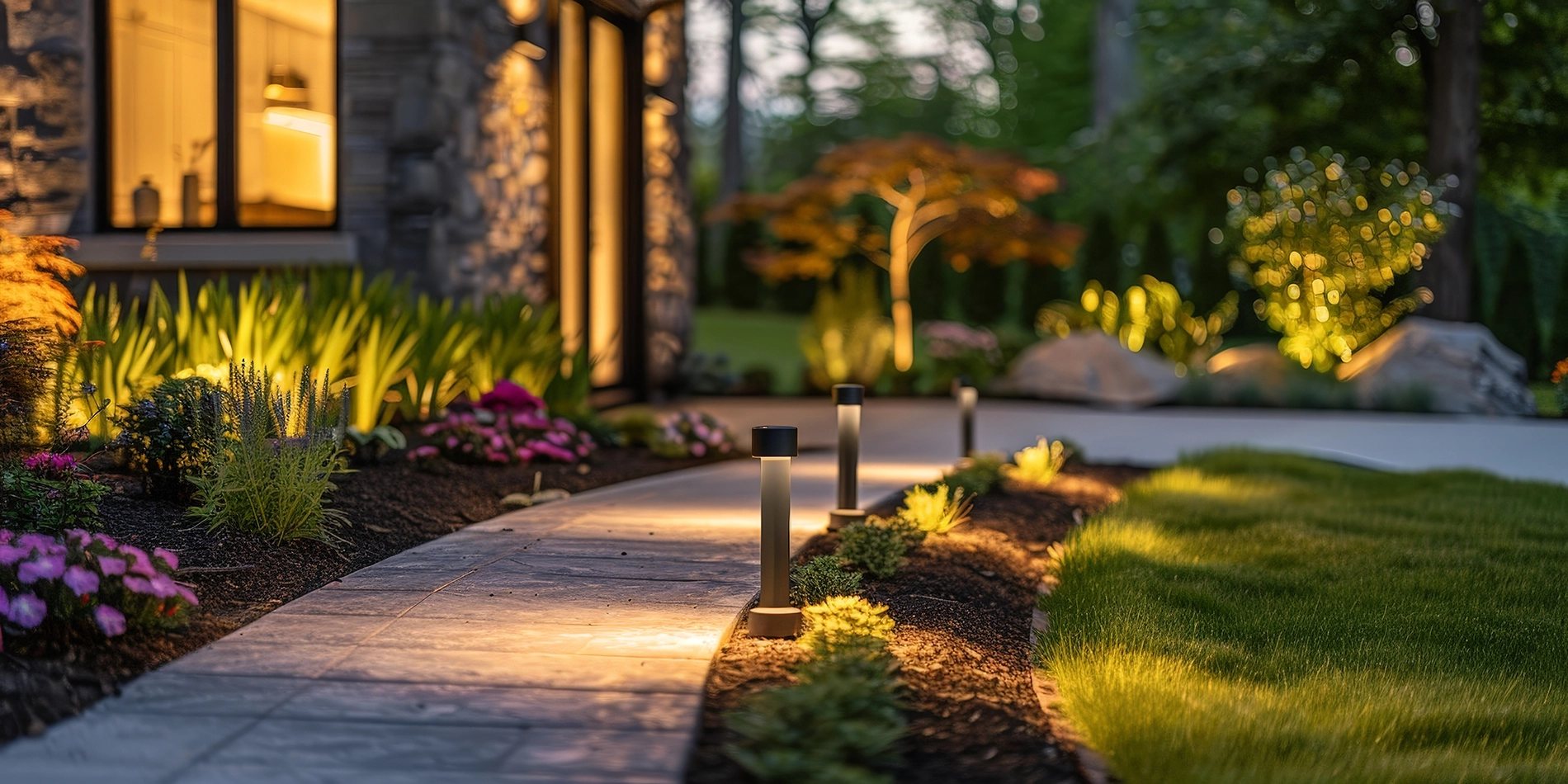
Outdoor landscape lighting is one of the highest-impact investments a Houston homeowner can make in their property's appearance and security. A well-designed lighting system transforms a Houston property after dark — revealing the canopy structure of mature live oaks, creating depth and dimension in ornamental plantings, defining hardscape edges and pathways, and producing a cohesive nighttime presence that is as considered as the daytime landscape.
The problem is that Houston's environment is genuinely hostile to outdoor lighting equipment. The combination of year-round high humidity — Houston regularly sees relative humidity above 90 percent during summer nights — intense summer heat that pushes ambient temperatures above 95 degrees Fahrenheit for months at a time, UV radiation that is among the most intense in the continental United States, and in some Houston areas, salt air influence from the Gulf Coast creates an operating environment that degrades cheap or incorrectly specified lighting equipment rapidly. Fixtures that would last 15 years in a dry climate can show significant corrosion, seal failure, and lens degradation within two to three seasons in Houston's conditions.
At Gulf Reserve Landscape & Pools, custom lighting design and installation is one of our signature services across Houston's luxury residential market. The difference between lighting that looks stunning for a decade and lighting that looks deteriorated within three years almost always comes down to fixture specification, system design, and installation quality — decisions made before a single fixture goes in the ground. Here is what outdoor landscape lighting done correctly looks like in Houston's specific environment.
Why Houston's Environment Destroys Cheap Landscape Lighting
Understanding the specific failure modes that Houston's environment creates for outdoor lighting helps explain why fixture specification matters so much in this market.
Humidity and moisture ingress is the primary failure mechanism for landscape lighting in Houston. Fixtures with inadequate IP ratings — the Ingress Protection standard that defines a fixture's resistance to dust and water penetration — admit moisture through gasket failure, lens seal degradation, or housing material porosity. Once moisture enters a landscape fixture in Houston, the consequences are accelerated and predictable. Corrosion develops on electrical contacts, reducing connection reliability and creating voltage drop that dims fixtures and stresses the transformer. LED driver boards exposed to internal moisture fail prematurely. Lenses fog from condensation cycling, degrading light output and optical quality. In Houston's persistent humidity, these failure sequences happen faster than most homeowners expect when inadequate fixtures are specified.
The IP rating standard uses two numbers to describe protection levels. The first digit describes dust protection on a scale of 0 to 6. The second describes water protection on a scale of 0 to 9. For Houston outdoor landscape applications, a minimum rating of IP65 — dust tight and protected against water jets from any direction — is the appropriate minimum threshold for above-grade fixtures. For in-grade uplights installed flush with Houston lawn surfaces — where they are subject to irrigation overspray, pooling water during rain events, and Houston's periodic flooding — IP67 or IP68 rated fixtures provide meaningful additional protection against water ingress during submersion events.
UV degradation of fixture housings and lens materials is a Houston-specific concern that is more severe than most manufacturers' testing environments reflect. Houston's solar radiation intensity — driven by the city's southern latitude, high solar angle, and limited cloud cover during peak summer months — accelerates UV degradation of plastic fixture components at rates that can be surprising to homeowners accustomed to landscape lighting performance in northern markets. Polycarbonate lenses yellow and lose optical clarity. Plastic housing materials become brittle, develop surface crazing, and eventually crack. UV stabilization in plastic fixture components provides some protection but does not eliminate degradation in Houston's radiation environment over a 10 to 15 year fixture lifespan.
Thermal stress on LED driver components from Houston's ambient temperature conditions affects the operating life of LED landscape fixtures differently than manufacturer specifications based on standard testing temperatures suggest. LED driver life — the primary determinant of LED fixture longevity in landscape applications — degrades significantly as operating temperature increases above the standard 25 degrees Celsius testing baseline. In Houston's summer conditions, fixture housings exposed to direct sun can reach internal temperatures that meaningfully reduce driver life compared to the same fixture installed in a cooler climate. Thermal management in fixture design — heat sinking, driver placement, and housing material thermal conductivity — matters more in Houston's conditions than in most American markets.
Salt air influence on Houston properties within roughly 50 miles of the Gulf Coast — which includes the entire Houston metro — accelerates corrosion of ferrous metal fixture components, fasteners, and electrical connections beyond what inland markets experience. Fixtures with steel components — even coated steel — show accelerated corrosion on Houston Gulf Coast properties. Brass, copper, and marine-grade aluminum are the materials that resist Houston's salt air influence over a realistic fixture lifespan.
Fixture Materials for Houston Landscape Lighting — What Holds Up
The fixture material selection for a Houston landscape lighting system is one of the most consequential specification decisions and one where the performance difference between correct and incorrect choices is most visible over a 5 to 10 year period.
Solid brass fixtures are the premium standard for Houston landscape lighting and the material that provides the most reliable longevity in Houston's humid, salt-influenced environment. Brass does not rust, develops a natural patina over time that many Houston homeowners find aesthetically appropriate for the Gulf Coast character, and maintains structural integrity and electrical connection reliability through Houston's seasonal conditions without the maintenance that other materials require. The initial cost premium of solid brass fixtures over aluminum or composite alternatives is real but represents a fraction of the replacement and labor cost of a system built on inferior materials that requires partial or complete replacement within 5 to 7 years of installation in Houston's conditions.
Copper fixtures share the corrosion resistance profile of brass and develop a distinctive living patina — progressing from bright copper through brown and ultimately to a blue-green verdigris — that produces a genuinely beautiful aged appearance appropriate for Houston's high-end residential landscape. Copper's natural antimicrobial properties are irrelevant to lighting performance but its thermal conductivity — higher than brass — provides marginally better heat dissipation for LED driver components in Houston's high-ambient-temperature environment.
Marine-grade aluminum — specifically 6061-T6 or similar marine alloys with appropriate anodized or powder-coated finish — provides good corrosion resistance in Houston's environment at a lower cost point than brass or copper. Aluminum's significantly lower density than brass or copper makes it the practical choice for larger fixture formats where solid brass would produce prohibitively heavy and expensive assemblies. The key specification variable for aluminum fixtures in Houston is finish quality — anodized aluminum in Houston's conditions outperforms powder-coated aluminum for long-term corrosion resistance, and the coating thickness and adhesion quality matters significantly for Houston's humidity and UV environment.
Composite and plastic fixtures — regardless of how premium their appearance at purchase — are not appropriate for Houston landscape lighting applications where longevity is a goal. The UV degradation, thermal cycling stress, and moisture ingress vulnerability that Houston's environment creates for plastic materials makes composite and plastic fixtures a high-replacement-frequency choice in this market. The apparent cost savings of plastic fixtures relative to brass or copper are consumed by replacement cycles that brass installations avoid entirely.
LED Technology Specification for Houston Conditions
The LED technology choices within a Houston landscape lighting system affect both the quality of the lighting effect and the system's longevity in Houston's environment.
Color temperature is one of the most impactful specification decisions for the aesthetic quality of a Houston landscape lighting system and one of the areas where inconsistency across a system is most visible and most damaging to the overall lighting design quality. Color temperature is measured in Kelvin — lower numbers produce warmer, more amber light while higher numbers produce cooler, bluer light.
For Houston residential landscape applications, 2700K is the standard color temperature that produces the warm, inviting nighttime appearance associated with high-quality landscape lighting. It reads as natural and flattering on Houston's live oak bark, limestone hardscape, and warm-toned architectural materials common in Houston's residential market. At 2700K, a Houston landscape at night feels welcoming rather than institutional.
3000K is appropriate for Houston applications where a slightly crisper, more modern appearance is desired — contemporary architecture, clean-lined hardscape, or commercial adjacent applications where a more alert quality of light is appropriate. The difference between 2700K and 3000K is subtle in isolation but visually obvious when mixed across a Houston landscape — which is the most important reason to specify color temperature consistently across the entire system rather than mixing temperature by fixture type or zone.
Color temperatures above 3000K — 4000K, 5000K, and 6500K daylight-range temperatures — are inappropriate for Houston residential landscape applications. They produce harsh, cold light that is unflattering to Houston's landscape materials and architectural contexts, creates an institutional rather than residential quality, and is more disruptive to Houston's wildlife — including the migratory birds that traverse the Gulf Coast flyway and are sensitive to artificial light at night.
CRI — Color Rendering Index measures how accurately a light source renders the colors of objects it illuminates compared to natural sunlight. A CRI of 100 is perfect rendering. For Houston landscape lighting, a minimum CRI of 80 is the standard threshold, with 90-plus CRI being the appropriate specification for luxury Houston residential applications where the accurate rendering of plant colors, stone textures, and architectural materials is important to the lighting design quality. Low CRI LED sources make Houston's live oak bark look gray-green rather than its natural warm brown and reduce the visual richness of ornamental plantings that is one of the primary goals of Houston residential landscape lighting.
Lumen output calibration for Houston landscape applications requires matching fixture output to the specific application rather than defaulting to the maximum available output. Over-lamped Houston landscape lighting — too much lumen output for the scale of the feature being lit — produces harsh, blown-out effects that are as damaging to the nighttime landscape appearance as under-lamped fixtures that don't have adequate output to define the feature. Path lights in Houston residential applications typically need 30 to 80 lumens. Uplights for medium-scale Houston ornamental shrubs need 100 to 200 lumens. Uplights for large Houston live oaks may need 400 to 800 lumens depending on canopy height and density. Matching output to application is a design skill that separates professional Houston landscape lighting from fixture-collection.
Houston Landscape Lighting Design Principles — Creating a Cohesive Nighttime Landscape
Technical specification produces durable, reliable Houston landscape lighting. Design produces landscape lighting that is genuinely beautiful and that transforms the Houston property's nighttime appearance in ways that add real value. The two disciplines need to work together.
Layered lighting is the design approach that produces the most sophisticated and visually rich results in Houston residential landscape applications. Rather than lighting everything at the same intensity from the same direction, layered lighting creates depth by using different fixture types, mounting heights, and intensities to illuminate different elements of the Houston landscape at different visual planes.
In a well-designed Houston landscape lighting system, large canopy trees — live oaks, pecans, bald cypress — are uplighted from multiple positions to reveal their three-dimensional canopy structure and create the highest layer of the lighting composition. Intermediate ornamental shrubs and architectural features are lit at middle height to define the Houston landscape's structure and create the mid-ground layer. Path and step lighting provides the lowest layer — functional illumination that also creates visual rhythm across the Houston landscape's horizontal surfaces. When all three layers work together in a Houston residential landscape, the result has depth and dimension rather than the flat, uniformly bright appearance of an over-lit or single-layer system.
Uplighting Houston live oaks is the single lighting technique that produces the most dramatic visual impact available in Houston residential landscape lighting. A mature live oak uplighted from three to four positions with appropriately sized LED uplights — creating overlapping pools of warm light that reveal the tree's spreading branch structure and canopy complexity — is one of the most compelling nighttime landscape features available in Houston's residential market. The key variables are fixture positioning to avoid visible hot spots on the trunk, lumen output matched to the tree's canopy height, and color temperature consistency across all fixtures lighting the tree.
Moonlighting — the technique of installing fixtures in the canopy of Houston live oaks to cast downward-filtered light through the leaves, mimicking the effect of full moonlight filtering through tree canopy — is the most naturalistic lighting technique available for Houston's tree-canopy-rich Inner Loop properties. When executed correctly on Houston live oaks with the right fixture output and positioning, moonlighting produces a quality of light that is genuinely beautiful and that cannot be achieved from ground-mounted uplighting alone. The combination of uplighting from below and moonlighting from above on a significant Houston live oak produces the most complete and sophisticated tree lighting effect available.
Hardscape definition lighting on Houston patios, driveways, pathways, and pool surrounds requires fixture selection and positioning that provides clear visual definition of edges and transitions without creating glare that compromises the comfort of the outdoor space. Hardscape definition lighting in Houston should never be visible as a light source — the fixture should be invisible and only the lit surface or edge should be apparent. Recessed step lights, in-grade fixtures at paving transitions, and low-profile path lights positioned to graze hardscape surfaces rather than shine directly into the eyes of people using the space are the techniques that achieve this goal in Houston's residential landscape.
Silhouetting — positioning Houston landscape fixtures behind plants to cast them in shadow against a lit wall or fence — creates dramatic graphic effects that are particularly effective with Houston's ornamental grasses, architectural shrubs, and native perennials that have interesting silhouette profiles. Gulf muhly in fall, with its cloud-like plume structure silhouetted against a warm-lit fence, is one example of a Houston plant and lighting technique combination that produces genuinely memorable nighttime landscape moments.
Transformer Sizing and System Design for Houston Landscape Lighting
The transformer is the heart of a Houston low-voltage landscape lighting system and its sizing and specification directly determines the system's capacity, reliability, and upgradeability.
Transformer capacity calculation for a Houston residential landscape lighting system starts with totaling the wattage of all fixtures in the system and applying a loading factor that leaves capacity for future expansion. Professional practice for Houston residential systems is to load the transformer to no more than 80 percent of its rated capacity at installation — providing the 20 percent headroom that allows fixture additions without transformer replacement. A Houston homeowner who installs a landscape lighting system and immediately wants to add fixtures to a fully-loaded transformer faces either transformer replacement or living with a system that can't be expanded.
Multi-zone transformer capability is important for Houston residential landscape lighting systems of any meaningful complexity. Multi-zone transformers allow different areas of the Houston landscape — front yard versus backyard, tree lighting versus path lighting, pool area versus entry — to be controlled independently with different on and off schedules, dimming levels, and photocell or timer responses. A single-zone transformer running the entire Houston landscape on one schedule and at one intensity level is a design constraint that prevents the system from being operated in ways that produce the best results at different times of evening or in different seasonal conditions.
Smart transformer integration with app-based control is the current standard for Houston luxury residential landscape lighting and provides the operational flexibility that fixed-schedule analog transformers cannot deliver. Smart-enabled transformers allow Houston homeowners to adjust zone schedules, dim individual zones, create scene presets for different occasions, and respond to Houston's seasonal variation in sunset and sunrise times without manual reprogramming. Integration with Houston smart home systems — Control4, Lutron, and similar platforms common in Houston's luxury residential market — allows landscape lighting to be incorporated into whole-home automation scenes.
Wire gauge and run length calculation for Houston landscape lighting systems needs to account for voltage drop across the full wire run from transformer to the most distant fixture in each zone. Undersized wire or excessive run lengths create voltage drop that dims fixtures at the ends of runs relative to fixtures close to the transformer — one of the most common quality problems in Houston residential landscape lighting installations that weren't properly engineered. For Houston systems with long runs — common on larger River Oaks and Memorial properties — home-run wiring configurations, hub-and-spoke layouts, or 12-gauge or 10-gauge wire on critical runs maintain consistent voltage and fixture output across the full system.
Mosquito Season and Outdoor Lighting — A Houston-Specific Design Consideration
Houston's mosquito season — which runs effectively year-round given the city's warm temperatures and standing water availability — is a meaningful outdoor lighting design consideration that most lighting system discussions don't address.
Shorter wavelength light — blue-white light in the 5000K to 6500K range — is significantly more attractive to mosquitoes and other insects than longer wavelength warm light. This is one of several reasons that the 2700K color temperature recommendation for Houston residential landscape lighting is the correct standard — beyond the aesthetic advantages of warm light in Houston's residential context, it also produces a meaningfully less insect-attractive light environment than cooler color temperature alternatives. Houston homeowners who specify 5000K or 6500K landscape lighting for their outdoor entertaining areas on the grounds that it looks brighter and more modern are creating an insect attraction problem that undermines the usability of the outdoor space at the times when lighting matters most.
LED landscape lighting at 2700K in Houston does not eliminate mosquito presence — Houston's mosquito population is driven by breeding habitat availability, not primarily by lighting attraction — but it reduces the lighting system's contribution to insect attraction relative to cooler color temperature alternatives. In Houston's outdoor living environment, every design decision that marginally improves comfort during mosquito season is worth making.
Maintenance Requirements for Houston Landscape Lighting
A properly specified Houston landscape lighting system requires minimal but consistent maintenance to perform at its design intent over its full service life.
Annual fixture inspection and cleaning removes the algae, mineral deposits from Houston's hard municipal water, and debris accumulation that affects fixture optical performance over time. In Houston's humid climate, biological growth — algae and lichen — on fixture lenses develops faster than in drier markets and degrades light output if not addressed periodically. Lens cleaning on Houston landscape fixtures during annual maintenance restores output quality and extends the period before lens replacement is needed.
Transformer timer and photocell calibration at the beginning and end of Houston's daylight saving time periods — and periodic recalibration for Houston's seasonal sunset variation — keeps the system operating on a schedule that makes sense for the actual light conditions rather than gradually drifting out of sync as the season progresses.
Wire and connection inspection at accessible points — junction boxes, fixture connections, and transformer terminals — identifies developing corrosion or connection issues before they cause fixture failures or system outages. In Houston's humidity, connection points that were not properly weatherproofed at installation develop corrosion that creates voltage drop and eventually connection failure. Catching these early during annual maintenance prevents the cascading fixture failures that occur when a connection problem affects multiple fixtures on a daisy-chain run.
Fixture repositioning as Houston landscape plants mature is ongoing maintenance that professional Houston lighting systems include as a standard service. A live oak uplight that was correctly positioned when the tree was 12 inches in diameter needs to be repositioned as the trunk grows and the canopy spreads — the fixture that produced the right effect at installation produces a different effect five years later if it has not been adjusted for the tree's growth. Houston's fast-growing landscape plants require more frequent fixture repositioning than slower-growing species in cooler climates.

Gulf Reserve Landscape & Pools designs and installs custom landscape lighting systems across Houston, River Oaks, Memorial, Katy, Sugar Land, Pearland, The Woodlands, and surrounding areas. Every system we design starts with a nighttime site walk — because the way a Houston property looks at night is what the lighting system needs to be built around, and that assessment can only happen after dark.
Request your free estimate at gulfreservelandscaping.com — and let's show your Houston property in its best light.


