




Natural Stone Pathways and Garden Walls in Houston — How to Design and Build Them for Gulf Coast Longevity
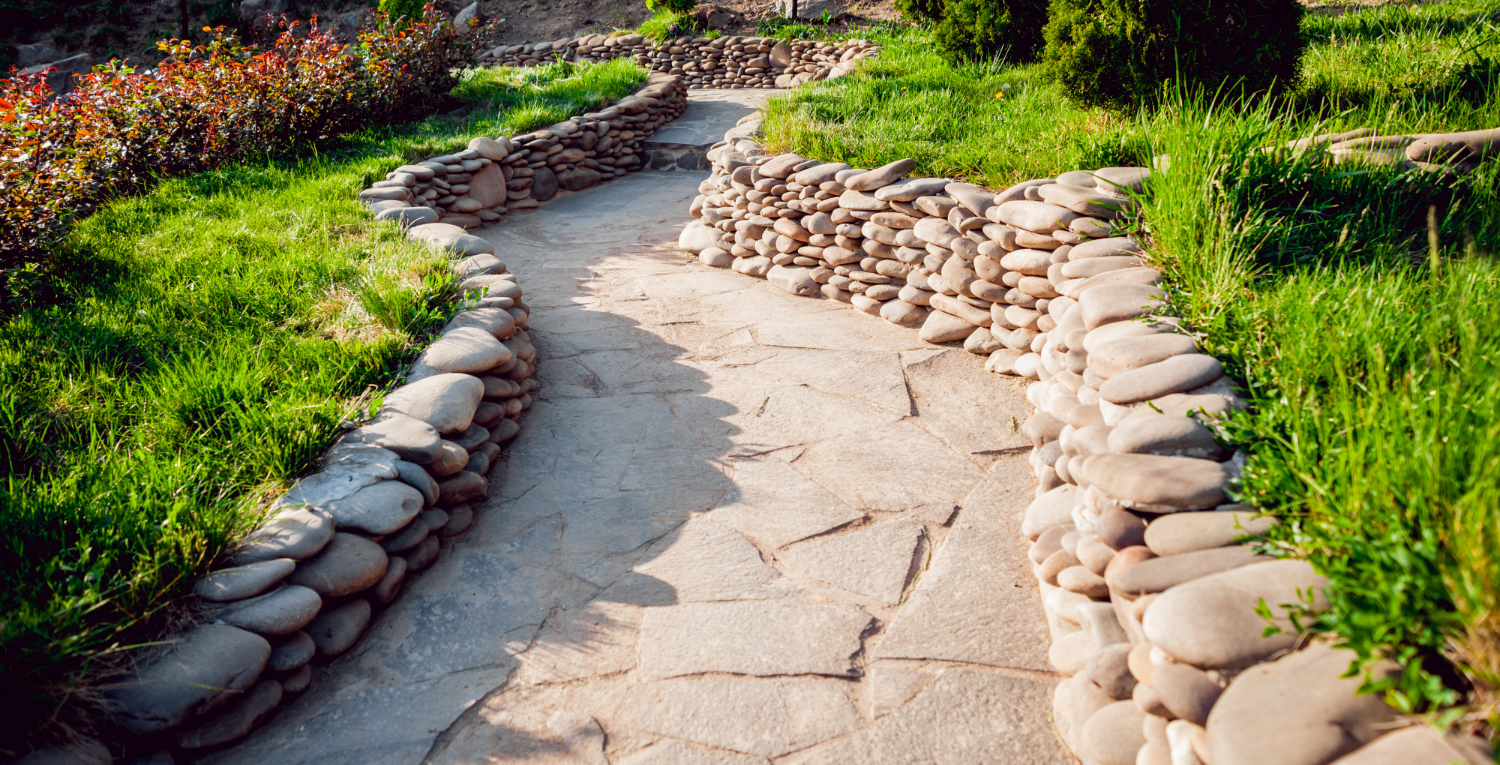
Natural stone is the hardscape material that ages most gracefully in Houston's landscape. Where concrete weathers to a dull gray and manufactured pavers show UV bleaching and efflorescence over time, natural stone — limestone, granite, sandstone, and the native Texas materials that have a genuine relationship with Houston's architectural and landscape character — develops a patina in Houston's Gulf Coast climate that makes it look more beautiful at 15 years than it did at installation. It is also the material that fails most expensively when it is installed without the foundation design, mortar system, and base preparation that Houston's clay soil movement and rainfall conditions demand.
The gap between natural stone work that lasts decades and natural stone work that requires significant repair within 5 to 10 years on Houston properties is almost entirely in the decisions made before the first stone is placed. Footer depth, base material specification, mortar system selection, drainage design, and joint detail — the components that are invisible in the finished installation — determine whether the stone above them holds its position and appearance over Houston's wet-dry cycles or shifts, cracks, and separates as the clay soil beneath it responds to Houston's climate.
At Gulf Reserve Landscape & Pools, natural stone pathways, garden walls, retaining structures, and decorative stonework are core components of our stone work service across Houston's luxury residential market. Here is a comprehensive guide to what natural stone work in Houston actually requires — from material selection through installation details and long-term maintenance.
Natural Stone Material Selection for Houston's Gulf Coast Conditions
The first design decision for any Houston natural stone project is material selection — and in Houston's specific environment, material performance differences between stone types are more significant than in most markets. Houston's UV intensity, humidity, rainfall, and biological growth conditions affect different stone materials differently over a 10 to 20 year performance horizon.
Texas limestone is the most appropriate natural stone for Houston pathways and garden walls and the material that Gulf Reserve specifies most frequently on Houston stone work projects. Its relationship to Houston's architectural character is genuine — limestone is native to the Texas Hill Country and has been used in Texas construction for over 150 years, producing a visual language that is authentically regional rather than imported. Houston limestone weathers beautifully in the Gulf Coast climate, developing a warm patina that deepens over time rather than degrading. Its light color — buff, cream, and warm gray tones — reflects solar radiation rather than absorbing it, staying cooler than darker stone alternatives in Houston's direct summer sun. And its moderate hardness — softer than granite, harder than sandstone — allows it to be cut, shaped, and fitted with the precision that quality pathway and wall work requires.
Texas limestone varieties available for Houston stone work projects span a range from the rougher, more rustic Austin stone commonly used in garden wall applications to the finer-grained, more consistent Lueders limestone that cuts cleanly for formal pathway and coping applications. Choosing the appropriate limestone variety for the specific application — rustic irregular flagstone for a naturalistic Houston garden pathway, cut Lueders limestone for a formal entry approach, coursed Austin stone for a garden wall that complements a brick home — requires knowledge of the available material and how each performs in the specific application and Houston's conditions.
Granite is the premium choice for Houston stone work applications where maximum hardness, stain resistance, and long-term durability are the primary criteria. Houston's high humidity and biological growth conditions — the algae, lichen, and moss that colonize stone surfaces in Gulf Coast conditions — affect granite significantly less than limestone or sandstone because granite's lower porosity provides fewer sites for biological material to establish. For Houston pathways in heavily shaded conditions where biological growth on stone surfaces is a persistent maintenance issue, granite's resistance to colonization is a meaningful performance advantage over more porous alternatives.
Granite's weight and hardness make it more difficult and more expensive to work with than limestone — cutting, shaping, and fitting granite requires diamond-tipped tooling and more labor time than limestone work of equivalent complexity. For Houston applications where the additional cost is justified by the performance requirements, granite delivers unmatched longevity. For applications where limestone provides adequate performance, the cost premium of granite is not necessary.
Sandstone is the natural stone that Houston's Gulf Coast conditions treat most harshly and the one Gulf Reserve most consistently steers Houston clients away from for pathway and structural wall applications. Sandstone's relatively high porosity — significantly higher than limestone or granite — makes it susceptible to the moisture absorption, freeze-thaw cycling during Houston's occasional hard freeze events, and biological growth colonization that Houston's humidity enables. Sandstone pathways and walls in Houston show surface spalling, biological staining, and structural deterioration on timescales that limestone and granite installations do not experience. Where sandstone is desired for its warm, earthy tones in a Houston landscape, it is most appropriate as a decorative accent element rather than a primary pathway or structural wall material.
Fieldstone and river rock — the rounded, water-worn stones available through Houston landscape suppliers — are appropriate for Houston decorative wall applications, dry-stack accent walls, and naturalistic planting bed borders where their informal character is appropriate to the design. Their rounded geometry makes them inappropriate for pathway applications where flat, stable walking surfaces are required, and their lack of consistent dimensions makes coursed wall construction with standard mortar joints impractical. Fieldstone and river rock Houston installations are best executed as dry-stack or semi-dry applications where the natural variation in stone size and shape is accommodated by the installation method rather than fought against.
Foundation and Base Design for Houston Natural Stone Pathways
Natural stone pathway installation in Houston requires a foundation system that keeps the stone surface level, stable, and in consistent plane through Houston's clay soil movement cycles. The pathway that looks perfect at installation and develops uneven, rocking stones within 3 to 5 years — a common sight on Houston residential properties — almost always reflects a foundation system that was not designed for Houston's clay conditions.
Compacted aggregate base for Houston natural stone pathways should be a minimum of 4 inches of compacted crushed limestone for pedestrian-load pathways and 6 inches for pathways that will see occasional vehicle or heavy equipment loads. The compacted base layer serves two functions simultaneously — it provides a stable, non-settling foundation for the stone above it, and it creates a drainage layer that moves water away from the interface between the stone and the underlying Houston clay. Water accumulation at this interface accelerates clay movement forces on the pathway foundation and contributes to the biological growth that colonizes pathway joints in Houston's humid conditions.
Setting bed options for Houston natural stone pathways affect both the initial installation quality and the long-term performance of the pathway under Houston's clay movement conditions. Dry-set sand beds — the quickest and least expensive installation method — allow individual stone movement as the clay beneath the pathway shifts. For Houston pathways where perfectly consistent surface plane is the standard — formal entry approaches, primary garden paths on prominent Houston properties — a mortar setting bed over the compacted base provides the stone-to-base bond that resists the individual stone movement that dry-set installations allow.
Mortar setting beds for Houston require polymer-modified mortar rather than straight Portland cement mortar — the same principle that governs pool deck tile installation in Houston's thermal cycling environment. Houston's temperature differential between winter cold events and peak summer heat exceeds 100 degrees Fahrenheit across the year. Straight Portland cement mortar becomes brittle under this thermal cycling and develops cracks at the stone-to-mortar interface that allow water infiltration — water that freezes during Houston's occasional hard freeze events and contributes to progressive mortar failure. Polymer-modified mortar maintains flexibility through Houston's thermal range and resists the cracking that straight mortar develops in these conditions.
Edge restraints for Houston natural stone pathways are the installation detail that most commonly determines whether the pathway maintains its defined edges over time or gradually spreads at the borders as stones migrate laterally under pedestrian loads and clay movement. Steel landscape edging set to a depth that anchors into the compacted base layer — not simply sitting on the soil surface — provides the edge restraint that keeps Houston pathway borders defined over the years of clay movement and seasonal moisture variation the installation will experience.
Garden Wall Construction for Houston — What Structural Integrity Requires
Garden walls in Houston — the low to medium height freestanding or retaining walls that define outdoor rooms, create grade transitions, and provide the structural bones of Houston luxury landscape compositions — face the same clay movement, drainage pressure, and biological growth challenges that affect all masonry construction in Houston's conditions. The wall construction details that produce Houston garden walls lasting 25 to 30 years are specific and worth understanding before any stone wall project begins.
Footer design for Houston garden walls follows the principles established in Blog 05 on Houston retaining walls — but even decorative garden walls that are not managing significant grade changes require adequate footer depth to resist the clay movement forces that Houston's soil generates. A freestanding garden wall with no footer — stones simply placed on the ground surface — will shift, lean, and require reconstruction within a few years as Houston's clay moves beneath it. A footer that extends below the active clay movement zone — minimum 12 inches below finished grade for Houston conditions — provides the stable base that resists this movement.
Concrete footers for Houston garden walls should be a minimum of 8 inches wide and 6 inches thick for walls up to 2 feet in height, increasing proportionally for taller walls. The footer concrete needs to be adequately cured before wall construction begins — Houston summer heat requires moisture retention measures during the first week of footer cure to prevent the surface drying that weakens the footer concrete at the critical first days of hydration.
Drainage behind Houston garden walls is relevant even for walls that are not managing significant grade changes. Water accumulation behind any masonry wall in Houston's clay soil creates the hydrostatic pressure that pushes wall faces outward over time. Even low decorative walls that retain only a few inches of grade or planting bed soil benefit from drainage aggregate backfill and weep hole provisions at the base of the wall that prevent water accumulation behind the face.
Mortar selection for Houston garden walls requires the same polymer-modified approach specified for pathway setting beds — both for its flexibility under Houston's thermal cycling and for its resistance to the biological growth that colonizes mortar joints in Houston's humid conditions. Standard Portland cement mortar in Houston's conditions develops surface porosity over time that provides ideal colonization sites for algae and lichen — the greenish-black biological staining visible on unprotected Houston masonry surfaces. Polymer-modified mortar with lower porosity is more resistant to this biological colonization and maintains a cleaner appearance through Houston's humid conditions with less maintenance intervention.
Capstone installation on Houston garden walls is the detail that most directly protects the wall from water infiltration and the progressive mortar joint deterioration that water infiltration accelerates. A projecting capstone — extending 1 inch beyond the wall face on each side — sheds water away from the wall face during Houston rain events rather than allowing it to run down the face and into the joint system. Capstones set flush with the wall face or slightly recessed provide no water-shedding protection and allow the cumulative moisture exposure that degrades Houston garden wall mortar joints over time.
Capstone mortar joints should be struck to a slightly convex profile — proud of the stone face rather than tooled concave — to shed water rather than collecting it. Concave joint profiles create channels that hold water against the joint face and accelerate the deterioration cycle that flat or convex profiles avoid.
Biological Growth on Houston Natural Stone — Management and Prevention
Houston's high humidity, warm temperatures, and rainfall frequency create ideal conditions for algae, lichen, and moss colonization of natural stone surfaces. This biological growth is one of the most persistent maintenance challenges on Houston stone work and one of the factors that most significantly affects the appearance of Houston natural stone installations over time.
Algae colonization on Houston natural stone produces the greenish staining visible on north-facing and shaded stone surfaces — particularly in Houston's Inner Loop neighborhoods where mature tree canopy creates the consistently moist, shaded conditions that algae favor. Algae staining is primarily aesthetic in its early stages but creates a surface that retains moisture more persistently, accelerating biological community development toward lichen and eventually moss if not addressed.
Lichen colonization on Houston natural stone — the circular, crusty growths in gray, orange, and black tones — is slower to establish than algae but significantly harder to remove. Lichen penetrates stone surfaces with root-like structures that remain after the surface growth is removed, allowing rapid recolonization. Houston limestone surfaces with established lichen require treatments with lichen-specific biocides and scrubbing rather than simple pressure washing to achieve meaningful reduction in colonization.
Moss growth on Houston stone pathways creates a serious slip hazard — wet moss on a stone pathway surface in Houston after rainfall is among the most slippery surfaces available in a residential landscape. Houston stone pathways in consistently shaded, moist conditions — under mature tree canopy, along north-facing structures — develop moss colonization that requires regular removal for both aesthetic and safety reasons.
Preventive treatments for Houston natural stone biological growth use biocide-based products — sodium hypochlorite solutions, quaternary ammonium compounds, or copper-based treatments — applied to clean stone surfaces to inhibit biological establishment. Preventive application on Houston stone work twice annually — at the beginning and end of the primary growing season — significantly reduces biological colonization compared to untreated stone in Houston's conditions. The application requires appropriate dilution, adequate dwell time on the stone surface, and thorough rinsing to prevent concentration effects that can damage stone surface finishes.
Sealing Houston natural stone with appropriate penetrating sealers reduces the porosity that biological growth exploits and provides a moisture-resistant surface layer that extends the interval between cleaning requirements. Sealing is most appropriate for Houston limestone applications — granite's lower natural porosity makes sealing less critical — and needs to be performed on clean, dry stone to achieve effective penetration. Houston's humidity means finding adequate consecutive dry days for stone sealing is a scheduling consideration that affects when this maintenance can be performed effectively.
Integrating Natural Stone With Houston Landscape Plantings
The relationship between natural stone hardscape and adjacent plantings in Houston landscapes is a design element that significantly affects both the appearance of the stone work and the long-term performance of both components.
Root zone consideration for Houston stone pathway and wall installations near mature trees requires the same attention that any hardscape work near significant Houston trees demands. Pathway installation through the critical root zone of mature Houston live oaks — using mortar-set stone on a continuous concrete base — cuts and compacts roots in ways that affect tree health over years. Permeable pathway systems — dry-set flagstone with groundcover in the joints, stepping stones through gravel or decomposed granite — allow tree root systems to continue functioning beneath the pathway while providing the functional hardscape surface the design requires.
Planting pocket integration in Houston natural stone wall design — spaces intentionally left without mortar fill at specific locations in the wall face or cap for planting small-scale ornamentals, groundcovers, or trailing plants — creates the combined stone and planting composition that characterizes the most beautiful Houston garden walls. Creeping phlox, elfin thyme, and trailing rosemary all perform in Houston's conditions in south and west-facing wall planting pockets. Ferns and cast iron plant perform in the moist, shaded conditions of north-facing Houston garden wall planting pockets.
The plant selection for Houston wall planting pockets needs to account for the alkaline pH of the mortar environment — mortar leaches calcium into the adjacent soil, raising pH in the immediate wall environment. Plants tolerant of alkaline conditions perform better in Houston wall planting applications than acid-preferring species that struggle against both Houston's native alkaline soil and the additional alkalinity of the mortar environment.
Maintenance Schedule for Houston Natural Stone Work
Natural stone work in Houston requires a defined maintenance schedule to preserve both its appearance and its structural integrity over the long service life that the material investment is intended to deliver.
Annual inspection of mortar joints — particularly in Houston stone walls exposed to direct rainfall and at pathway edges subject to foot traffic and lawn mower contact — identifies deteriorating joints before water infiltration through failed mortar reaches the stone-to-foundation interface where the most damaging moisture effects occur. Tuckpointing — refilling deteriorated joints with fresh mortar — performed at the first sign of joint deterioration prevents the progressive failure that occurs when water infiltration is allowed to continue unchecked through failed joints in Houston's rainfall environment.
Biannual biological growth treatment — applying appropriate biocide treatment to stone surfaces showing early colonization — prevents the establishment of the persistent lichen and moss communities that are far more difficult to remove than early-stage algae. The investment in preventive biological growth management on Houston natural stone is consistently lower than the remediation cost of addressing established lichen and moss communities that have had multiple seasons to colonize.
Periodic sealer reapplication on Houston limestone surfaces — typically every 3 to 5 years depending on exposure conditions and foot traffic — maintains the surface protection that reduces both biological growth colonization and staining from organic debris, soil splash, and the pool chemicals that contact stone surfaces in Houston pool deck and water feature applications.

Gulf Reserve Landscape & Pools designs and builds natural stone pathways, garden walls, retaining structures, and decorative stone work across Houston, River Oaks, Memorial, Katy, Sugar Land, Pearland, The Woodlands, and surrounding areas. Every stone work project starts with site assessment and material selection calibrated for the specific Houston property conditions and the design standards the installation needs to meet.
Request your free estimate at gulfreservelandscaping.com — and let's build stone work on your Houston property that looks better every year.


