



Landscaping a Houston Bayou-Adjacent Property — What Erosion Control, Flood Zones, and Wet Soil Conditions Actually Require
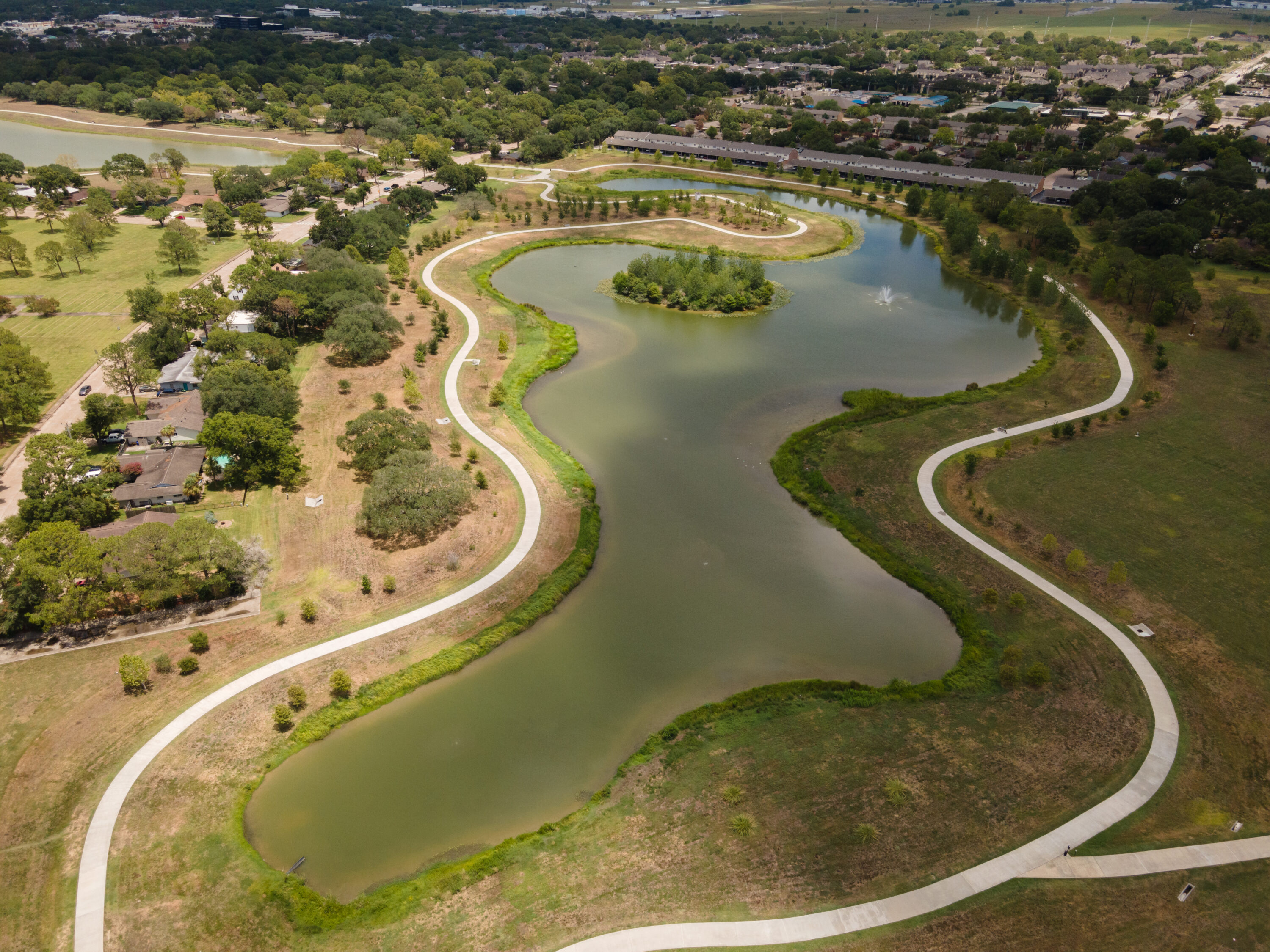
Properties backing up to Houston's bayou system occupy some of the most visually distinctive and environmentally complex residential sites in the city. The view of Buffalo Bayou, Brays Bayou, White Oak Bayou, or any of the dozens of tributary channels that define Houston's drainage geography is genuinely beautiful — mature riparian trees, moving water, wildlife activity, and a sense of natural openness that is rare in one of America's largest and most densely developed cities. That view comes with site conditions and regulatory constraints that make landscape work on bayou-adjacent Houston properties fundamentally different from standard residential landscaping anywhere else in the metro.
The banks of Houston's bayou system are dynamic environments. They experience periodic inundation during Houston's frequent heavy rain events — some bayou-adjacent properties flood multiple times per year in normal Houston rainfall years. The soil along Houston's bayou banks is perpetually in some state of wet-dry transition that affects plant establishment, hardscape stability, and the erosion forces that the bayou's water velocity creates during high-flow events. The regulatory environment — FEMA floodplain designations, Harris County Flood Control District jurisdiction over the bayou channels themselves, and local floodplain management rules — constrains what can be built and how within defined distances of the bayou channel.
At Gulf Reserve Landscape & Pools, bayou-adjacent landscape work is one of the most technically demanding project types we take on — and one of the most rewarding when the design correctly addresses the site's constraints and leverages its extraordinary natural assets. Here is what landscape design and construction on Houston bayou-adjacent properties actually requires.
Understanding Houston's Bayou System and What It Means for Adjacent Properties
Houston's bayou network is not a natural river system in the traditional sense. The bayous — Buffalo, Brays, White Oak, Greens, Hunting, and their tributaries — are partially engineered drainage channels that the Harris County Flood Control District manages as the primary infrastructure for moving storm water out of the Houston metro. Their water levels respond rapidly to rainfall events across the entire watershed they drain — which means that a heavy rain event 20 miles upstream can cause a bayou-adjacent Houston property to experience rising water even when no rain is falling at the property itself.
The Harris County Flood Control District has jurisdiction over the bayou channels and a defined buffer zone along each bayou — the floodway and floodplain boundaries that FEMA designates and that Harris County enforces. Within the floodway — the active channel and its immediate banks — no development or permanent structures are permitted. Within the 100-year floodplain — the broader area that has a 1 percent annual probability of inundation — development is regulated but not prohibited, subject to elevation and design requirements that ensure new construction does not increase flood risk for neighboring properties.
For bayou-adjacent Houston homeowners, the practical implication of this regulatory framework is that the portion of their property closest to the bayou — which is often the most visually prominent and potentially most valuable portion — is subject to development constraints that limit what can be built and how. Understanding the specific floodplain designation of each portion of the property is the starting point for any bayou-adjacent landscape design in Houston.
Bayou bank erosion is the physical process that most directly threatens bayou-adjacent Houston properties over time. During high-flow events — the Houston rain events that push bayou water levels above normal channel capacity and accelerate flow velocity — water moving along the bank exerts shear stress on the soil that removes material progressively. Unprotected Houston bayou banks that consist of bare soil or poorly rooted vegetation lose material during every significant flow event, with the rate of loss accelerating as the bank face becomes more exposed and unstable. Properties that were 10 feet from the bayou channel 20 years ago may be 6 feet from it today on sections of Houston's bayou system where bank erosion has not been addressed.
Erosion Control on Houston Bayou Banks — What Actually Works
Bayou bank erosion control on Houston properties combines plant-based stabilization, structural armoring where flow velocities exceed what vegetation alone can withstand, and the integration of both approaches in a way that protects the bank while maintaining the natural character that makes bayou-adjacent Houston properties distinctive.
Native riparian vegetation is the foundation of any sustainable erosion control approach on Houston's bayou banks. The root systems of plants native to Houston's riparian environments — the species that evolved in the wet-dry, periodically inundated conditions of the Gulf Coast bayou system — provide the most effective and environmentally appropriate bank stabilization available. These plants establish deep, fibrous root systems that bind the bank soil, reduce the erosive impact of flowing water on the bank face, and recover from inundation events that would kill non-adapted species.
Bald cypress is the most important tree species for Houston bayou bank stabilization. Its root system — including the pneumatophores that extend above the soil surface in wet conditions — anchors bank soil more effectively than any other large tree available for Houston riparian applications. Bald cypress tolerates complete inundation for extended periods, thrives in Houston's wet clay bayou bank conditions, and grows to a substantial size that provides both structural root mass for erosion control and the visual character that defines the most beautiful sections of Houston's bayou corridors.
Eastern cottonwood establishes rapidly on disturbed Houston bayou banks and provides fast-growing root mass that begins stabilizing freshly exposed or recently eroded bank material while slower-growing species establish. Its rapid growth rate — among the fastest of any native Texas tree — makes it valuable for erosion control applications where speed of establishment matters for bank protection during the years before a longer-term vegetation community develops.
Native willows — black willow and sandbar willow — are the classic Houston bayou bank stabilization shrubs. Their flexible stems survive high-velocity flow events that snap more rigid plants, and their aggressive root sprouting from stem cuttings makes them one of the most cost-effective bank stabilization plantings available for Houston bayou applications. Willow stakes driven directly into Houston bayou bank soil — live cuttings from established willows — root and begin stabilizing the bank in a single growing season.
For the understory layer of Houston bayou bank plantings, native sedges — specifically Carex and Scirpus species native to the Gulf Coast — provide dense, low root mass in the critical near-water zone where erosive forces are most concentrated. Giant river cane — Arundinaria gigantea, the native bamboo of the Gulf Coast — stabilizes Houston bayou banks aggressively once established and provides the dense root matrix in the bank face that resists erosive shear during high-flow events.
Structural bank armoring — riprap, gabion baskets, and concrete revetment — is appropriate on Houston bayou bank sections where flow velocities during high events exceed what vegetation alone can withstand. The sections of Houston's bayou system most exposed to high-velocity flow — outer bends of the channel where centrifugal force concentrates flow energy against the bank, sections immediately downstream of culverts and bridges where flow is accelerated, and sections where the bank face is already severely eroded and too unstable for vegetation establishment — require structural armoring as either a primary protection or as a foundation for vegetation integration.
Riprap — angular quarry stone placed along the bank face — is the most common structural armoring for Houston bayou bank stabilization on residential properties. The angular stone interlocks to resist displacement by flow forces, and vegetation established in the voids between stones over time creates a combined structural-biological protection system that performs better than either component alone. Riprap specification for Houston bayou bank applications needs to account for the flow velocities specific to the bayou section being protected — undersized stone is displaced during high-flow events, creating a worse bank condition than unprotected native soil.
Gabion baskets — wire mesh containers filled with stone and stacked to form a retaining structure along the bank face — are appropriate for Houston bayou bank sections where the grade change between the property and the water surface is steep and where riprap slope alone cannot provide adequate protection. Gabion structures on Houston bayou banks must be designed to accommodate the vegetation integration that transitions them from engineered structures to naturalistic features over time — bare gabion basket walls without vegetation are visually incongruous in Houston's bayou landscape and resist the naturalization that makes them appropriate long-term solutions.
Harris County Flood Control District has jurisdiction over work within the bayou channel and on bayou banks, and permits from the HCFCD are required for structural bank work on properties adjacent to Harris County-maintained bayous. The permit process confirms that proposed bank work does not obstruct the channel, increase flood risk for neighboring properties, or interfere with HCFCD's flood control operations. Working with contractors familiar with the HCFCD permit process — who can prepare the required documentation and navigate the review timeline — is essential for Houston bayou bank stabilization projects that involve structural work.
Plant Selection for Houston Bayou-Adjacent Properties Beyond the Bank
The landscape area beyond the immediate bayou bank — the transition from the riparian edge through the broader property — presents plant selection requirements that differ from both the bank stabilization zone and the standard Houston residential landscape. This transition zone experiences periodic inundation during Houston's larger rain events, has permanently elevated soil moisture relative to higher-ground Houston properties, and supports a specific plant community that bridges the riparian and upland landscape types.
Trees for Houston bayou-adjacent landscapes beyond the immediate bank zone include species that tolerate both periodic flooding and the extended dry periods that Houston's wet-dry climate produces. Water oak — Quercus nigra — is one of the most reliable medium to large canopy trees for Houston's bayou-adjacent transition zone. It tolerates periodic flooding better than live oak, develops a handsome rounded canopy, and is a native species of Houston's natural bottomland forest communities. Overcup oak — Quercus lyrata — tolerates even longer inundation periods than water oak and is appropriate for the lowest-elevation portions of Houston bayou-adjacent properties that flood most frequently.
Sugarberry — Celtis laevigata, the native Texas hackberry — is a reliable medium canopy tree for Houston bayou-adjacent landscapes that tolerates wet soil and periodic flooding while also performing in drier conditions as elevation increases across the property. Its fruits provide significant wildlife value on Houston bayou-adjacent properties where the natural corridor supports bird and small mammal populations.
Understory and shrub layer plants for Houston bayou-adjacent transition zones include species that provide ornamental value while tolerating the wet-dry soil conditions characteristic of this landscape type. Buttonbush — Cephalanthus occidentalis — is one of the best-performing flowering shrubs for Houston's wettest bayou-adjacent landscape areas. Its white spherical flower clusters attract pollinators through summer, its seed heads provide fall and winter wildlife interest, and it establishes readily in Houston's wet clay soil conditions that challenge most ornamental shrubs. Virginia willow — Itea virginica — provides fragrant white flower spikes in early summer and exceptional fall color — unusual in Houston's subtropical climate — while tolerating the wet soil conditions of Houston's bayou-adjacent transition zones.
Louisiana iris is the premier ornamental perennial for Houston's bayou-adjacent landscape areas and one of the most effective plants for naturalizing the transition between the engineered or stabilized bank zone and the broader landscape. Its rhizomatous spread creates dense colonies that stabilize soil, manage water, and produce a spectacular spring flowering display that is one of the most beautiful seasonal events available in Houston's residential landscape.
Drainage and Hardscape Design on Houston Bayou-Adjacent Properties
Hardscape design on Houston bayou-adjacent properties requires integrating two sets of constraints simultaneously — the standard Houston clay soil and drainage requirements that govern hardscape on all Houston properties, and the floodplain restrictions that limit what can be built within defined distances of the bayou channel.
Impervious surface limitations within Houston floodplain areas restrict the total hardscape coverage that can be added to bayou-adjacent properties in ways that do not apply to higher-ground Houston properties. Adding impervious surface within a floodplain increases the volume and velocity of runoff that reaches the bayou channel during rain events, which can increase flood levels for neighboring properties downstream. Harris County and the City of Houston both regulate impervious surface additions within floodplain areas, and proposals that would significantly increase impervious coverage on Houston bayou-adjacent properties may require mitigation — compensatory detention storage or permeable paving systems that offset the additional runoff the new impervious surface would generate.
Permeable paving systems are particularly appropriate for Houston bayou-adjacent properties where hardscape is desired but floodplain impervious surface limitations constrain conventional concrete and stone options. Permeable pavers, decomposed granite with stabilizer, and gravel pathway systems all provide functional hardscape surfaces while maintaining the infiltration capacity that floodplain management regulations protect. For Houston bayou-adjacent patios and pathways within the regulated floodplain area, permeable paving systems that meet the applicable infiltration standards allow hardscape installation that would not be possible with conventional impervious materials.
Retaining walls and grade changes on Houston bayou-adjacent properties require specific attention because grade changes near the bayou bank can affect the erosion and drainage dynamics that the existing topography manages. Retaining walls that redirect drainage toward the bayou bank rather than away from it accelerate erosion. Grade changes that reduce the natural infiltration capacity of the transition zone between the property and the bayou increase the velocity of runoff reaching the bank during rain events. Any significant grade change or retaining wall installation on a Houston bayou-adjacent property should be evaluated for its effect on bank erosion and bayou-directed drainage before construction.
Lighting Design for Houston Bayou-Adjacent Properties
The views from Houston bayou-adjacent properties are among the most distinctive in the city — and landscape lighting designed to enhance and extend those views into the evening creates outdoor living experiences that are genuinely extraordinary. The quality of light available on a well-lit Houston bayou-adjacent property at dusk — mature riparian tree canopies illuminated from below, the movement of water visible in the background, the transition from sky color to landscape lighting — is one of the most compelling outdoor living environments available anywhere in the Houston residential market.
Lighting design for Houston bayou-adjacent properties needs to account for the same fixture durability requirements that apply to all Houston outdoor lighting — brass or copper fixtures with appropriate IP ratings for Houston's humidity — and the additional consideration that properties close to a water body experience consistently higher moisture exposure than standard residential properties. Fixtures on Houston bayou-adjacent decks, terraces, and lower garden areas that are near the water are subject to moisture levels that accelerate fixture deterioration even faster than standard Houston residential conditions.
Dark sky considerations are relevant for Houston bayou-adjacent properties because the bayou corridor is a wildlife movement pathway — migratory birds follow Houston's bayou system as a navigational corridor during spring and fall migration. Lighting systems on Houston bayou-adjacent properties that minimize upward light scatter and use warm color temperatures consistent with 2700K recommendations reduce the disruption to nocturnal wildlife that is a genuine consideration for properties on Houston's bayou corridors.
What a Full Landscape Makeover Looks Like on a Houston Bayou-Adjacent Property
For Houston bayou-adjacent homeowners whose properties have eroding banks, invasive plant colonization, degraded transition zone vegetation, or disconnected relationships between the house, the landscape, and the bayou view, a full landscape makeover approach — addressing the entire property from bayou bank to house foundation as a unified design — produces the most coherent and durable results.
The sequence of work on a Houston bayou-adjacent landscape makeover typically begins with bank stabilization — addressing erosion and establishing the native riparian plant community that protects the bank long-term. This work needs to precede any landscape investment in the transition zone and upper property because uncontrolled bank erosion progressively undermines everything installed above it.
With bank stabilization underway, the transition zone planting — the native trees, shrubs, and perennials that bridge the riparian bank and the residential landscape — creates the ecological and visual connection between the bayou corridor and the cultivated landscape. This layer is where the most distinctive and visually compelling plant communities for Houston bayou-adjacent properties are established — the bald cypress canopy, the buttonbush understory, the Louisiana iris colonies that bloom in spring along the water's edge.
The upper property — the patio, lawn, and foundation planting areas closer to the house — can be designed with the full range of Houston residential landscape options, informed by the drainage conditions and flood zone designations that govern this portion of the property. Views from the upper property toward the bayou corridor, framed by the riparian tree canopy, are the visual asset that distinguishes these Houston properties — and landscape design that protects and enhances those sightlines rather than blocking them with inappropriate plantings or structures delivers the full value of the bayou-adjacent location.

Gulf Reserve Landscape & Pools designs and installs landscape makeovers on bayou-adjacent properties across Houston — from the Inner Loop bayou corridors of Buffalo Bayou and White Oak Bayou through the suburban bayou systems of Katy, Sugar Land, Pearland, and The Woodlands. We handle the HCFCD permitting process, the bank stabilization design, and the full landscape development from bayou edge to house foundation.
Request your free estimate at gulfreservelandscaping.com — and let's develop your Houston bayou property to its full potential.


