




How Long Does Sod Take to Root in Houston — And What Affects Establishment Time in Clay Soil
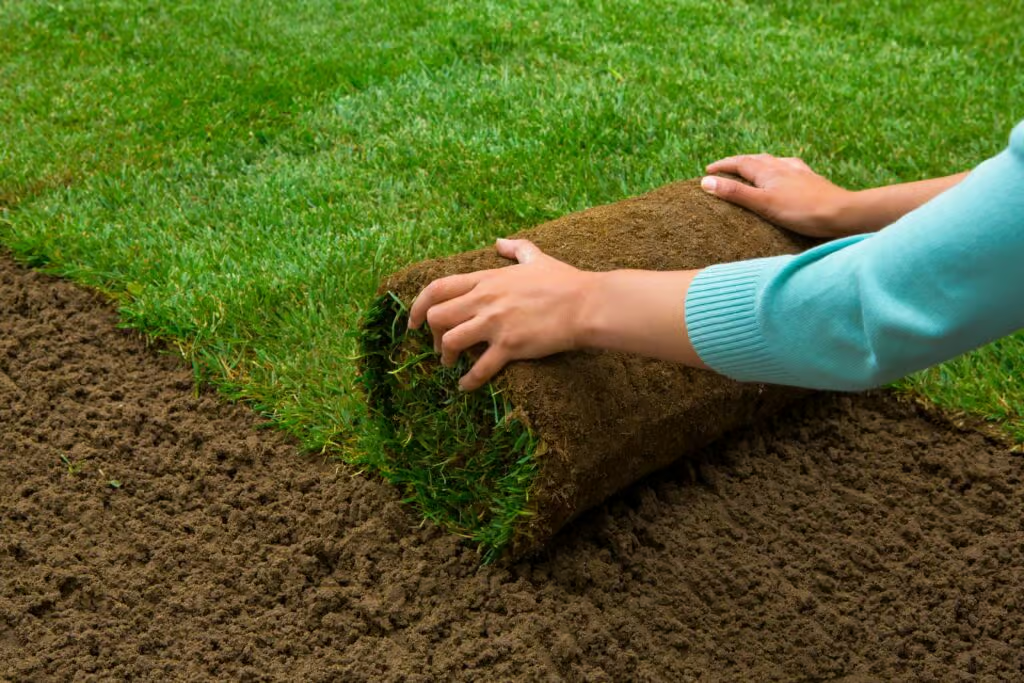
The most common question Houston homeowners ask after new sod is installed is some version of the same thing — when can I walk on it, when can I mow it, when will it look like a real lawn, and how do I know if it is actually rooting or just sitting on top of the soil looking green while quietly dying underneath?
These are legitimate questions and the answers matter practically. New sod in Houston that is walked on too early compresses the soil before roots have established, disrupting the root-to-soil contact that establishment depends on. Sod that is mowed before it has rooted sufficiently gets pulled up by the mower deck rather than cut. Sod that is watered on a schedule appropriate for established turf gets underwatered during the critical first two weeks when moisture demand is highest. And sod that looks green on the surface for three weeks before turning yellow is telling you that it never rooted — a failure that is almost always caused by conditions that could have been identified and corrected before installation began.
At Gulf Reserve Landscape & Pools, sod installation is one of our most requested services across Houston. The establishment period — the weeks between installation and full rooting — is the phase that determines whether the investment produces the lawn the homeowner paid for. Here is a complete, Houston-specific guide to sod rooting timelines, the factors that affect them in Houston's clay soil conditions, and what to watch for week by week after installation.
What Sod Rooting Actually Means in Houston
Before getting into timelines, it helps to be precise about what sod rooting means — because the visual appearance of new sod in Houston tells only part of the story of what is happening below the surface.
Freshly installed sod arrives with a thin mat of soil attached to its root system — the growing medium from the sod farm where it was harvested. This mat keeps the grass plant alive during transport and the first days after installation. The grass looks green and healthy because it is drawing on the moisture and nutrients stored in the sod mat. This green appearance has nothing to do with whether rooting into the underlying Houston soil has begun.
Rooting — the process that actually establishes the sod as part of the Houston landscape rather than a mat of grass sitting on top of it — begins when the sod's root system grows downward through the sod mat and into the soil beneath it. This process requires physical contact between the bottom of the sod mat and the Houston soil surface, adequate moisture in both the sod mat and the receiving soil, soil temperatures warm enough to support root growth, and a receiving soil that roots can actually penetrate — which in Houston's clay conditions requires appropriate soil preparation.
Full rooting — the point at which the sod has developed enough root mass in the underlying Houston soil to support itself without the sod mat's stored resources — takes longer than most Houston homeowners expect and varies significantly based on the conditions at installation.
Houston Sod Rooting Timeline — What to Expect Week by Week
The following timeline reflects typical rooting progression for St. Augustine sod — Houston's most commonly installed variety — in properly prepared Houston soil during the peak growing season from April through September. Rooting timelines extend significantly during cooler periods and compress somewhat in ideal spring and early fall conditions.
Days 1 through 7 — initial contact and surface rooting. During the first week after Houston sod installation, the primary establishment activity is physical — the sod mat softening and beginning to make contact with the soil beneath it, and the first root hairs beginning to explore the interface between the sod mat bottom and the Houston soil surface. The grass above ground looks identical to how it looked at installation. There is no visible indicator of rooting progress during this period. The lawn is entirely dependent on irrigation to maintain the moisture levels that allow this initial contact and surface rooting to begin.
The Houston sod installation that fails most commonly does so because of what happens during this first week — specifically inadequate irrigation that allows the sod mat to dry out before the roots have any connection to the underlying soil moisture. A dry sod mat in Houston's summer heat desiccates within 24 to 48 hours. Once the sod mat dries to the point of visible stress — edges curling, color shifting from green toward yellow-green — the window for successful establishment has narrowed significantly.
Days 7 through 14 — root penetration begins. By the end of the second week after Houston sod installation in warm soil conditions — soil temperatures above 65 degrees Fahrenheit, which covers most of Houston's growing season from April through October — root tips have begun penetrating the interface between the sod mat and the Houston soil beneath it. These initial root penetrations are shallow — 0.5 to 1 inch into the soil surface — but they represent the beginning of genuine establishment.
The tug test — gently pulling up a corner of the sod to assess whether resistance indicates rooting — can be performed at the end of week two on Houston sod installations. At this stage, properly establishing sod should show slight resistance when the corner is lifted — not the easy carpet-like lifting of unrooted sod and not the firm resistance of fully rooted sod, but a modest resistance indicating that initial root attachment has begun. Houston sod that lifts with no resistance at day 14 is not establishing correctly and the cause — typically inadequate moisture or poor soil contact — needs to be identified and corrected immediately.
Days 14 through 21 — accelerating root development. The third week of Houston sod establishment is typically when the most rapid early root development occurs in warm soil conditions. Root tips that penetrated the surface in week two are now extending 2 to 3 inches into the Houston soil, and new root tips are initiating along the entire bottom surface of the sod mat. The lawn above ground begins to look more settled — the edges between sod pieces close as lateral growth from stolons begins bridging the installation seams, and the overall color stabilizes to a consistent green.
The tug test at the end of week three on a properly establishing Houston lawn should show clear resistance — lifting the sod requires genuine effort and produces an audible or tactile resistance indicating that roots are engaged with the underlying soil. Houston sod installations that pass the week three tug test are on track for successful establishment. Those that still lift easily at day 21 have a problem that has not been identified and addressed.
Days 21 through 35 — establishment consolidation. The fourth and fifth weeks of Houston sod establishment are the period when the rooting system transitions from fragile initial penetrations to a genuinely functional root network capable of supporting the grass through Houston's demanding growing conditions. Root depth extends from 2 to 3 inches to 4 to 6 inches in properly amended Houston soil during this period. The sod becomes noticeably firmer underfoot — the soft, spongy feel of freshly installed sod that compresses under foot pressure transitions to the more solid feel of established turf with a developed root system.
Light foot traffic — walking across the lawn for maintenance and inspection — is generally appropriate beginning around day 21 to 28 for Houston sod installations showing normal establishment progression. The test is whether footprints recover within 30 to 60 minutes of being made. Persistent footprints in Houston sod indicate that the root system is not yet developed enough to support foot traffic without compressing the soil-root interface in ways that set back establishment.
Days 35 through 60 — full establishment. Houston sod is generally considered fully established — meaning the root system is sufficiently developed to support normal maintenance activities, withstand normal Houston weather variability without special irrigation attention, and begin responding to fertilization — between 35 and 60 days after installation in warm season conditions. The variation within this range reflects the significant effect of installation timing, soil conditions, and irrigation management on Houston sod establishment rate.
Houston sod installed in October or November — the fall planting window — establishes more slowly than spring and summer installations because cooler soil temperatures reduce root growth rate. Fall-installed Houston sod may take 60 to 90 days to reach the establishment threshold that spring-installed sod reaches in 35 to 45 days — but it is not failing during this extended establishment period, simply developing more slowly in cooler conditions.
Factors That Affect Houston Sod Rooting Time
The 35 to 60 day establishment timeline above reflects normal conditions. Several Houston-specific factors can significantly extend or compress this timeline.
Soil preparation quality is the single most influential factor in Houston sod establishment time. Sod installed over properly amended Houston clay — pH-corrected toward 6.5, compost-incorporated to improve structure, graded for positive drainage — roots 30 to 50 percent faster than sod installed over unamended, compacted Houston clay. The roots of newly installed sod can penetrate amended Houston soil more easily, find available water and nutrients more readily, and establish the deep root mass that sustains the lawn through Houston's demanding summer conditions significantly faster in prepared soil.
Unamended Houston clay with a pH of 7.8 to 8.2 creates a challenging root environment — the alkalinity that locks up iron and other micronutrients affects the newly establishing roots that need those nutrients to support rapid growth. This is why soil pH testing and amendment before sod installation is not optional in Houston — it directly affects how quickly the investment roots and how well it performs once established.
Soil temperature at the time of Houston sod installation affects root growth rate more directly than air temperature. Root growth in warm-season grasses like St. Augustine, Bermuda, and Zoysia is optimized at soil temperatures between 70 and 85 degrees Fahrenheit. Houston's soil temperatures in this range typically occur from April through October. At soil temperatures below 65 degrees Fahrenheit — which Houston sees from November through February in most years — root growth slows significantly and establishment timelines extend accordingly.
Measuring soil temperature before Houston sod installation using an inexpensive soil thermometer at 4-inch depth — the primary rooting zone for new sod — provides actual data rather than air temperature approximation. Houston soil at 4-inch depth lags air temperature changes by days to weeks — soil that feels warm on the surface can be below 65 degrees at rooting depth in early spring or late fall when air temperatures have risen or remained moderate.
Installation season in Houston affects establishment time through both soil temperature and evapotranspiration demand. Houston sod installed in June, July, and August roots in warm soil but faces the highest evapotranspiration demands of the year — the establishment irrigation requirement during Houston's peak summer is daily watering for the first two weeks, which demands either a functioning irrigation system or consistent manual watering commitment from the homeowner. Houston sod installed in April, May, September, or October roots in warm soil with lower evapotranspiration demand — establishing more easily and with lower irrigation intensity requirements.
Sod variety affects establishment rate in Houston in ways that are worth understanding for homeowners comparing options. St. Augustine — particularly the Floratam variety — establishes the fastest of Houston's common sod options, rooting aggressively via stolons and typically reaching the establishment threshold within 35 to 45 days in warm conditions. Bermuda establishes comparably fast via its rhizome and stolon system. Zoysia is the slowest-establishing Houston sod variety — its establishment rate is roughly half that of St. Augustine and Bermuda, with full establishment often taking 60 to 90 days even in optimal Houston summer conditions. The tradeoff is that established Zoysia in Houston produces a denser, finer-textured turf with better long-term weed suppression than either St. Augustine or Bermuda — the slower establishment is a one-time investment in a superior long-term result.
Sod freshness at installation affects establishment rate because sod that was cut days before installation at the farm has depleted more of its stored resources and been under more transport stress than sod installed within 24 hours of cutting. In Houston's summer heat, sod sitting on a pallet for more than 24 to 48 hours before installation begins heating internally — the metabolic activity of the grass plant continues after cutting and generates heat within the rolled sod that damages root tips and reduces establishment vigor. Gulf Reserve installs Houston sod within 24 hours of farm delivery as standard practice — not because it is more convenient but because sod freshness at installation directly affects the establishment outcome the homeowner paid for.
Houston Sod Establishment Irrigation — Week by Week
Irrigation during the establishment period is the variable that Houston homeowners have the most control over and the one that most commonly determines whether new sod roots successfully or fails to establish.
Week one — daily watering, twice daily in peak summer heat. The first week of Houston sod establishment requires keeping the sod mat and the top 2 inches of underlying soil consistently moist — not saturated, but consistently moist. In Houston's summer conditions, this typically means irrigation twice daily — early morning and late afternoon — for the first 5 to 7 days. The objective is preventing the sod mat from drying out entirely between irrigation cycles. A Houston sod mat that dries out during the first week before any root penetration into the underlying soil has occurred is a sod mat that is living on borrowed time.
The early morning irrigation cycle is the most important — it replenishes moisture lost through overnight transpiration and sets the moisture level for the warmest part of the Houston day. The late afternoon cycle prevents the extreme stress that Houston's 95-plus degree peak afternoon heat creates in unrooted sod with no access to soil moisture reserves.
Week two — daily watering, transitioning to once daily. During the second week, as initial root contact with the Houston soil begins, the twice-daily irrigation frequency can typically be reduced to once daily for installations showing normal establishment progression. The morning cycle provides sufficient moisture in most Houston fall and spring conditions. Summer Houston sod installations may benefit from a supplemental cycle if afternoon temperatures and low humidity create visible stress — edges curling or color shifting — in the afternoon hours.
Week three — every other day. By week three, sod with developing root contact into Houston soil can be transitioned to every-other-day irrigation in most conditions. The root system is beginning to access moisture from the underlying soil rather than depending entirely on irrigation-supplied moisture in the sod mat. This transition should be made gradually — watch for stress signs in the 24 hours following the first skipped irrigation day and revert to daily irrigation if stress is visible.
Weeks four and five — transition to established schedule. As Houston sod approaches the establishment threshold, irrigation frequency should be transitioning toward the established turf schedule — deep, infrequent watering that encourages root depth rather than the frequent, shallow irrigation of the establishment period. For Houston St. Augustine, the established schedule is typically 2 to 3 times per week during summer, providing approximately 1 inch of water per week from combined irrigation and rainfall.
The transition from establishment irrigation to established schedule needs to happen gradually rather than abruptly — cutting from daily to three times per week in a single step during Houston's peak summer stresses the recently established root system before it has developed the depth to handle the longer intervals between irrigation events.
Signs That Houston Sod Is Not Establishing Correctly
Recognizing the signs of establishment failure early — before the sod has died outright — allows intervention that can save the installation rather than requiring replacement.
Yellowing that begins at the edges of sod pieces is the most common early sign of establishment failure in Houston. Sod edges dry out faster than sod centers because they have more surface area exposed to Houston's drying conditions and less soil contact. Yellowing edges in the first two weeks indicate inadequate irrigation — the sod mat is drying between irrigation cycles and the edges are the first areas to show stress.
Lifting without resistance at day 14 or later indicates that rooting has not progressed normally. The causes to investigate are soil compaction preventing root penetration into the underlying Houston clay, inadequate soil-to-sod contact from installation on uneven grade, and soil pH so extreme that root growth is inhibited by nutrient lockout in the root zone.
Uniform yellowing across entire sod pieces rather than edge yellowing indicates a different problem — typically waterlogging from inadequate drainage in Houston's clay, which suffocates roots and prevents establishment, or a disease outbreak in the stressed newly installed sod. Overwatering on Houston's clay is a genuine establishment failure mode — the goal is consistent moisture, not saturation.
Footprints that do not recover after 24 hours beyond day 28 indicate that root development is significantly behind schedule and that the cause needs to be identified before the sod has been stressed beyond recovery.
When Houston Sod Installation Fails — Knowing When to Renovate
Despite proper installation and establishment irrigation, some Houston sod installations fail to root and require replacement. Recognizing this outcome decisively rather than continuing to irrigate failing sod saves time and money compared to extended attempts to revive sod that has passed the recovery threshold.
Houston sod that is still failing the tug test at day 35 — lifting with no resistance — and showing widespread yellowing across more than 50 percent of the installed area has almost certainly failed to establish and needs to be assessed for replacement. The causes of the failure need to be identified and addressed before replacement sod is installed — otherwise the replacement faces the same conditions that caused the first installation to fail.
The most common causes of Houston sod installation failure that Gulf Reserve identifies during replacement assessments are inadequate soil preparation — specifically pH levels above 8.0 in the receiving soil, severe compaction from construction or equipment traffic, and drainage conditions that kept the soil saturated during the establishment period. All three of these are addressable with appropriate soil amendment, aeration, and drainage correction before replacement sod is installed.

Gulf Reserve Landscape & Pools installs sod across Houston, River Oaks, Memorial, Katy, Sugar Land, Pearland, The Woodlands, and surrounding areas. Every installation starts with soil assessment and site evaluation — because the establishment outcome is determined before the first roll of sod goes down, and we want every Houston sod installation we do to root successfully the first time.
Request your free estimate at gulfreservelandscaping.com — and let's get your Houston lawn established correctly from the start.


