




Houston Pool Deck Materials Compared — What Survives Gulf Coast Heat, UV, Clay Soil Movement, and Bare Feet in July
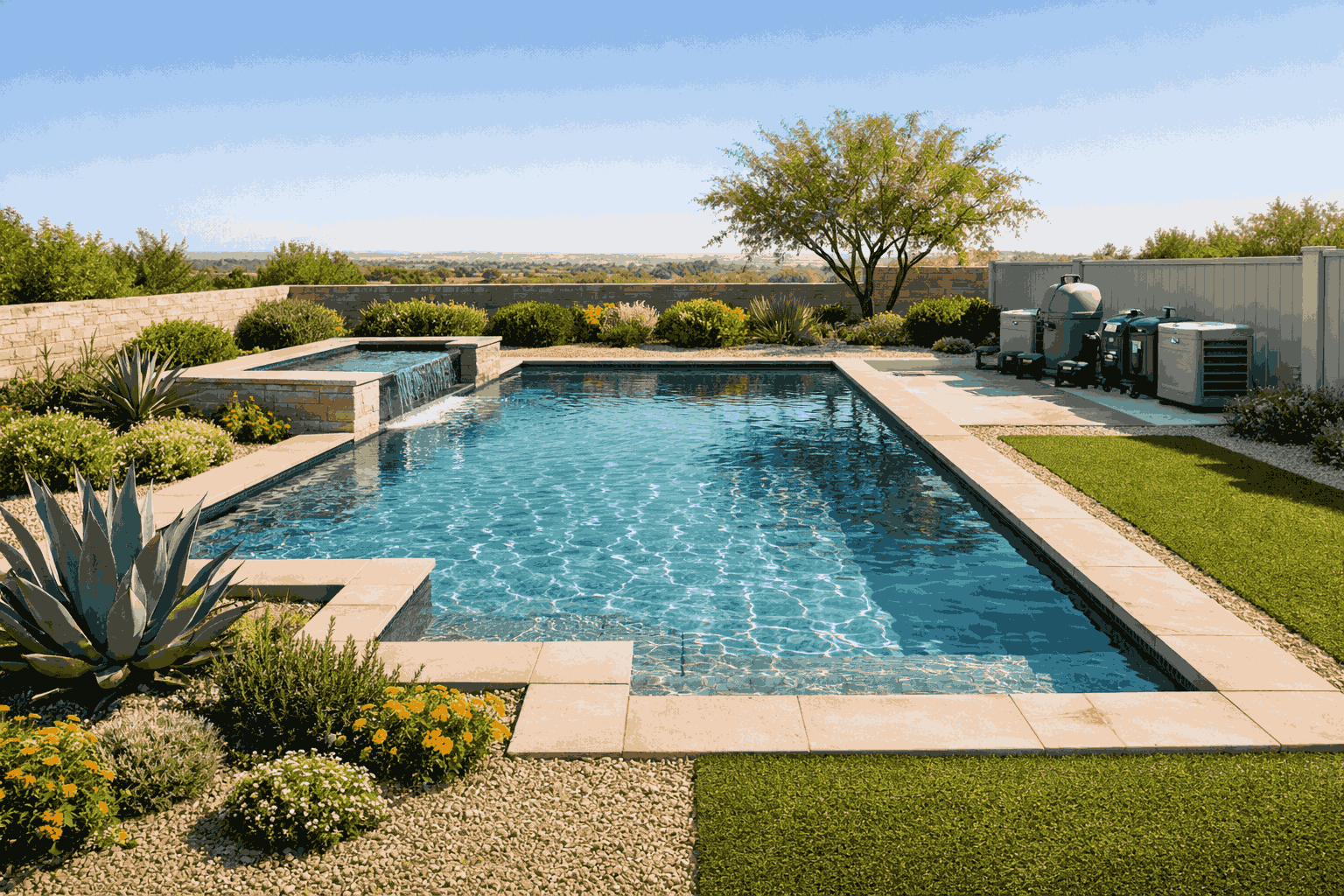
A pool deck in Houston works harder than a pool deck almost anywhere else in the country. It absorbs direct sun in a climate where ambient temperatures exceed 95 degrees Fahrenheit for months at a time and UV radiation intensity is among the highest in the continental United States. It gets wet and dries repeatedly — hundreds of times per year — in a humidity environment that keeps moisture in material surfaces longer than dry climates do. It sits on Houston's expansive clay soil, which moves as it wets and dries and generates the lateral and vertical forces that crack, shift, and separate improperly designed flatwork. And it needs to be comfortable underfoot for bare feet at 2 in the afternoon in August — a performance requirement that eliminates several otherwise attractive material choices.
Getting the material selection right on a Houston pool deck matters more than it does on a standard patio or driveway because the pool deck is the surface that guests and family interact with at close range, in bare feet, in the heat, every time the pool is used. A pool deck that looks good in photographs but gets uncomfortably hot underfoot, shows UV bleaching within three seasons, or develops cracks from clay soil movement is a constant source of dissatisfaction and eventually a significant repair or replacement cost.
At Gulf Reserve Landscape & Pools, pool deck design and installation is one of our core concrete and stone work services across Houston. Here is an honest, Houston-specific comparison of the primary pool deck material options — what each one does well, where each one falls short in Houston's conditions, and what the right choice looks like for different Houston property types and budgets.
The Houston Pool Deck Performance Requirements — What Any Material Needs to Pass
Before comparing specific materials, it helps to define the performance requirements that the Houston pool deck environment creates. Any material that cannot meet these requirements will underperform in Houston regardless of how well it performs in other markets.
Heat reflectance and surface temperature is the pool deck performance requirement that Houston homeowners feel most immediately and most consistently. Dark materials that absorb solar radiation reach surface temperatures exceeding 150 degrees Fahrenheit on Houston summer afternoons — temperatures that are genuinely painful and potentially dangerous for bare feet and that make the deck unusable during peak hours. Light-colored, high-reflectance materials stay meaningfully cooler in Houston's sun and remain usable through more of the Houston summer day.
Slip resistance when wet is a safety requirement that Houston's pool deck environment demands. A surface that looks beautiful when dry but becomes dangerously slippery when splashed with pool water or when Houston's afternoon thunderstorms arrive while the deck is in use is not appropriate for a pool deck regardless of its other qualities. Texture, surface finish, and aggregate exposure all affect wet slip resistance in Houston pool deck applications.
Resistance to pool chemical exposure is a material durability requirement specific to pool deck environments. Chlorine, pool shock compounds, and pH adjustment chemicals splash onto deck surfaces continuously during normal pool use. Materials that are chemically sensitive — certain natural stones, unprotected metals, and low-quality sealers — show deterioration from chemical exposure that accelerates in Houston's heat because higher temperatures increase the reactivity of pool chemicals with deck surfaces.
Thermal expansion and contraction compatibility with Houston clay is the structural requirement that determines whether a Houston pool deck maintains its integrity over time or develops the cracking and joint separation that is visible on so many Houston pool decks within 5 to 10 years of installation. Houston's clay soil moves. Houston's deck materials expand and contract with temperature changes. The combination of soil movement from below and thermal movement within the material requires control joint design and base preparation that accommodates both movement sources simultaneously.
Barefoot comfort in Houston summer conditions is the user experience requirement that several otherwise attractive materials fail in Houston. This is not simply surface temperature — it is the combination of temperature, texture, and thermal conductivity that determines how a material feels underfoot on a Houston summer afternoon.
Material 1 — Brushed and Exposed Aggregate Concrete: Houston's Most Versatile Pool Deck Option
Concrete is the most widely used Houston pool deck material for good reasons — it is durable, designable, cost-effective relative to natural stone, and when properly specified and installed for Houston's conditions, it performs reliably for 20 to 30 years. The key phrase is properly specified and installed — generic concrete pool decks in Houston fail from the same causes as any other concrete flatwork in the city when base preparation and reinforcement are not calibrated for Houston's clay soil conditions.
Brushed concrete — the standard broom finish that provides slip resistance through surface texture — is the baseline Houston pool deck concrete option. It is functional, affordable, and durable when properly poured. Its limitation in Houston is primarily aesthetic and thermal. Standard gray brushed concrete absorbs heat significantly in Houston's sun, reaching surface temperatures that limit barefoot comfort during peak summer hours. Its appearance, while completely acceptable functionally, reads as utilitarian against the architectural quality of Houston's more aspirational pool installations.
Exposed aggregate concrete solves both the thermal and aesthetic limitations of standard brushed concrete in Houston pool deck applications. By seeding the top surface with rounded pea gravel, quartz aggregate, or locally sourced river rock and exposing it through surface washing before final cure, exposed aggregate concrete creates a textured surface that provides excellent slip resistance, scatters sunlight rather than absorbing it — staying meaningfully cooler than smooth concrete in Houston's sun — and delivers a visual quality that reads as considerably more refined than standard brushed finishes.
The aggregate selection for Houston exposed aggregate pool decks affects both the thermal performance and the barefoot comfort of the finished surface. Rounded river pebble aggregate stays cooler than sharp crushed stone aggregate in Houston's sun and is more comfortable underfoot. Light-colored aggregate — white quartz, tan river pebble, cream-toned limestone aggregate — reflects more solar radiation than dark aggregate and produces cooler surface temperatures in Houston's summer heat. For Houston pool decks where barefoot comfort through the summer day is a priority, light-colored rounded aggregate is the correct specification.
Colored concrete with integral pigment or surface-applied color hardener expands the design range of Houston pool deck concrete beyond the gray palette of standard mixes. Warm buff, cream, and tan tones are the most appropriate Houston pool deck colors — they complement the water color of most Houston pools, read as warm and inviting against Houston's landscape plantings, and reflect more solar radiation than the gray tones of standard concrete. Cool blue and green tones that might seem intuitive for a pool context absorb heat more aggressively in Houston's sun than the warm neutral tones that landscape designers specify for Houston luxury pool installations.
The concrete work requirements for Houston pool decks are the same as for any other Houston flatwork — proper subgrade evaluation and compaction, 6-inch minimum crushed limestone base, centered rebar reinforcement, correct mix design for Houston's heat curing conditions, and control joints placed to manage the thermal and clay movement forces that Houston's environment generates. Pool decks have the additional requirement of slope toward the pool or perimeter drains — a minimum of 1/8 inch per foot directed away from the pool equipment area and toward drainage collection — to prevent water from pooling on the deck surface and against the pool shell.
Material 2 — Travertine Pavers: Houston's Premium Natural Stone Pool Deck Option
Travertine is the natural stone that has become the dominant premium pool deck material in Houston's luxury residential market over the past decade, and its performance in Houston's specific conditions explains the preference. Travertine's thermal properties, slip resistance, and aesthetic quality make it one of the best-suited natural stones for Houston's Gulf Coast pool deck environment when properly installed.
Thermal performance is travertine's most important Houston pool deck advantage. Travertine's natural porosity and lighter color tones — cream, ivory, walnut, and noce are the most common Houston pool deck travertine colors — give it significantly lower surface temperatures than concrete, ceramic tile, or darker natural stones in Houston's direct sun. Independent surface temperature measurements in Houston summer conditions consistently show travertine running 20 to 30 degrees Fahrenheit cooler than comparable concrete surfaces in the same sun exposure — a difference that is immediately felt underfoot and that keeps Houston pool decks usable through more of the summer day.
Slip resistance of travertine in Houston pool deck applications depends on the surface finish specified. Tumbled or brushed travertine — the most common Houston pool deck finish specifications — provides good slip resistance when wet from pool splash or Houston afternoon rainfall. Polished travertine — appropriate for interior applications — is not appropriate for Houston pool deck use and should never be specified in this application regardless of its visual appeal.
Travertine installation for Houston pool decks requires specific attention to the base system design given Houston's clay soil conditions. Travertine pavers installed over a sand-set base directly on Houston clay will shift and settle as the clay moves through wet and dry cycles — the individual paver joints open unevenly, pavers rock underfoot, and the deck develops a wavy surface within a few seasons. For Houston pool deck installations on native clay, a concrete bond coat over a properly designed concrete slab base provides the stable, non-moving substrate that travertine requires to perform as installed for decades rather than years.
The mortar system used to bond travertine to the concrete base on Houston pool decks needs to be flexible enough to accommodate the thermal expansion and contraction of both the travertine and the concrete base without bond failure. Standard Portland cement mortar, while adequate for cooler climates, can become brittle in Houston's temperature extremes and fail at the travertine-to-mortar interface over time. Polymer-modified thin-set mortars specified for exterior pool deck applications in Houston's climate provide the flexibility that standard mortar lacks and are the appropriate specification for Houston travertine pool installations.
Grout joints in Houston travertine pool decks require movement accommodation at control joint locations — typically every 8 to 10 feet — to prevent the travertine field from cracking as a unit when thermal expansion occurs during Houston's summer heat. These movement joints, filled with flexible sealant rather than rigid grout, are not visible as a design element when correctly detailed but are structurally essential on Houston pool decks where the temperature differential between a cold Houston winter morning and a peak summer afternoon exceeds 100 degrees Fahrenheit.
Material 3 — Cool Deck and Kool Coat Concrete Coatings: Houston's Most Popular Mid-Range Solution
Cool Deck — the trademarked name for a textured concrete coating system originally developed in Arizona — and its various generic equivalents are among the most widely installed pool deck surfaces in Houston's market, particularly on renovation projects where an existing concrete slab is being refinished rather than replaced. These systems apply a thin cementitious coating over existing concrete, creating a textured, light-colored surface that reflects solar radiation and stays cooler underfoot than bare concrete.
Thermal performance of Cool Deck and similar coating systems in Houston is their primary selling point and genuine strength. The light colors and textured surface of these coatings produce surface temperatures significantly lower than bare concrete in Houston's sun — typically 30 to 40 degrees cooler than an adjacent dark concrete surface, and comparable to travertine in many Houston summer conditions. For Houston homeowners with existing concrete pool decks that are structurally sound but thermally uncomfortable, Cool Deck resurfacing is the most cost-effective way to meaningfully improve barefoot comfort without replacing the underlying slab.
Durability in Houston's conditions is where Cool Deck and similar coating systems require honest performance assessment. These are thin-film coatings bonded to the existing concrete surface — they do not add structural strength to the slab beneath and they are subject to delamination when the bond between the coating and the substrate is compromised by moisture infiltration, freeze-thaw cycling, or substrate movement. In Houston's clay conditions, where the concrete slab beneath the coating may experience some movement from soil dynamics, coating delamination — visible as bubbling, flaking, or peeling areas on the deck surface — is a real and relatively common occurrence.
The lifespan of Cool Deck and similar coatings on Houston pool decks is typically 7 to 12 years before recoating is required, compared to 20 to 30 years for properly installed concrete or travertine. Houston pool deck owners should factor the recoating cycle into their cost comparison when evaluating these systems against more durable alternatives.
Material 4 — Concrete Pavers: Design Flexibility With Houston-Specific Considerations
Concrete pavers — manufactured concrete units in a range of sizes, colors, and textures — offer design flexibility and the practical advantage of individual unit replaceability that poured concrete cannot provide. A damaged paver on a Houston pool deck can be lifted and replaced individually without the patching that poured concrete requires. This replaceability is particularly relevant for Houston pool decks near significant trees where root growth may eventually disturb isolated areas of the deck surface.
Concrete paver performance in Houston pool deck applications is good when the installation base system is correctly specified for Houston's clay soil conditions. Like travertine, concrete pavers installed on a sand-set base over Houston clay will shift as the clay moves — the individual units separate at joints, rock underfoot, and create an uneven surface over time. A concrete base system with the pavers mortar-set or placed in a bedding course over the concrete provides the stability that sand-set installation cannot achieve on Houston's expansive clay.
Surface temperature of concrete pavers in Houston varies significantly by color. Light-colored concrete pavers — cream, buff, and warm gray tones — stay meaningfully cooler in Houston's sun than dark charcoal and slate-toned pavers that are popular in contemporary design applications. Houston homeowners who select dark-toned concrete pavers for their aesthetic appeal in design photographs frequently find that the surface temperature of those pavers in Houston's direct afternoon sun limits the usability of the pool deck during peak summer hours.
Material 5 — Porcelain Tile: Houston's Most Demanding Pool Deck Option
Large-format porcelain tile has become an increasingly popular Houston luxury pool deck material as tile manufacturing technology has improved product durability and Houston designers have specified it on high-end installations seeking a contemporary, refined aesthetic. Its performance in Houston's conditions requires specific attention to installation system design and material specification that generic tile installation practice does not address adequately.
Slip resistance is the most important porcelain tile specification variable for Houston pool deck applications. Polished porcelain tile — beautiful on interior floors — is completely inappropriate for Houston pool deck use. For Houston pool deck applications, porcelain tile must be specified with a wet DCOF — Dynamic Coefficient of Friction — of 0.42 or greater, the ANSI standard for wet floor applications. This requirement eliminates the majority of large-format porcelain tiles from Houston pool deck use and narrows the appropriate field to tiles specifically manufactured and rated for exterior wet applications.
Thermal expansion management for large-format porcelain tile on Houston pool decks requires control joint spacing that is tighter than standard tile installation practice. Porcelain tile has a lower thermal expansion coefficient than concrete — meaning it expands and contracts at a different rate than the concrete substrate beneath it. In Houston's temperature extremes, this differential movement creates shear stress at the tile-to-mortar bond that causes tile delamination and cracking when control joints are not adequately spaced to relieve it. On Houston pool decks, porcelain tile control joints at 8-foot intervals in both directions are the appropriate standard rather than the 12 to 16 foot spacing common in interior tile applications.
Drainage Design for Houston Pool Decks — The Component Most Contractors Underspecify
Pool deck drainage in Houston is not an afterthought — it is a primary design component that affects both the deck's structural longevity and the usability of the pool area during and after Houston's frequent heavy rain events.
A Houston pool deck that slopes correctly toward collection points manages the significant water volumes that Houston's rainstorms generate without producing the sheet flow across the deck surface, ponding in low areas, or water running against the pool shell and house foundation that poorly drained Houston pool decks create. The minimum slope standard of 1/8 inch per foot toward drains is adequate for normal pool splash management but may need to be increased to 1/4 inch per foot in areas of Houston pool decks that receive significant roof drainage or where the lot topography directs additional surface flow across the deck during rain events.
Channel drains at the perimeter of Houston pool decks — particularly at the transition between the pool deck and adjacent lawn areas — intercept water running off the deck surface before it saturates the lawn and the clay subgrade beneath hardscape areas adjacent to the pool. This perimeter drainage management is one of the highest-value additions to Houston pool deck design relative to cost and is the detail that most consistently differentiates durable, well-functioning Houston pool deck installations from ones that create ongoing drainage problems for the surrounding landscape.
What the Right Houston Pool Deck Looks Like — Putting It Together
For Houston homeowners planning a new pool deck or renovating an existing one, here is how the material choices align with different priorities and budgets.
For Houston homeowners who want the best long-term performance, barefoot comfort, and visual quality, travertine on a concrete base system is the correct answer. It performs better in Houston's heat than any concrete alternative, delivers a level of material quality that is appropriate for Houston's luxury residential market, and with proper installation lasts for decades without the recoating cycles that surface-applied systems require.
For Houston homeowners who want excellent performance at a lower cost point than travertine, light-colored exposed aggregate concrete with rounded pea gravel or quartz aggregate provides good thermal performance, genuine durability, and a visual quality that reads as considerably more refined than standard brushed concrete. It is the most common material specification on Gulf Reserve pool deck installations where travertine is not in the budget.
For Houston homeowners with an existing structurally sound concrete pool deck that needs thermal improvement, Cool Deck or a similar coating system is the most cost-effective intervention available. Its 7 to 12 year lifespan before recoating needs to be factored into the long-term cost comparison with more durable alternatives.
For Houston homeowners who want design flexibility and the pattern options that individual units provide, light-colored concrete pavers on a concrete base system perform reliably in Houston's conditions and offer the individual unit replaceability that is a practical advantage near Houston's tree canopy.

Gulf Reserve Landscape & Pools designs and installs pool decks across Houston, River Oaks, Memorial, Katy, Sugar Land, Pearland, The Woodlands, and surrounding areas — in concrete, travertine, pavers, and stone — with base preparation and drainage design calibrated for Houston's clay soil and Gulf Coast climate conditions.
Request your free estimate at gulfreservelandscaping.com — and let's build a Houston pool deck that performs as well as it looks.


