




Houston Lawn Weeds Identified — The 5 Species Destroying Houston Yards and How to Actually Get Rid of Them
If you have been fighting weeds in your Houston lawn for more than one season and still losing, the problem is almost certainly not effort. It is identification. The five weed species that do the most damage to Houston lawns have completely different lifecycles, germination windows, and control requirements — and a product or program that works on one of them does nothing to the others. Treating crabgrass with the same approach you use for nutsedge is like taking the wrong medication. Not only does it not work, it wastes time and money while the real problem keeps spreading.
Houston's climate creates one of the most weed-friendly environments in the United States. The combination of warm temperatures that persist nearly year-round, high humidity, heavy clay soil that holds moisture at the surface, and a growing season that stretches from March through November gives weeds more opportunity to germinate, establish, and spread than almost any other major American city. Add the alkaline pH of Houston's native clay — which stresses the desirable grass species that compete with weeds — and the conditions for chronic weed pressure are fully established.
At Gulf Reserve Landscape & Pools, weed pressure is one of the most common topics that comes up during Houston lawn assessments. In many cases, what a homeowner describes as a fertilization problem or a watering problem is actually a weed identification and control problem that has been misdiagnosed for multiple seasons. Here is a definitive guide to Houston's five most damaging lawn weed species — what they look like, how they spread, when they germinate in Houston's specific climate, and what actually controls them.
Why Houston Lawn Weed Control Fails So Consistently
Before getting into individual species, it is worth understanding why Houston homeowners spend years and significant money on weed control without achieving the results they are looking for. The failures almost always fall into one of four patterns.
The first is misidentification. Products are labeled for specific weed species or categories — grassy weeds, broadleaf weeds, sedges. A product labeled for grassy weeds does nothing to nutsedge, which is a sedge. A pre-emergent that stops crabgrass does not stop Virginia buttonweed, which spreads vegetatively rather than by seed. Buying the wrong product because the weed was not correctly identified is the most common and most costly Houston lawn weed control mistake.
The second is timing failure. Pre-emergent herbicides work by preventing seed germination — they are completely ineffective once weeds have already emerged and are growing. Houston homeowners who apply pre-emergent in April after crabgrass is already visible in the lawn have missed the control window entirely. Understanding when each Houston weed species germinates in Houston's specific climate calendar is the difference between prevention and reaction.
The third is incomplete coverage. Houston's clay soil and thatch layers can intercept pre-emergent herbicide before it reaches the germination zone if application and irrigation timing are incorrect. Granular pre-emergents require adequate post-application irrigation to move the active ingredient into the soil profile where it creates the germination barrier. Pre-emergents applied without adequate post-application water in Houston's spring dry periods sit on the thatch surface and provide minimal control.
The fourth is resistant or escaping populations. Virginia buttonweed and nutsedge — two of Houston's most persistent lawn weed problems — have proven resistance or tolerance to some of the most commonly used Houston lawn herbicides when those products are used alone without appropriate program design. Single-product programs against these species routinely fail to provide adequate control in Houston's conditions.
Weed 1 — Crabgrass: Houston's Most Widespread Summer Annual
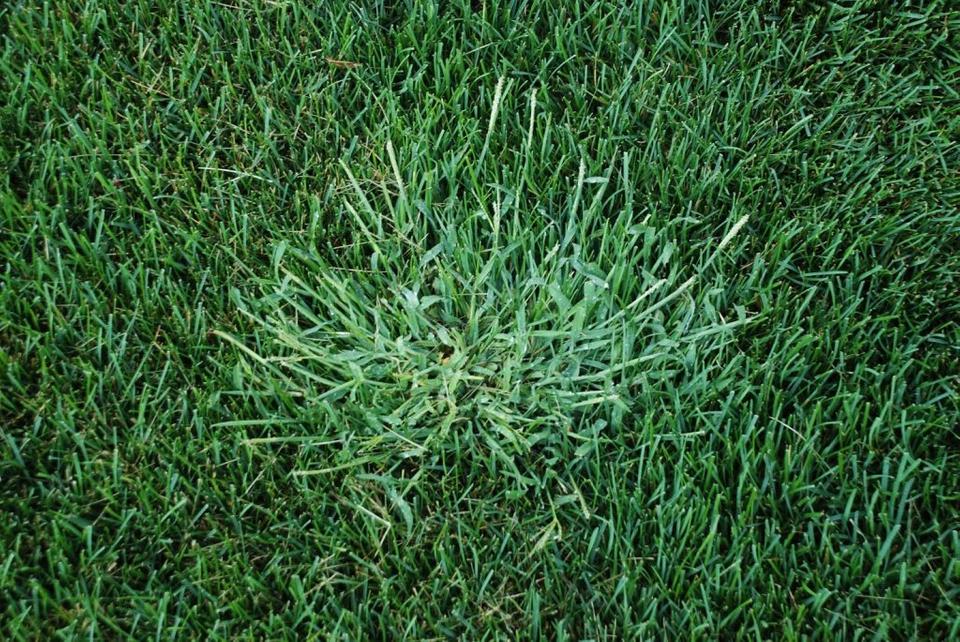
Crabgrass is the most widely recognized lawn weed in Houston and one of the most manageable when the control program is timed correctly. It is a summer annual — meaning it germinates from seed in spring, grows through Houston's summer, produces seed in late summer and fall, and dies with the first Houston frost or cold snap. Each plant produces thousands of seeds before dying, which is why crabgrass populations in Houston lawns build rapidly when they are not controlled consistently.
Crabgrass in Houston germinates when soil temperatures reach 55 degrees Fahrenheit consistently — which in Houston's climate typically occurs between late February and mid March depending on the specific year's weather pattern. This germination window is the critical pre-emergent application target for Houston crabgrass control. Pre-emergent herbicide applied to Houston lawns in late February creates a chemical barrier at the soil surface that prevents crabgrass seed germination through the primary spring window.
Identification is straightforward once you know what to look for. Young crabgrass in Houston lawns appears as light green, wide-bladed grass seedlings emerging in clusters — often in areas where the turf is thin, stressed, or bare. As the plant matures through Houston's summer, it develops a low, spreading, crab-like growth habit with stems radiating outward from a central root point. The seed heads — finger-like projections from the stem tips — appear in late summer and are the visual sign that the plant has already set seed for next year's Houston lawn weed population.
Post-emergent control of actively growing crabgrass in Houston lawns requires products containing quinclorac or fenoxaprop applied according to label instructions during active growth. These products provide reasonable control of young crabgrass in Houston but become less effective as the plants mature. Large, established crabgrass plants in Houston lawns in August are difficult to control post-emergently — which is why pre-emergent prevention in late February is far more cost-effective than post-emergent rescue treatment later in the season.
The relationship between crabgrass and Houston lawn health is important to understand. Crabgrass establishes most aggressively in Houston lawns that are thin, stressed, or have bare soil exposed — conditions created by incorrect mowing height, drought stress, pest damage, or soil compaction. A thick, dense Houston St. Augustine lawn maintained at the correct 3.5 to 4 inch mowing height shades the soil surface and physically suppresses crabgrass germination more effectively than any herbicide program alone. The best long-term Houston crabgrass control is a healthy, dense lawn.
Weed 2 — Grassbur: Houston's Most Physically Painful Lawn Problem
Grassbur — also called field sandbur or sticker weed across Houston — is the weed that makes walking barefoot in a Houston lawn genuinely painful and that causes more immediate homeowner distress than any other Houston weed species. The sharp, spiny burs that attach to clothing, skin, and pet fur are the seed structures of a summer annual grass that thrives in Houston's hot, dry conditions and particularly in lawns with thin turf and sandy or disturbed soil zones.
Grassbur in Houston follows the same general summer annual lifecycle as crabgrass — germinating in spring as soil temperatures rise, growing through summer, producing burs from midsummer through fall, and dying in winter. The critical difference from a control standpoint is that grassbur seed has significant dormancy — meaning a large proportion of the seed in Houston soil does not germinate in the first season after it is produced, remaining viable in the soil for multiple years. This seed bank persistence is why grassbur is so difficult to eliminate from Houston lawns once it is established — a single season of excellent control still leaves viable seed in the soil that will germinate in subsequent years when conditions are right.
Pre-emergent control of grassbur in Houston follows the same late February to early March timing as crabgrass control, using products containing pendimethalin, prodiamine, or dithiopyr. Because of grassbur's seed bank persistence in Houston soil, a consistent two to three year pre-emergent program is necessary to deplete the seed reservoir and achieve durable control rather than the season-by-season suppression that a single-year program provides.
Grassbur in Houston has a specific site preference worth understanding for targeted control. It establishes most aggressively in hot, dry, compacted areas of Houston lawns — typically near driveways and sidewalk edges, in south-facing lawn areas with reflected heat from hardscape, and in areas where turf has been damaged by foot traffic or pet activity. Addressing the underlying thin turf and compaction conditions in these Houston lawn areas through core aeration, soil amendment, and overseeding or sod repair provides a more durable solution than herbicide programs alone against these persistent establishment zones.
Weed 3 — Doveweed: Houston's Most Misidentified Summer Problem
Doveweed is the Houston lawn weed that most consistently defeats homeowner control programs — not because it is the most difficult to kill chemically, but because it is consistently misidentified as St. Augustine grass by Houston homeowners who then apply no control measures until the infestation is extensive. By midsummer in Houston, doveweed can occupy 30 to 50 percent of a lawn that appeared weed-free in spring simply because its resemblance to St. Augustine delayed recognition and treatment.
The identification challenge is real. Young doveweed in Houston St. Augustine lawns has wide, succulent-feeling leaves with a similar color and texture to St. Augustine at a glance. The distinguishing characteristics that separate doveweed from St. Augustine are its slightly narrower leaf blade, its lack of the folded leaf sheath characteristic of St. Augustine, its succulent stem texture when squeezed, and — most reliably — its small lavender-blue flowers that appear from midsummer through fall and are unmistakably not St. Augustine.
Doveweed in Houston germinates significantly later in the spring than crabgrass and grassbur — soil temperatures of 65 to 70 degrees Fahrenheit are required, which in Houston typically means late March through April germination rather than late February. Standard pre-emergent applications timed for the late February crabgrass window provide only partial control of doveweed in Houston because a significant proportion of doveweed germination occurs after the early applications have begun to break down. A split pre-emergent program — first application in late February and second application in early April — provides substantially better doveweed control in Houston than a single early application.
Post-emergent control of doveweed in Houston St. Augustine lawns is limited by the chemistry available that is safe for use in St. Augustine. Carfentrazone products provide the most reliable post-emergent doveweed suppression that is safe for Houston St. Augustine lawns, though repeat applications are typically necessary and timing during active doveweed growth is important for efficacy. Treating doveweed in Houston when it is stressed by heat or drought reduces control reliability.
The conditions that favor doveweed in Houston lawns are worth understanding for longer-term management. Doveweed thrives in consistently moist Houston soil — it is particularly aggressive in lawns that are overwatered or that have irrigation scheduling producing chronically wet soil surface conditions. Correcting irrigation scheduling to allow the Houston soil surface to dry between watering cycles reduces the moisture advantage that doveweed exploits in Houston lawns where it is consistently problematic.
Weed 4 — Virginia Buttonweed: Houston's Most Persistent Broadleaf Problem
Virginia buttonweed is the Houston lawn weed that most reliably frustrates experienced homeowners and lawn care professionals alike. It is a warm-season perennial that spreads through Houston lawns by seed, stem fragments, and underground root segments simultaneously — which means that mechanical control methods including mowing actually worsen infestations by distributing stem fragments across the lawn. A single Virginia buttonweed plant in a Houston lawn that goes uncontrolled through one season can colonize a significant area through its multiple propagation pathways.
Identification of Virginia buttonweed in Houston lawns is distinctive once you know the plant. It has small, opposite leaves with a rough texture, produces small white four-petaled flowers that appear throughout Houston's growing season, and grows in a prostrate spreading mat that follows the lawn surface closely. The plants in a Houston lawn typically form irregular patches that expand outward from the original establishment point and that maintain their color and vigor even when surrounding St. Augustine is stressed — Virginia buttonweed actually seems more comfortable in Houston's hot, humid, wet conditions than the desirable turf it is displacing.
Post-emergent control of Virginia buttonweed in Houston lawns requires products containing triclopyr, metsulfuron, or carfentrazone applied during active growth. The important qualification is that Virginia buttonweed in Houston typically requires multiple applications across the growing season rather than a single application — the perennial root system and underground fragment reservoir mean that a single treatment kills the above-ground growth while the root system recovers and resprouts. A program of three to four applications spaced 3 to 4 weeks apart during Houston's active growing season provides substantially better season-long control than one or two applications.
The irrigation connection to Virginia buttonweed in Houston is strong and consistently observed. Overwatered Houston lawns — lawns with irrigation running on fixed summer schedules that continue through Houston's wet fall periods, or lawns in low-lying areas that collect water after rain events — develop severe Virginia buttonweed pressure while better-drained areas of the same Houston property remain relatively clean. Addressing drainage problems and correcting irrigation scheduling are important complementary interventions to herbicide programs for Houston lawns with significant Virginia buttonweed pressure.
Weed 5 — Nutsedge: The Houston Lawn Problem That Herbicides Alone Cannot Solve
Nutsedge — yellow nutsedge and purple nutsedge, both common across Houston — is in a different category from the four grass and broadleaf weeds discussed above. It is not a grass. It is a sedge — a distinction that matters enormously for control because the herbicide chemistry that controls grassy weeds does nothing to nutsedge, and standard broadleaf herbicides are equally ineffective. Houston homeowners who have applied multiple products to nutsedge without results are almost always using chemistry that is simply wrong for the plant they are trying to control.
Nutsedge identification is straightforward once you understand the basic characteristic — it is a grass-like plant with triangular stems. Grasses have round stems. Sedges have triangular stems — a cross-section of the stem has three sides rather than being round. Additionally, nutsedge in Houston lawns grows faster than the surrounding St. Augustine during Houston's warm growing season and stands noticeably taller than the mowed turf surface within days of mowing — the characteristic that most often prompts Houston homeowners to notice it for the first time.
The control challenge with nutsedge in Houston goes beyond herbicide selection. Nutsedge reproduces primarily through underground tubers — small, hard, nut-like structures attached to the root system at 4 to 8 inches below the soil surface. These tubers are resistant to most herbicide treatments and to physical removal — pulling nutsedge plants from Houston lawns typically leaves the tubers behind, which resprout readily. A single nutsedge plant can produce dozens of tubers in a single Houston growing season, each capable of producing a new plant. The tuber reservoir in Houston soil on established infestations can persist for years of control effort.
Halosulfuron and sulfentrazone are the active ingredients with proven efficacy against nutsedge in Houston lawn situations. Both require multiple applications — typically three or more per season — to provide adequate control of established nutsedge populations in Houston St. Augustine. The mechanism of control is suppression and gradual depletion of the tuber bank rather than single-application elimination — Houston homeowners who expect nutsedge to disappear after one or two treatments are setting unrealistic expectations that lead to abandoning effective programs before they produce results.
Wet soil conditions are the primary environmental driver of nutsedge pressure in Houston lawns. Nutsedge thrives in consistently moist, poorly drained soil — conditions that Houston's clay creates inherently and that overwatering and drainage problems compound. On Houston properties with significant nutsedge pressure, drainage improvement and irrigation correction are the changes that make the herbicide program work rather than fight a losing battle against the conditions that favor nutsedge over desirable turf.
When Weed Control Is Not Enough — Recognizing When Houston Sod Needs Replacement
There is a point in weed infestation progression where control programs — regardless of how correctly timed and applied — cannot restore a Houston lawn to acceptable condition within a reasonable timeframe. Recognizing this point saves Houston homeowners years of ongoing chemical expense and frustration that produces marginal results.
The threshold for sod replacement rather than weed control is generally reached when weed species occupy more than 40 to 50 percent of the lawn area. At this point, the desirable turf is too sparse and fragmented to fill back in effectively even after weeds are controlled — the bare areas left by weed elimination become reinfestation sites for the next generation of Houston weed pressure rather than recovering with desirable grass. Fresh sod installation over properly prepared, amended Houston soil — with pre-emergent applied at the correct timing after establishment — resets the lawn to a condition where ongoing maintenance can actually achieve the result the homeowner is looking for.
Houston sod installation is not simply placing new grass over the existing problem. The soil conditions that allowed weed pressure to dominate need to be addressed before new sod goes down — pH correction for Houston's alkaline clay, drainage improvements for waterlogged areas that favor doveweed and nutsedge, and compaction relief through aeration and compost incorporation for the thin, stressed turf areas where crabgrass and grassbur establish most aggressively. New sod installed over unaddressed Houston soil problems replicates the conditions that produced the weed problem in the first place.

Gulf Reserve Landscape & Pools provides sod installation across Houston, River Oaks, Memorial, Katy, Sugar Land, Pearland, The Woodlands, and surrounding areas. Every installation starts with soil assessment and drainage evaluation so the conditions that drove weed pressure are addressed before the first roll of sod goes down.
Request your free estimate at gulfreservelandscaping.com — and let's get your Houston lawn to where it should be.


