




Houston Lawn Weeds — How to Identify What Is Growing in Your Lawn and Eliminate It Correctly
Is your Houston lawn being invaded by weeds that keep returning despite the pre-emergent and post-emergent applications you have been making — and are you wondering whether you are treating the right weeds with the right products at the right times? Houston's warm climate, alkaline soil, and year-round growing season create one of the most challenging weed management environments in the country. The same conditions that make Houston an exceptional place to grow warm-season grasses also give every weed species the extended opportunity to establish, seed, and return that cooler climates interrupt with dormancy. Getting weed identification right before treatment decisions are made is the foundational step that makes control programs actually work rather than treating the wrong species with the wrong product and wondering why the weeds keep coming back.
At Gulf Reserve Landscape & Pools, weed management is part of every Houston sod installation and lawn maintenance program we execute. Here is how to identify the weeds that most commonly invade Houston lawns and what to do about each one.
Summer Annual Weeds — Houston's Peak Season Invaders
Summer annual weeds in Houston germinate in late winter and early spring when soil temperatures rise above 55 degrees Fahrenheit, complete their life cycle through the summer growing season, set seed, and die with the first cold event of fall. The seed bank they leave in the soil germinates the following spring to repeat the cycle — making pre-emergent herbicide timing the most important weed management intervention for Houston lawns against these species.
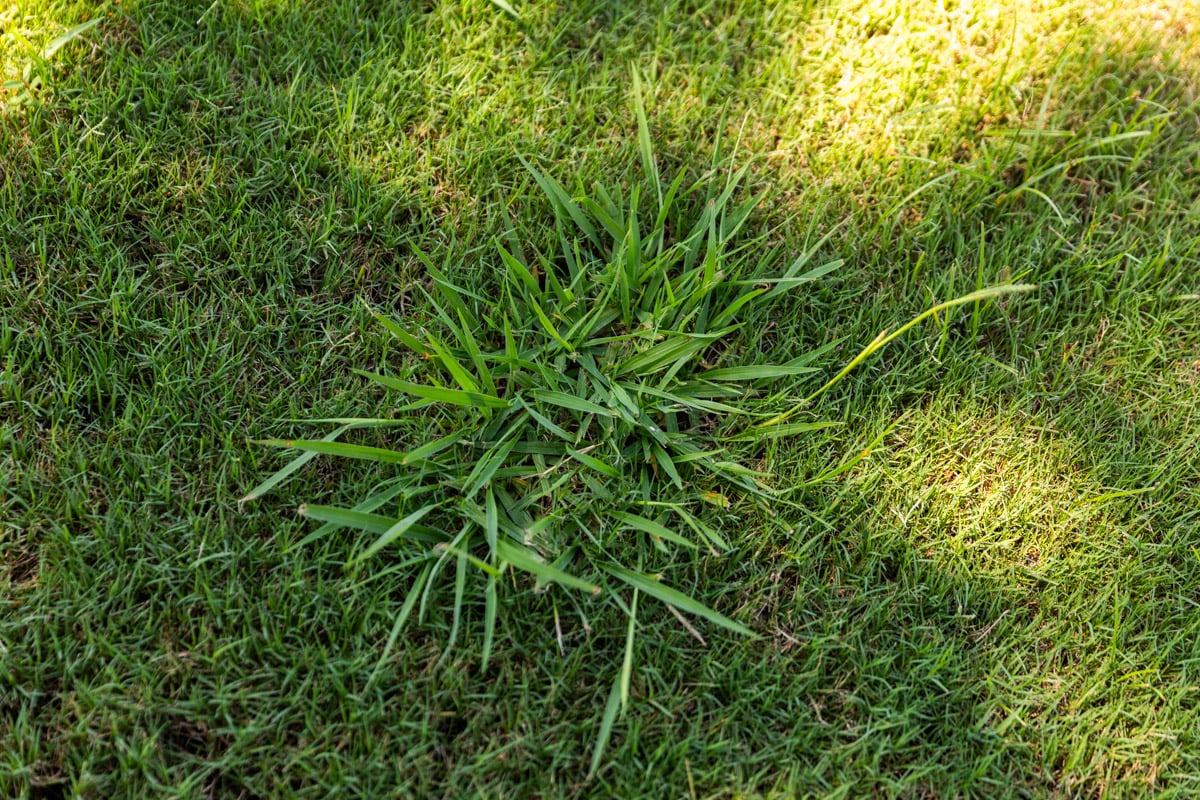
Crabgrass is the most widespread summer annual grass weed in Houston lawns — the coarse-textured, spreading grass that germinates in late February and early March in Houston's warming soil and that develops into the sprawling, seed-producing clumps that take over thinning areas of Houston St. Augustine and Bermuda lawns by midsummer if pre-emergent applications missed the germination window. Crabgrass identification in Houston lawns is straightforward — the seedling that emerges in early spring has the wide, flat blades and horizontal spreading growth habit that distinguishes it from St. Augustine's coarser but more upright blade and from Bermuda's fine, low-growing texture. Established crabgrass in Houston midsummer lawns is obvious — the sprawling, coarse clumps with the star-shaped seed heads on branching stems that emerge above the surrounding turf communicate its presence unmistakably.
Pre-emergent herbicide applied in late February before soil temperatures reach 55 degrees Fahrenheit is the correct and most cost-effective crabgrass control for Houston lawns. Products containing pendimethalin, prodiamine, or dithiopyr in formulations labeled for the specific turf variety on the property provide the 8 to 12 week residual barrier that prevents crabgrass germination through Houston's spring germination window. Post-emergent control of established crabgrass in Houston St. Augustine lawns is limited — most post-emergent grass herbicides that control crabgrass are damaging or lethal to St. Augustine — making pre-emergent timing the correct management approach for Houston St. Augustine lawns rather than the post-emergent rescue treatments that are viable in Bermuda and Zoysia lawns.
Grassbur is the summer annual grass weed that Houston homeowners encounter most painfully — literally. The sharp, spiny burs that grassbur produces at maturity are the seed structures that attach to clothing, embed in bare feet, and make the Houston lawn where grassbur has established genuinely unpleasant to use. Grassbur identification in Houston lawns reveals the same pre-emergent opportunity that crabgrass presents — grassbur germinates at similar soil temperatures and responds to the same pre-emergent products that crabgrass pre-emergent programs use. Houston lawns where the late February pre-emergent application is timed correctly and applied at adequate rates consistently have dramatically lower grassbur pressure than lawns where pre-emergent applications were delayed, inadequately applied, or skipped entirely.
Doveweed is the summer annual broadleaf weed that most commonly invades Houston St. Augustine lawns in the midsummer period — the succulent, low-growing weed with the oval leaves and tiny blue flowers that thrives in the moist, over-irrigated conditions that Houston's summer irrigation creates in lawns with drainage problems or irrigation coverage that keeps the soil surface consistently moist. Doveweed identification in Houston St. Augustine lawns requires close observation — the succulent stems and oval leaves that distinguish it from St. Augustine are not immediately obvious at mowing height but become apparent when the turf is examined at close range. Doveweed control in Houston requires the post-emergent broadleaf herbicide applications — products containing atrazine or triclopyr labeled for use in St. Augustine — applied when doveweed is actively growing and before it has set seed.
Winter Annual Weeds — Houston's Cool Season Invaders
Winter annual weeds in Houston germinate in fall when soil temperatures drop below 70 degrees Fahrenheit, grow through Houston's mild winter, and set seed before dying in spring when temperatures warm. They are the weeds that make Houston lawns look weedy through the winter months when warm-season grasses are dormant or semi-dormant and the competitive suppression that dense turf provides is at its lowest.
Annual bluegrass is the winter annual grass weed that most consistently invades Houston lawns during the cool season — the light-colored, clumping grass with the distinctive boat-shaped leaf tips that distinguishes it from desirable turf grasses and that produces the white seed heads that make it visible in Houston lawns from February through April. Annual bluegrass in Houston lawns thrives in the moist, fertile soil conditions that summer fertilization and irrigation have created — the conditions that make heavily managed Houston lawns more susceptible to annual bluegrass invasion than less intensively maintained ones.
Pre-emergent herbicide applications in late September and early October — timed before the soil temperature drop that triggers annual bluegrass germination — provide the fall equivalent of the spring pre-emergent program that summer annual weed management uses. The same products that control summer annuals are labeled for fall pre-emergent application at timing appropriate for the winter annual weed species — pendimethalin and prodiamine at fall application rates and timing are the correct tools for Houston's winter annual weed prevention program.
Henbit and common chickweed are the winter annual broadleaf weeds that create the purple-flowered and white-flowered weed carpets in Houston lawn areas during late winter and early spring. Both species germinate in fall, grow slowly through Houston's winter, and bloom prolifically in February through April before setting seed and dying as spring temperatures warm. Their bloom period makes them highly visible in Houston lawns during the late winter period when warm-season grasses are at their least competitive — the purple henbit flowers and white chickweed blooms that cover thin or bare areas of Houston lawns in February are the seed production events that replenish the seed bank for the following year's germination.
Post-emergent broadleaf herbicide applications using products containing 2,4-D, dicamba, or triclopyr in formulations labeled for the specific turf variety provide effective control of henbit and chickweed when applied while these weeds are actively growing. Houston homeowners who observe henbit and chickweed blooming in February and apply post-emergent broadleaf herbicides before the plants set seed reduce the seed bank that the following year's invasion draws from — the treatment that provides both current control and future prevention.
Perennial Weeds — Houston's Persistent Invaders
Perennial weeds in Houston lawns return from established root systems year after year regardless of whether the above-ground growth is removed or the seeds they produce are controlled. They are the weed category that most frustrates Houston homeowners because the annual programs that manage annual weeds do not eliminate them — perennial weed control requires the specific treatments and persistence that established root systems make necessary.
Nutsedge is the perennial weed that most consistently defies the standard weed control programs that Houston homeowners apply. The triangular stems and grass-like leaves that distinguish nutsedge from true grasses are the identification characteristics that confirm nutsedge presence — if you pull it and the stem is triangular in cross-section rather than round or flat, it is nutsedge. Purple nutsedge and yellow nutsedge are both present in Houston lawns and landscapes, thriving in the moist, poorly drained conditions that Houston's clay soil and irrigation create.
Nutsedge control in Houston requires the specific herbicide products labeled for sedge control — halosulfuron and sulfentrazone products labeled for nutsedge management in St. Augustine, Bermuda, and Zoysia lawns provide the post-emergent control that standard broadleaf herbicides do not achieve against this sedge species. Multiple applications through the growing season are typically required for adequate nutsedge suppression — the first application reduces the above-ground growth, and follow-up applications address the regrowth from the underground nut structures that single applications do not eliminate. Drainage improvement in the areas where nutsedge concentrates is the cultural management that reduces the moist conditions nutsedge prefers alongside the herbicide program that provides direct control.
Florida betony is the perennial broadleaf weed with the white-banded, segmented tubers that Houston homeowners frequently encounter when digging in lawn and garden areas. The square stems and opposite leaves with rounded teeth are the above-ground identification characteristics. Control of Florida betony in Houston lawns uses the post-emergent broadleaf herbicide products labeled for its management — multiple applications are required because the tuber segments that remain in the soil after herbicide application on the above-ground growth regenerate new plants that require additional treatment.
Wild violet in Houston lawns — the broadleaf perennial with the heart-shaped leaves and purple flowers that spreads through rhizomes in shaded, moist lawn areas — is one of the most difficult perennial weeds to control in Houston's established residential landscapes. The waxy leaf surface that most wild violet species produce reduces the penetration of post-emergent herbicide applications — requiring the triclopyr-containing products that are most effective against wild violet and the repeat applications that the wax-protected leaves make necessary for adequate control.
Pre-Emergent Timing — Houston's Most Important Weed Management Investment
Pre-emergent herbicide timing in Houston lawns is the single highest-return weed management investment available to Houston homeowners — the application that prevents the germination of the majority of Houston's annual weed species before they establish rather than the post-emergent programs that control established weeds at higher cost and with more variable effectiveness.
The Houston pre-emergent program requires two applications annually — the late February application that targets summer annual weeds before soil temperatures reach the 55 degrees Fahrenheit germination threshold, and the late September application that targets winter annual weeds before soil temperatures drop below 70 degrees Fahrenheit. These timing windows are Houston-specific — the national recommendations that suggest spring and fall pre-emergent application without specific timing guidance do not capture the specific soil temperature thresholds that Houston's Gulf Coast climate creates for weed germination.
Pre-emergent products appropriate for Houston lawns include granular pendimethalin, prodiamine, and dithiopyr in formulations labeled for the specific turf variety. Pre-emergent applied to St. Augustine requires confirmation that the specific product is labeled for St. Augustine use — some pre-emergent products damage or suppress St. Augustine establishment and are not appropriate for use in St. Augustine lawns regardless of their effectiveness against target weed species.

Has weed pressure in your Houston lawn been defeating the control programs you have been applying — and have you been treating the symptoms without addressing the underlying lawn conditions that weed invasion exploits? Gulf Reserve Landscape & Pools assesses Houston lawn weed pressure personally — identifying the specific weed species present, the seasonal patterns that explain when and why they are appearing, and the treatment and cultural program that addresses both the weeds and the lawn conditions that enable them.
Get your free estimate at gulfreservelandscaping.com


