




Drip Irrigation for Houston Landscape Beds — Why It Outperforms Spray Heads in Gulf Coast Conditions
The standard approach to irrigating ornamental planting beds on Houston residential and commercial properties is overhead spray — the same rotary heads and spray nozzles used for turf areas, either dedicated to bed zones or sharing zones with adjacent lawn areas. This approach delivers water to the bed, keeps plants alive, and is familiar to every Houston irrigation contractor and homeowner. It is also, in Houston's specific conditions, a significantly inferior approach to drip irrigation for ornamental bed applications — one that wastes water, promotes the fungal diseases that Houston's humidity enables, deposits mineral scale on foliage and hardscape from Houston's hard municipal water, and delivers water less efficiently to the root zones where Houston's landscape plants actually need it.
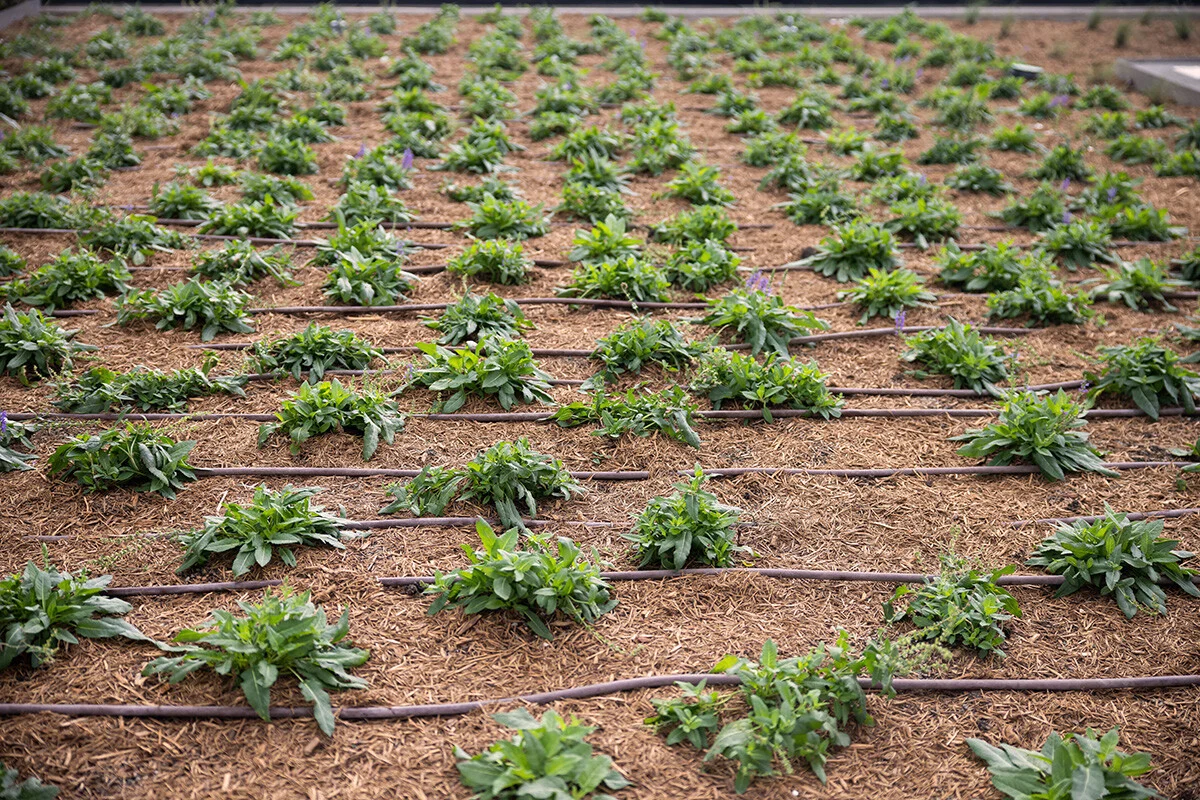
Drip irrigation — the delivery of water directly to the root zone of individual plants through low-flow emitters placed at or near the soil surface — is not a new technology. It has been standard practice in agricultural and commercial landscape applications for decades. Its adoption in Houston residential landscape bed irrigation has been slower than its performance advantage justifies, primarily because Houston irrigation contractors are more familiar with spray systems and because the upfront cost of properly designed drip systems is somewhat higher than spray head installation. The performance difference in Houston's conditions — particularly for ornamental bed health and water efficiency — makes drip the correct specification for most Houston landscape bed irrigation applications.
At Gulf Reserve Landscape & Pools, drip irrigation design and installation for Houston ornamental beds is a standard component of the irrigation systems we design and install across Houston's residential and commercial market. Here is a comprehensive guide to why drip outperforms spray in Houston's conditions and what a properly designed Houston landscape bed drip system actually looks like.
Why Overhead Spray Irrigation Underperforms in Houston Landscape Beds
Understanding the specific ways that overhead spray irrigation underperforms in Houston's ornamental bed environment helps explain why drip's advantages are more pronounced in Houston than in many other markets.
Foliar wetness and fungal disease is the most significant performance problem with overhead spray irrigation in Houston landscape beds. Houston's combination of warm temperatures and high humidity — relative humidity regularly exceeding 80 percent overnight through most of the growing season — creates ideal conditions for the fungal pathogens that cause leaf spot diseases, powdery mildew, and the crown rots that kill ornamental plants in Houston's landscape. Overhead spray irrigation that wets foliage in the afternoon or evening leaves plant surfaces moist through Houston's warm, humid nights — exactly the temperature and moisture conditions that fungal pathogens require to infect plant tissue.
The connection between irrigation timing, foliage wetness, and fungal disease in Houston landscapes is well-established and consistently demonstrated in landscape health assessments across the city. Houston ornamental beds irrigated with overhead spray scheduled for evening or nighttime cycles — the time that minimizes water loss to evaporation but maximizes foliage wetness through the night — develop significantly higher rates of fungal disease than the same plant material irrigated with drip systems that never wet foliage regardless of scheduling. The water efficiency argument for nighttime irrigation in Houston is real. The plant health argument against it is stronger. Drip irrigation resolves this conflict by delivering water to the root zone regardless of scheduling time without ever wetting foliage.
Water waste from overspray and evaporation is the second major performance problem with overhead spray in Houston landscape beds. Spray heads designed for turf coverage — with throw distances of 5 to 15 feet — inevitably overspray bed borders, landing water on adjacent hardscape, mulch surfaces, and the sidewalk and driveway edges that frame Houston residential landscape beds. This overspray delivers no irrigation benefit while contributing to the mineral scale deposits on Houston hardscape that result from the city's hard municipal water evaporating and leaving calcium and magnesium deposits on concrete and stone surfaces.
Evaporation loss from overhead spray in Houston's summer conditions — where ambient temperatures exceed 90 degrees Fahrenheit and low-humidity periods in the afternoon create rapid evaporative drying — removes a significant percentage of the water a spray head delivers before it reaches the soil surface. In Houston's peak summer heat, spray irrigation applied during daytime hours loses 15 to 30 percent of applied water to evaporation before infiltration — a loss that drip irrigation, delivering water at or below the mulch surface directly to the soil, almost entirely eliminates.
Compaction of Houston clay from overhead spray impact is a less-discussed but genuine performance problem in Houston ornamental beds. The impact energy of water droplets falling from overhead spray heads onto exposed Houston clay soil surfaces compacts the surface layer progressively — sealing the surface and reducing the infiltration rate that Houston's already slow-draining clay provides. Drip emitters delivering water at near-zero velocity directly to the soil surface or beneath a mulch layer do not create this impact compaction, maintaining the soil structure that supports ornamental plant root development in Houston's clay.
Mineral scale from Houston's hard water on ornamental plant foliage is both an aesthetic problem and a plant health consideration. Houston's municipal water — supplied primarily by surface water from Lake Houston, the Trinity River, and Lake Livingston — has significant dissolved mineral content, with hardness typically ranging from 100 to 200 parts per million depending on the specific service area and seasonal variation in source water quality. Overhead spray that wets foliage in Houston's ornamental beds deposits these minerals on leaf surfaces as the water evaporates — creating the white mineral scale deposits visible on plants in Houston landscape beds irrigated with spray heads. While not immediately damaging to plant health, persistent mineral deposits on foliage interfere with light absorption and gas exchange and contribute to the generally stressed appearance of ornamental plants in Houston landscape beds where overhead spray has been applied for multiple seasons.
How Drip Irrigation Works in Houston Landscape Beds
Drip irrigation for Houston ornamental beds delivers water through a network of supply tubing and individual emitters placed at or near the root zones of specific plants. The system operates at significantly lower pressure than spray irrigation — typically 15 to 25 PSI compared to 30 to 45 PSI for spray systems — and delivers water at flow rates measured in gallons per hour rather than gallons per minute.
The basic components of a Houston landscape bed drip system are the supply line — typically 1/2-inch poly tubing running from the zone valve to the bed area — the distribution tubing — 1/4-inch spaghetti tubing running from the supply line to individual plant positions — and the emitters themselves — the small devices that regulate flow and deliver water at a defined rate to each plant position.
Emitter selection for Houston landscape bed drip systems balances the flow rate needed to meet each plant's water requirements against the soil infiltration rate that Houston clay provides. Standard pressure-compensating emitters in 0.5, 1.0, and 2.0 gallon-per-hour flow rates are appropriate for most Houston ornamental bed drip applications. Pressure-compensating emitters — which deliver their rated flow regardless of pressure variation across the system — are important for Houston beds with significant elevation changes or long supply line runs where pressure variation would cause non-compensating emitters at different positions to deliver different flow rates.
Emitter placement relative to individual plants in Houston ornamental beds should be at the drip line of the plant rather than at the stem — the drip line being the outer edge of the plant's canopy, where the active root absorption zone is located. Placing emitters at the stem of Houston ornamental plants delivers water to the crown area where it contacts the stem base — a position that promotes the crown rot and stem base fungal diseases that Houston's humidity already encourages. Drip line placement delivers water where it is used most efficiently and with the lowest disease risk in Houston's conditions.
Multi-emitter placement around larger ornamental shrubs and trees in Houston landscape beds accounts for the three-dimensional root zone that larger plants develop. A single emitter for a mature Nellie R. Stevens holly or a large crape myrtle in a Houston landscape bed delivers inadequate water volume and covers insufficient root zone area to support the plant through Houston's demanding summer. Two to four emitters placed at the drip line of large Houston ornamental shrubs — spaced equally around the plant at the drip line radius — provides complete root zone coverage and adequate flow volume for Houston's heat conditions.
Drip System Design for Houston's Clay Soil
Houston's clay soil infiltration rate — 0.1 to 0.2 inches per hour under normal conditions — is the primary soil characteristic that affects drip system design in Houston. The relationship between emitter flow rate and Houston clay infiltration rate determines whether the drip system delivers water that the soil can absorb or creates surface ponding at emitter locations that defeats the infiltration-based delivery advantage drip provides.
Emitter flow rate matching to Houston clay requires selecting emitters whose output rate does not exceed the infiltration capacity of the soil at the emitter location. A 2.0 gallon per hour emitter delivering water continuously at a single point on Houston clay creates a pond at the emitter location — the clay cannot absorb water at that rate from a single point, and water ponds on the surface and runs off rather than infiltrating. A 0.5 gallon per hour emitter at the same location delivers water at a rate the Houston clay can absorb continuously, building a wetted zone that expands slowly through the root zone over the run cycle.
For Houston landscape beds where emitter flow rate needs to be higher than what the clay infiltration rate supports at a single point — large shrubs or trees with high water demand — multiple low-flow emitters distributed around the plant rather than a single high-flow emitter provide adequate total flow while keeping each emitter's individual application rate within Houston clay's absorption capacity.
Run time calculation for Houston drip systems needs to account for the slower, more thorough water delivery that drip provides compared to spray. A Houston landscape bed spray zone that delivers adequate water in 10 to 15 minutes of run time requires 45 to 90 minutes of drip system run time to deliver equivalent water volume at drip's lower flow rates. Houston homeowners and irrigation contractors transitioning from spray to drip need to recalibrate their zone run time expectations accordingly — a drip zone running for only 10 minutes delivers a small fraction of the water a spray zone delivers in the same time and will leave Houston ornamental plants underwatered if run times are not adjusted for the lower flow rate.
Cycle and soak programming for Houston drip zones — running the zone for a defined interval, waiting for a soak period, and then running again — can improve water infiltration into Houston clay beyond what a single continuous run cycle achieves. Clay that has been wetted at the surface by a drip emitter cycle needs time for that water to move downward through the soil profile before the next cycle adds more water at the surface. In Houston's densest clay conditions, a cycle-and-soak approach with two or three shorter run cycles separated by 30 to 60 minute soak intervals achieves better root zone moisture distribution than a single long run cycle of equivalent total duration.
Drip System Components That Matter in Houston's Conditions
The durability and maintenance requirements of Houston landscape bed drip systems depend significantly on component quality and specification — particularly for the elements most exposed to Houston's UV radiation, hard water, and biological growth conditions.
Pressure regulation is essential for Houston drip systems because the municipal water pressure in Houston's residential distribution system — typically 60 to 80 PSI at the meter — far exceeds the 15 to 25 PSI that drip emitters are designed to operate at. Without pressure regulation at the zone valve or the supply line inlet, Houston's municipal pressure forces water through drip emitters at rates that exceed their design flow, delivers inconsistent application across the system, and accelerates emitter wear. A pressure regulator installed at the beginning of each drip zone — maintaining downstream pressure at 20 to 25 PSI regardless of incoming pressure variation — ensures consistent emitter performance across the Houston drip system.
Filtration at the zone inlet prevents the mineral deposits and particulate matter in Houston's municipal water from clogging drip emitters. Houston's water hardness — 100 to 200 ppm dissolved minerals — creates scale deposits inside drip emitter orifices over time if the water is not filtered before it reaches the emitters. A 150-mesh filter at the zone inlet catches mineral particles and debris before they reach the emitters, significantly extending the interval between emitter flushing and replacement maintenance. Houston drip systems installed without filtration develop clogged emitters — delivering less water than specified or no water at all at affected positions — within seasons of installation.
UV-resistant tubing is important for the portions of Houston drip systems that are exposed to direct sunlight rather than buried under mulch. Standard poly tubing degrades in Houston's UV environment — becoming brittle and developing cracks that create leaks — significantly faster than UV-stabilized tubing formulated for above-ground exposure. Houston drip systems where supply line tubing is run across exposed bed surfaces rather than buried under mulch should specify UV-stabilized tubing to avoid the progressive leakage that UV degradation creates.
Check valves at drip zone emitters prevent the low-head drainage that occurs when Houston drip zone water pressure drops to zero at the end of an irrigation cycle — the condition where water drains from the supply line through the lowest-positioned emitters, creating puddles at the lowest bed positions and delivering unintended water to those plant positions between irrigation cycles. Pressure-compensating emitters with integrated check valves prevent this low-head drainage, maintaining the precise water delivery control that makes drip systems more efficient than spray in Houston's conditions.
Drip vs. Spray — Houston Water Savings in Real Conditions
The water efficiency advantage of drip over spray irrigation in Houston ornamental beds is real and measurable — though the specific savings vary by system design, plant material, and Houston's seasonal rainfall patterns.
Texas A&M AgriLife Extension research on drip versus spray irrigation in Texas landscape bed applications has consistently documented water use reductions of 30 to 50 percent for drip systems compared to equivalent spray systems delivering adequate plant water requirements. In Houston's conditions — where the spray evaporation loss, overspray waste, and foliage interception that drip eliminates are all significant — the lower end of this range is conservative for well-designed Houston drip systems.
For Houston commercial properties with large ornamental bed areas — office park entries, retail center landscaping, multifamily community beds — the water cost reduction from converting spray-irrigated beds to drip can represent meaningful annual savings on irrigation water bills. Properties with 5,000 to 10,000 square feet of ornamental bed area converted from spray to drip irrigation in Houston's conditions typically see irrigation water use reductions in those zones of 35 to 45 percent annually — savings that compound over years of operation and offset a significant portion of the drip system installation cost over a 5 to 7 year period.
Drip System Maintenance in Houston
Houston landscape bed drip systems require specific maintenance attention that differs from spray system maintenance — primarily around emitter performance, filter cleaning, and the seasonal adjustments that Houston's climate demands.
Emitter inspection and flushing should be performed twice annually in Houston conditions — at the beginning of the irrigation season in spring and at the end in fall. Emitters that are delivering reduced flow from mineral scale buildup can often be restored by flushing the drip line with elevated pressure — temporarily removing emitter end caps and running the zone at full pressure to flush accumulated scale and debris from the tubing and emitter bodies. Emitters that do not restore to rated flow after flushing should be replaced — the cost of individual emitter replacement is minimal and maintaining accurate, consistent emitter performance across the Houston drip system ensures that water is delivered where the plants need it.
Filter cleaning at zone inlets should occur at the same frequency as emitter inspection — twice annually minimum in Houston's conditions, more frequently on systems serving Houston commercial properties where higher system run times accelerate mineral and particulate accumulation in filters. A clogged zone filter reduces pressure throughout the drip zone, causing all emitters in that zone to deliver below their rated flow. Filter cleaning is a 5-minute maintenance task that prevents the underwatering that reduced emitter flow causes.
Seasonal run time adjustment for Houston drip systems follows the same principles as spray system seasonal adjustment — reducing run times as Houston moves through fall and winter and increasing them as summer approaches. The absolute run times for drip zones are longer than spray zones delivering equivalent water, but the seasonal adjustment proportions are similar — reducing spring and fall run times by 30 to 40 percent from summer levels maintains appropriate root zone moisture without the overwatering that fixed summer schedules produce in Houston's cooler seasons.
Annual tubing inspection identifies supply line and distribution tubing that has been damaged by Houston's landscape maintenance activities — mowing equipment cutting exposed supply lines, string trimmer damage at bed edges, and root penetration of distribution tubing from aggressive Houston ornamental shrubs. Damaged tubing creates leaks that waste water and deliver it to non-target locations rather than the plant root zones the system was designed to serve. Identifying and repairing tubing damage annually — before the irrigation season begins — ensures the system operates as designed through Houston's peak demand period.
When to Specify Drip vs. Spray for Houston Irrigation Zones
Not every Houston irrigation application is better served by drip — understanding when drip is the correct specification and when spray remains appropriate guides the design of Houston irrigation systems that use each technology where it performs best.
Drip is the correct specification for Houston ornamental planting beds with defined plant material — established shrubs, perennials, trees, and groundcovers where individual plant root zones can be targeted with emitter placement. It is the correct specification for Houston beds with plant material susceptible to foliar fungal diseases — roses, ornamental grasses, foundation plants in high-humidity microclimates. It is correct for Houston beds adjacent to hardscape where overspray from spray heads would deposit mineral scale on concrete, stone, or pavers. And it is correct for Houston commercial properties where water cost management and plant health documentation are performance metrics that irrigation efficiency directly affects.
Spray remains appropriate for Houston turf areas where the uniform coverage requirements of lawn irrigation cannot be achieved with drip's point-source delivery. It remains appropriate for newly seeded or sodded Houston lawn areas during establishment where uniform surface moisture across the entire area — not just at individual plant positions — is the establishment irrigation requirement. And it remains appropriate for large-scale groundcover beds in Houston where the plant density is too high for individual emitter placement and the low growth habit makes foliar wetness less consequential for disease risk than it is for taller ornamentals.

Gulf Reserve Landscape & Pools designs and installs drip irrigation systems for Houston landscape beds as part of comprehensive irrigation system installations and as standalone upgrades to existing Houston spray systems. Every drip system we design is calibrated for Houston's clay soil infiltration rate, water pressure conditions, and plant material water requirements.
Request your free estimate at gulfreservelandscaping.com — and let's upgrade your Houston landscape bed irrigation to a system that actually works with Houston's conditions rather than against them.


