




Concrete Work for Houston Outdoor Living Spaces — What Patios, Walkways, and Flatwork Actually Require in Gulf Coast Conditions
Is the concrete on your Houston outdoor living space doing what it should — or are you looking at cracks, surface scaling, or sections that have shifted and separated from adjacent flatwork? Concrete is the most widely used outdoor living space material in Houston's residential market and the one whose performance varies most dramatically based on whether the installation was designed and built for Houston's specific conditions or simply poured to generic standards that do not account for what Gulf Coast clay soil, rainfall intensity, and UV exposure actually do to concrete over a 20 to 30 year service life.
The gap between Houston concrete work that lasts and concrete work that requires significant repair or replacement within a decade is almost entirely in the decisions made before the first yard of concrete is poured — subgrade evaluation, base material depth, reinforcement specification, mix design for Houston's heat curing conditions, and the drainage design that manages the water that Houston's 50-plus inches of annual rainfall generates around and beneath concrete surfaces. These decisions are invisible in the finished installation and easy to skip in the interest of reducing project cost. Their consequences are visible in every cracked, shifted, and deteriorating Houston concrete outdoor living space that was built without them.
At Gulf Reserve Landscape & Pools, concrete work is one of our core services across Houston's residential and commercial market — covering patios, walkways, pool surrounds, driveways, steps, and the full range of flatwork that outdoor living spaces require. Here is what concrete work done correctly for Houston's conditions actually looks like.
The Houston Concrete Work Performance Requirements
Before getting into specific applications, establishing what Houston's conditions demand from any outdoor concrete installation frames the evaluation correctly and explains why Houston-specific concrete specifications differ from generic residential concrete standards.
Clay soil movement resistance is the performance requirement that most differentiates Houston from average concrete markets. Houston's expansive clay generates the shrink-swell forces that crack, shift, and separate concrete flatwork that was not designed with adequate base depth, reinforcement, and control joint placement to accommodate these forces. As covered in detail in Blog 02, the shrink-swell cycle in Houston's native clay is aggressive and continuous — affecting concrete flatwork through every wet season and dry period for the entire service life of the installation.
Heat and UV resistance in Houston's summer conditions affects concrete surface quality in ways that generic mix designs and curing practices do not adequately address. Concrete placed in Houston's summer heat — where ambient temperatures regularly exceed 95 degrees Fahrenheit and direct sun surface temperatures on fresh concrete exceed 120 degrees — loses surface moisture so rapidly that the top layer cures before the interior, creating surface scaling and a weakened slab face that progressively deteriorates under foot traffic and weather exposure. Houston-specific curing practices — moisture retention compounds applied immediately after finishing, shading of fresh concrete during peak summer heat — prevent the surface quality problems that rapid moisture loss creates.
Drainage performance from concrete surfaces needs to manage Houston's intense rainfall volumes — the 3 to 5 inch events that occur multiple times annually — without ponding on the surface, channeling at erosion-vulnerable edges, or concentrating water against foundation walls or into landscape areas that cannot manage the volume Houston's storms generate.
Concrete Patio Design and Installation for Houston Outdoor Living Spaces
The concrete patio is the foundation of most Houston outdoor living spaces — the surface that defines the primary activity area, supports outdoor furniture and equipment, and establishes the spatial relationship between the house and the surrounding landscape. Getting the concrete patio right on a Houston property requires decisions across every component of the installation from subgrade to surface finish.
Subgrade preparation for Houston concrete patios starts with an honest evaluation of what the native soil is doing — compaction level, moisture content, and any areas of poor bearing capacity that need to be addressed before base material is placed. Houston clay that has been compacted by construction equipment or that has consolidated over years of use has a bearing capacity adequate for residential patio loads when properly assessed — but soft, recently disturbed, or poorly consolidated Houston clay needs to be addressed through compaction or replacement before a base material that will support a concrete slab can be established above it.
Base material specification for Houston concrete patios is 6 inches of compacted crushed limestone as the minimum standard for residential applications — increased to 8 inches on Houston properties in Pearland, League City, and other areas with particularly expansive Lake Charles clay conditions. The crushed limestone base serves two functions simultaneously — it provides the stable, non-settling foundation platform that the concrete slab needs above it, and it creates a drainage layer that moves water away from the subgrade interface where moisture accumulation accelerates clay movement forces on the slab.
Reinforcement specification for Houston concrete patios is No. 4 rebar at 16 inches on center in both directions, placed on chairs to maintain a centered position in the slab thickness — not wire mesh laid on the ground, which provides minimal tensile reinforcement and typically ends up at the bottom of the slab rather than centered where it can actually resist the flexural loading that Houston's clay movement creates. The rebar specification for Houston patios near significant trees — where root pressure and clay heaving combine to produce more aggressive slab loading — should be tightened to 12 inches on center spacing with thickened slab sections at 5 inches rather than the standard 4-inch residential thickness.
Mix design for Houston conditions specifies a minimum 3,500 PSI concrete strength for outdoor living space applications — higher than the 3,000 PSI minimum adequate for some Houston flatwork applications because patio surfaces receive the direct UV, chemical, and weathering exposure that accelerates surface deterioration in lower-strength mixes. Water-to-cement ratio of 0.45 or lower produces the dense, low-permeability concrete that resists the surface scaling and penetration of Houston's rainfall and biological growth agents over a long service life.
Control joint placement for Houston concrete patios needs to account for both the thermal expansion and contraction that Houston's temperature range creates and the clay movement forces that Houston's wet-dry cycles generate. Control joints at intervals no greater than 10 feet in either direction for standard 4-inch residential patio slabs — tighter spacing in areas with aggressive clay conditions or high sun exposure that creates larger thermal gradients across the slab — give the concrete a predetermined location to accommodate movement rather than developing random fractures across the patio surface.
Concrete Surface Finish Options for Houston Outdoor Living Spaces
The surface finish of Houston concrete outdoor living spaces affects both the aesthetic quality of the finished installation and the thermal and slip performance that determines how comfortable and safe the surface is in Houston's conditions.
Broom finish is the standard concrete surface finish that provides slip resistance through texture and is the most widely used finish on Houston residential concrete. Its limitation in Houston's outdoor living context is primarily aesthetic — standard gray broom-finished concrete reads as utilitarian against Houston's residential architecture and landscape character, and its relatively smooth surface between the broom marks provides less biological growth resistance than more textured alternatives in Houston's humid conditions.
Exposed aggregate is the surface finish that Gulf Reserve most consistently recommends for Houston outdoor living space concrete — the finish that provides the best combination of thermal performance, slip resistance, aesthetic quality, and biological growth resistance available in Houston's concrete market. The rounded aggregate exposed at the surface — pea gravel, quartz, or river stone — scatters rather than absorbs solar radiation, keeping the surface meaningfully cooler than smooth concrete in Houston's direct summer sun. The irregular surface texture provides excellent slip resistance in Houston's wet conditions. And the visual quality of exposed aggregate reads as considerably more refined than broom finish against Houston's residential and landscape context.
Stamped concrete in flagstone, cobblestone, or tile patterns provides the aesthetic of natural stone at a lower installed cost than natural stone work — and requires more maintenance in Houston's conditions than either broom finish or exposed aggregate. The integral color and surface release agent that produce stamped concrete's appearance require resealing every 2 to 3 years in Houston's UV environment to maintain color vibrancy and surface protection. Houston homeowners who commit to this maintenance program get a consistently attractive surface. Those who defer resealing find that color fade and surface wear develop on timescales that reflect Houston's aggressive UV and weather exposure.
Colored concrete through integral pigment or color hardener expands Houston concrete outdoor living space design beyond the gray palette of standard mixes. Warm buff, cream, and tan tones — the colors that complement Houston's architectural character and landscape materials most naturally — reflect more solar radiation than standard gray and stay cooler in Houston's direct summer sun. These warm neutral tones also read as more residential and intentional against Houston's landscape context than the utilitarian gray of standard concrete.
Concrete Walkways and Steps for Houston Properties
Concrete walkways and steps on Houston properties connect outdoor living spaces to each other and to the house entry — functional elements that are used daily and that need to perform correctly in Houston's weather conditions while maintaining the aesthetic quality that the overall outdoor living space requires.
Walkway width for Houston residential applications should reflect actual usage patterns rather than minimum functional dimensions. A 36-inch walkway — the minimum comfortable width for single-file pedestrian use — is inadequate for the primary entry approach to a Houston home where guests arrive alongside the homeowner rather than in single file. Primary entry walkways on Houston residential properties should be a minimum of 48 inches wide — 60 inches on properties where the entry approach is a prominent architectural feature — to accommodate two people walking side by side comfortably.
Step design for Houston concrete outdoor living applications requires specific attention to the dimensional relationships between rise and run — the vertical and horizontal dimensions of each step — that determine whether steps feel natural and comfortable to ascend and descend or awkward and potentially hazardous. The standard comfortable outdoor step proportion for Houston residential applications is a 6-inch rise and 12 to 14-inch run — the relationship that produces a natural stride length and comfortable footing on exterior steps used in the range of footwear and conditions that Houston's outdoor living environment creates.
Step nosing — the slight projection of the horizontal tread surface beyond the vertical riser face — is the detail that defines the edge of each step and provides the visual cue that helps users judge the step location. A 1-inch nosing on Houston concrete steps, formed with a bull-nose edge tool while the concrete is still workable, creates the defined step edge that reads clearly in the lighting conditions — including Houston's nighttime outdoor living environment — where steps are most commonly misjudged.
Concrete and Natural Stone Integration in Houston Outdoor Living Spaces
The most visually compelling Houston outdoor living space concrete installations integrate concrete with natural stone elements — using concrete for the primary flatwork areas where its cost efficiency and design flexibility are appropriate and natural stone for the border, coping, step, and feature elements where stone's material quality and visual character elevate the overall composition.
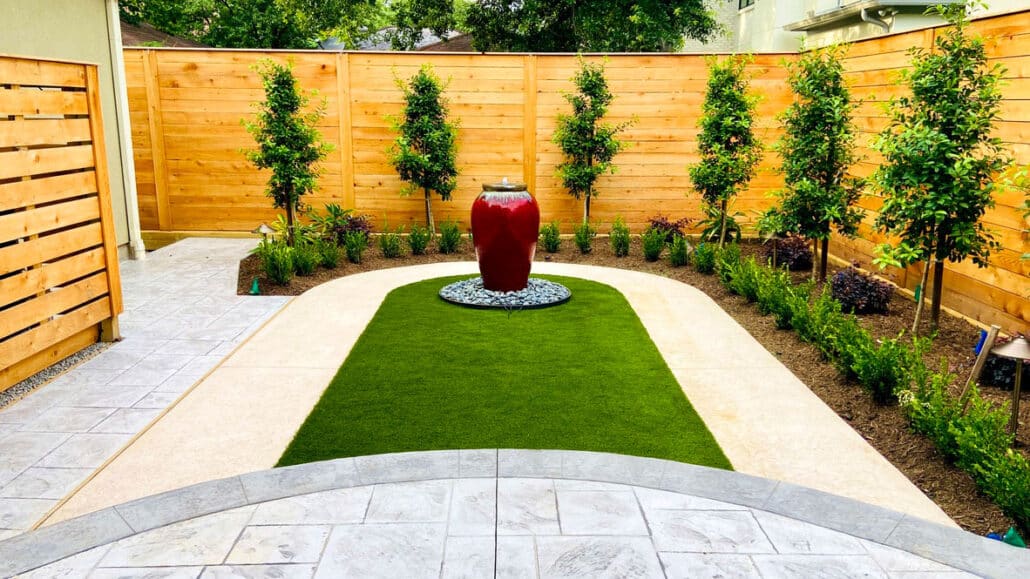
A Houston outdoor living space patio in exposed aggregate concrete with natural limestone border and step elements — the limestone providing a warm, refined edge treatment against the aggregate field — delivers a combination of material quality and cost efficiency that neither material alone achieves as completely. The limestone border reads as premium and architecturally considered. The exposed aggregate field provides the thermal performance and biological growth resistance that the primary activity surface requires. Together they produce an outdoor living space that looks more designed and more expensive than its actual cost because the material combination is more sophisticated than either material used uniformly.
This integration approach — concrete for field areas, natural stone for edges and features — is the specification that Gulf Reserve most consistently recommends for Houston outdoor living space projects where the budget does not support full natural stone coverage but where the aesthetic quality of an all-concrete installation does not meet the design standard the property requires.
Concrete Work and Drainage Integration for Houston Outdoor Living Spaces
Every concrete outdoor living space installation in Houston creates a defined impervious surface area that sheds rainfall at Houston's intensity — and every Houston concrete installation therefore requires drainage design that manages the water those surfaces generate rather than allowing it to pool, erode, or concentrate in ways that damage the surrounding landscape and the concrete installation itself.
Surface drainage slope calibration for Houston concrete outdoor living spaces needs to reflect the specific drainage outlets available for the surface water the concrete generates. A Houston patio that slopes toward the house rather than away from it — the negative grade condition that is common on Houston properties where original grading has settled or was inadequate — directs every Houston rain event's roof and surface runoff toward the foundation rather than away from it. Correcting negative grade at concrete outdoor living spaces during installation — when the subgrade is prepared and accessible — is the moment when this correction is least expensive and most effective.
Perimeter channel drains at the edges of Houston concrete outdoor living spaces — particularly at the transition between concrete and lawn areas where the drainage velocity from a large concrete surface during a Houston rain event can erode the lawn edge — intercept and collect surface runoff before it reaches the adjacent landscape. Channel drains at Houston concrete patio perimeters are connected to the property's broader drainage infrastructure — French drain networks, storm drainage connections, or grade-directed outlets — rather than simply releasing collected water at the patio edge where it recreates the problem the drain was designed to solve.
How to Evaluate Houston Concrete Work Contractor Proposals
Houston concrete work proposals for outdoor living space projects vary enormously in what they include — and the price differences between proposals often reflect genuine scope differences rather than contractor markup differences. Understanding what distinguishes a comprehensive Houston concrete work proposal from one that is missing the components that determine long-term performance allows Houston homeowners to evaluate proposals on value rather than simply selecting the lowest number.
Ask every Houston concrete contractor specifically what base depth they are proposing and how they will prepare the subgrade. Six inches of compacted crushed limestone on properly evaluated subgrade is the minimum adequate specification for Houston residential outdoor living space concrete. Responses that are vague about base depth or that default to whatever is standard without specifying a number indicate a proposal that may not include adequate base preparation for Houston's clay conditions.
Ask about reinforcement specification. No. 4 rebar at 16 inches on center placed on chairs centered in the slab is the correct answer for Houston outdoor living space concrete. Wire mesh or no reinforcement are answers that indicate undersized reinforcement for Houston's soil movement conditions.
Ask about control joint spacing and how it will be addressed — saw cutting after placement or formed joints during placement are both acceptable approaches, but the contractor should have a specific plan rather than a generic assurance that the work will be done correctly.
Ask about drainage slope and how surface water will be managed from the finished concrete area. A contractor who does not address drainage design is leaving the most consequential long-term performance variable unresolved in Houston's high-rainfall environment.

Not sure whether your Houston outdoor living space needs concrete work, stone work, or a combination of both? Gulf Reserve Landscape & Pools assesses every Houston property personally — evaluating soil conditions, drainage, and the specific site requirements before recommending materials or specifications — so the concrete work we build performs the way Houston's conditions demand.
Get your free estimate at gulfreservelandscaping.com


