




Concrete Work for Houston Commercial Properties — What Driveways, Walkways, and Flatwork at Commercial Scale Actually Require
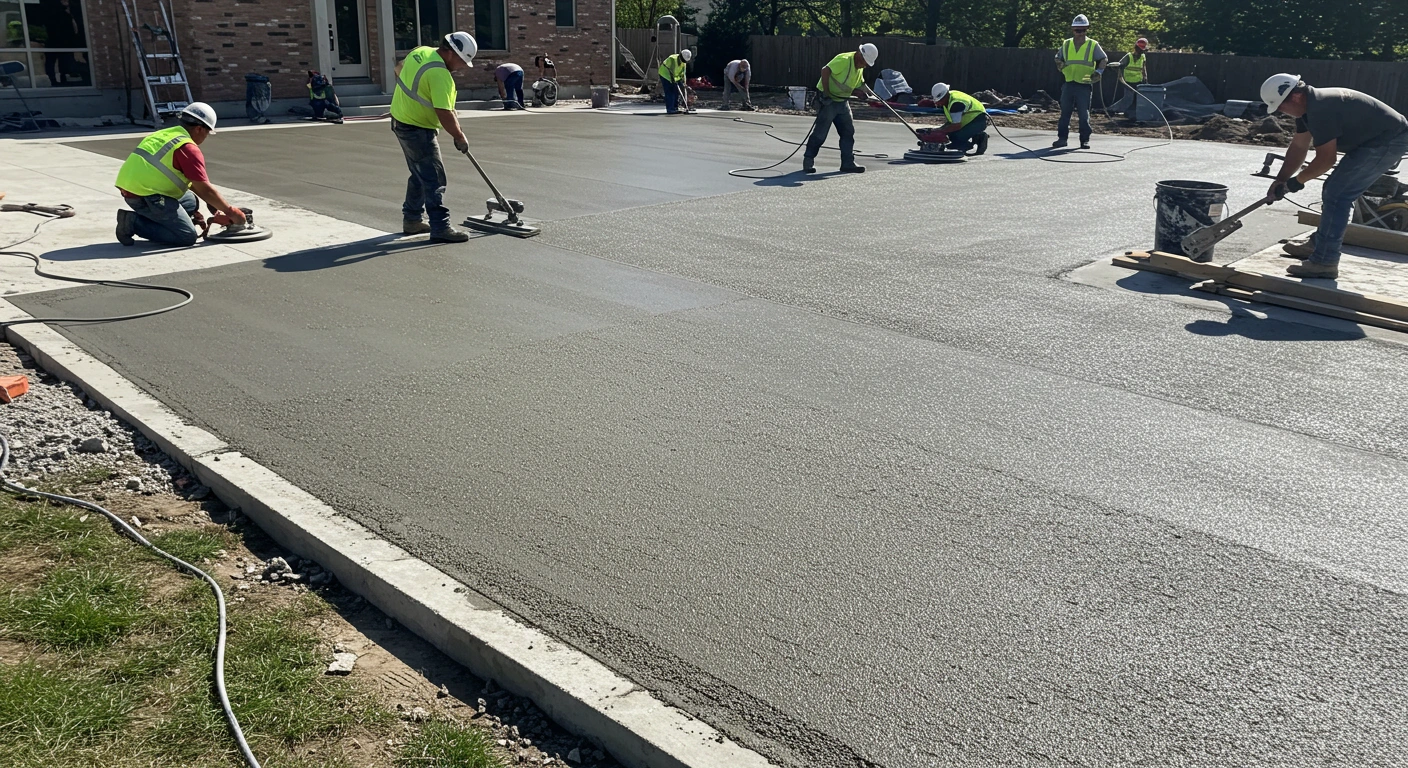
Is the concrete on your Houston commercial property holding up the way it should — or are you managing the cracked entry approaches, settled walkways, and deteriorating flatwork that inadequate base preparation and reinforcement produce on Houston commercial properties over the first 5 to 15 years of service? Commercial concrete failure in Houston follows the same predictable patterns that residential concrete failure does — clay soil movement on inadequately prepared subgrades, reinforcement that was not specified for Houston's actual soil conditions, and drainage that was not designed to manage the water volumes Houston's rainfall generates around and beneath concrete surfaces — but at a scale and visibility that makes the consequences more financially significant and more damaging to the property's market positioning.
The gap between Houston commercial concrete that performs correctly for 25 to 30 years and concrete that requires significant repair or replacement within a decade is almost entirely in the decisions made before the first yard of concrete was poured — subgrade evaluation, base depth, reinforcement specification, mix design for Houston's conditions, control joint placement, and drainage design that manages Houston's rainfall away from and beneath concrete surfaces. On commercial properties where these decisions were made correctly at installation, the concrete performs. On properties where they were not — the majority of Houston commercial concrete installed to production standards rather than Houston-specific standards — the deterioration timeline is predictable and the remediation cost is significant.
At Gulf Reserve Landscape & Pools, commercial concrete work — new installation, repair, and replacement of driveways, entry approaches, walkways, plazas, and flatwork on Houston commercial properties — is part of our concrete work and commercial maintenance contract services. Here is what commercial concrete done correctly for Houston's conditions actually looks like.
Why Houston Commercial Concrete Fails at Higher Rates Than It Should
Houston commercial concrete fails at higher rates than the material's inherent durability warrants — and understanding the specific failure modes that Houston's environment creates for commercial concrete helps property managers identify whether their property's concrete deterioration reflects normal wear or preventable failure.
Base preparation inadequacy is the primary cause of commercial concrete failure in Houston — the condition where concrete was placed over inadequately compacted subgrade or insufficient base depth that cannot resist Houston's clay soil movement forces over years of wet-dry cycling. Commercial concrete entry approaches, parking areas, and plaza surfaces on Houston properties that were installed with 2 to 4 inch base depths rather than the 6 to 8 inch minimum that Houston's conditions demand develop the voids and bearing capacity loss beneath them that produce cracking and settlement — typically visible within 5 to 10 years of installation and requiring significant repair or replacement by years 10 to 15.
Reinforcement undersizing for commercial applications in Houston — where vehicle loads, maintenance equipment loads, and the clay movement forces that Houston's soil generates exceed what residential reinforcement specifications account for — produces concrete that cracks under the combination of loading and soil movement that commercial use creates. Commercial Houston concrete entry approaches and drives that receive regular delivery vehicle loads need No. 5 rebar at 12 inches on center — heavier than the residential standard — to provide the crack resistance that these load conditions demand in Houston's clay soil environment.
Drainage concentration against and beneath Houston commercial concrete surfaces is the failure mode that most consistently surprises commercial property managers who understood that their concrete was properly reinforced and based but did not anticipate the accelerated clay movement that concentrated drainage produces. Roof drainage, parking lot runoff, and landscape irrigation that concentrates water against or beneath commercial concrete surfaces in Houston saturates the clay subgrade repeatedly — producing more aggressive shrink-swell cycling beneath the concrete than the surrounding, less-saturated clay generates. This concentrated drainage effect is why Houston commercial concrete adjacent to downspout discharge points, at low points in parking areas, and at the base of slopes that concentrate runoff consistently deteriorates faster than adjacent concrete in the same installation.
Commercial Concrete Applications on Houston Properties
Commercial concrete work on Houston properties addresses the specific flatwork components where concrete quality and installation standards most directly affect the property's safety, functionality, and market positioning.
Entry drive and approach concrete is the highest-visibility commercial concrete application on Houston properties — the surface that every arriving tenant, customer, and visitor encounters first and that communicates the property's maintenance standard before they reach the building. Entry drive concrete on Houston commercial properties needs to meet the loading requirements of the vehicle types that use it — light passenger vehicles for most Houston commercial entries, with heavier loading standards for properties that receive regular delivery truck access — and the appearance standard that the property's market positioning requires.
For Houston commercial properties where the entry drive and approach currently has the cracking, settlement, and surface deterioration that inadequate original specification produced, the replacement decision — whether to repair or replace — follows the structural assessment framework established earlier in this blog. Entry concrete with base failure requires replacement with properly specified installation. Entry concrete with surface deterioration on an adequate base may be a resurfacing candidate — though the resurfacing service life in Houston's conditions needs to be factored into the cost-benefit calculation.
Pedestrian walkway and plaza concrete on Houston commercial properties — the surfaces that tenant employees and customers use on every visit — needs to combine the functional performance of adequate drainage slope and slip-resistant surface texture with the aesthetic quality that commercial property presentation requires. Standard broom-finished gray concrete on Houston commercial pedestrian surfaces is functionally adequate but aesthetically generic — the finish that communicates minimum investment rather than quality intention. Exposed aggregate or brushed concrete with refined borders communicates investment and care at the same cost level that standard broom finish requires when the specification is established at installation rather than added as an upgrade after the standard finish decision has been made.
Loading dock and service area concrete on Houston commercial properties — the flatwork that receives the concentrated vehicle loads, forklift traffic, and heavy equipment use that service operations generate — requires the highest-specification concrete on the property. Loading dock concrete on Houston commercial properties needs the 8-inch minimum base depth, No. 5 rebar at 12 inches on center, and 4,000 PSI minimum concrete strength that heavy vehicle loads and frequent loading cycles demand. This is the commercial concrete application where undersized specification produces the fastest and most consequential failure — loading dock concrete that cracks under forklift loads within the first few years of use because it was specified to residential rather than commercial standards.
Curbing and edging concrete on Houston commercial properties — the concrete elements that define parking area edges, planting bed borders, and hardscape transitions — requires the same base preparation and reinforcement philosophy as primary flatwork at smaller scale. Concrete curbing on Houston commercial properties that was placed without adequate base preparation develops the differential settlement and cracking that separates curb from adjacent paving and creates the trip hazards and drainage failures that commercial property liability management requires to address promptly.
Repair vs. Replacement for Houston Commercial Concrete
The repair versus replacement decision for Houston commercial concrete follows the structural assessment framework that distinguishes base failure from surface deterioration — with the commercial-scale consideration that the cost of incorrect assessment in either direction is more significant than at residential scale.
Surface deterioration without base failure — scaling, surface cracking limited to the top inch of the slab, and color fade that does not reflect structural compromise — may be addressable through resurfacing with appropriate overlay systems. Houston commercial concrete resurfacing with polymer-modified overlays provides a restored surface appearance and improved surface durability at a cost below full replacement — but requires the honest assessment that the base and structural condition of the existing concrete can support the overlay without the continued movement that would crack the overlay surface as quickly as it cracked the original concrete.
Base failure with visible structural cracking — diagonal cracking at re-entrant corners, differential settlement between adjacent sections, and the slab rocking that indicates voids beneath the concrete — requires replacement rather than resurfacing. Overlaying structurally compromised Houston commercial concrete produces a resurfaced appearance that cracks along the same lines as the concrete beneath it within one to two years — the outcome that commercial property managers discover when resurfacing was applied to concrete that needed replacement.
Partial replacement of failed sections — removing and replacing the specific areas of Houston commercial concrete that have failed structurally while retaining adjacent areas that are in acceptable condition — is the cost-effective approach for commercial properties where base failure is localized rather than systemic. Partial replacement requires careful match of the new concrete surface finish and color to the adjacent existing concrete — a specification challenge in Houston's market where color and texture matching of aged concrete requires experience and material knowledge that not all commercial concrete contractors apply consistently.
Drainage Design for Houston Commercial Concrete
Drainage design for Houston commercial concrete flatwork is the specification component that most directly affects service life and that most frequently receives inadequate attention at installation — the gap that produces the accelerated deterioration that concentrated drainage against and beneath commercial concrete creates in Houston's high-rainfall environment.
Surface drainage slope calibration for Houston commercial concrete needs to account for the full range of water inputs that commercial surfaces receive — not just the rainfall that falls directly on the concrete surface but the roof drainage, landscape irrigation overspray, and adjacent surface runoff that concentrates against and across commercial flatwork during Houston rain events. Surface slopes of 1 to 2 percent toward defined drainage outlets provide adequate drainage for most Houston commercial concrete applications — with steeper slopes at locations where concentrated drainage inputs require faster surface water removal.
Perimeter drainage collection at the edges of Houston commercial concrete areas — channel drains that intercept surface runoff before it reaches adjacent landscaping or foundation areas — is the drainage infrastructure that most consistently distinguishes Houston commercial concrete installations that perform correctly from those that develop the accelerated base deterioration that concentrated drainage produces. Channel drains at the perimeter of Houston commercial entry drives, plaza areas, and loading dock approaches are not optional infrastructure on properties where the concrete investment needs to perform for 25 to 30 years.
Subgrade drainage beneath Houston commercial concrete on properties with shallow water tables or persistent subsurface moisture — the Pearland, League City, and lower-elevation Houston suburban commercial markets where seasonal water table rise affects foundation conditions — provides the positive drainage that prevents hydrostatic pressure buildup beneath commercial concrete slabs from the subsurface water conditions that surface drainage design alone cannot address.
Commercial Concrete Maintenance Program
Houston commercial concrete maintenance follows a proactive inspection and repair program that catches developing joint deterioration, minor cracking, and drainage blockage before they progress to the structural failure that requires the replacement spending that proactive maintenance avoids.
Annual joint inspection and sealing on Houston commercial concrete — evaluating control joint condition and reapplying joint sealant before joint deterioration allows water infiltration into the base — is the maintenance intervention with the highest return on investment for Houston commercial concrete service life extension. Control joints that are maintained in sealed, functional condition prevent the water infiltration that accelerates clay movement beneath commercial concrete in Houston's rainfall environment. Joints that are allowed to deteriorate open the base to the concentrated moisture cycling that produces the differential settlement and cracking that joint maintenance prevents.
Crack sealing on minor surface cracking — addressing cracks that have not yet reflected base failure with appropriate crack sealant before water infiltration through them reaches the base — extends the service life of Houston commercial concrete that is structurally adequate but showing the surface cracking that Houston's thermal cycling produces. Minor crack sealing is maintenance-level spending that prevents repair-level spending when the cracks that are sealed today become the moisture infiltration paths that produce base deterioration tomorrow.

Not sure whether the concrete on your Houston commercial property needs repair, resurfacing, or replacement? Gulf Reserve Landscape & Pools assesses Houston commercial concrete personally — evaluating base condition, structural integrity, and drainage performance before recommending any scope of work — so the investment you make produces durable results rather than a repair cycle that repeats.
Get your free estimate at gulfreservelandscaping.com


