



Commercial Landscaping Maintenance in Houston — What a Proper Contract Covers and What Property Managers Should Actually Demand
The commercial landscape maintenance market in Houston is one of the most competitive and most inconsistent service categories in the city's real estate industry. Property managers across Houston's office parks, retail centers, multifamily developments, and medical campuses have experienced the same cycle repeatedly — a low-bid contractor wins the maintenance contract, performs adequately for the first few months while the relationship is new, and gradually reduces service quality as the contract year progresses. Mowing frequency slips. Edging becomes inconsistent. Irrigation issues go unreported and unaddressed. Seasonal color is installed late or skipped entirely when the contractor's schedule gets tight. By renewal time the property looks noticeably worse than it did at contract signing and the property manager is evaluating bids again.
This cycle is not inevitable. It is the predictable outcome of a procurement process that prioritizes unit price over service scope, experience over lowest bid, and short-term cost over the long-term property value that quality landscape maintenance protects. Houston commercial properties where landscape maintenance is managed correctly — with detailed scope specifications, defined performance standards, regular site walks, and a maintenance partner who understands Houston's specific climate and soil demands — consistently outperform comparable properties where maintenance is managed as a commodity purchase.
At Gulf Reserve Landscape & Pools, commercial maintenance contracts are one of our core service offerings across Houston's commercial and multifamily property market. Here is what a proper Houston commercial landscape maintenance contract actually covers — and what the difference between adequate and excellent maintenance means for Houston commercial property performance.
Why Houston Commercial Landscape Maintenance Is More Demanding Than Most Markets
Houston's climate creates commercial landscape maintenance demands that exceed what property managers in most other American markets deal with — and that most commercial maintenance contracts written for generic markets do not adequately address.
Houston's year-round growing season means that warm-season turf, ornamental plantings, and weed pressure are all active for 9 to 10 months of the year rather than the 5 to 6 months that northern market maintenance programs are designed around. A Houston commercial property requires mowing from March through November — and in mild years through portions of December and February as well. Irrigation systems run for more of the year. Weed pressure is active nearly year-round in Houston's warm, humid conditions. Pest and disease monitoring needs to happen continuously through the growing season rather than being concentrated in a few critical months.
Houston's rainfall intensity means that commercial properties experience drainage stress during the city's frequent heavy rain events in ways that affect both the landscape's appearance and the turf's health. A Houston commercial property that looks excellent in dry weather but holds standing water for days after every significant rain event sends a visible maintenance quality signal to tenants, customers, and visitors that is difficult to overcome with otherwise high maintenance standards. Drainage management — keeping channel drains and area drains clear, reporting drainage problems before they become visible landscape damage, and adjusting irrigation scheduling after rain events — is a Houston-specific maintenance responsibility that generic commercial maintenance programs often underemphasize.
Houston's soil pH and clay conditions affect commercial landscape maintenance in ways that require Houston-specific knowledge to manage correctly. Commercial turf areas in Houston that are fertilized with generic balanced fertilizers without pH management develop the iron chlorosis and nutrient lockout that makes Houston alkaline soil so challenging for ornamental and turf performance. A maintenance contractor who does not understand Houston soil chemistry is fertilizing commercial properties with products that provide minimal benefit relative to cost and that leave the underlying pH problem unaddressed.
Houston's pest and disease pressure — chinch bugs, white grubs, take-all root rot, and the fungal diseases that Houston's humidity enables — requires proactive monitoring and timely intervention that a maintenance contractor who visits weekly for mowing but does not perform systematic pest monitoring misses until damage is visible and extensive. On a large Houston commercial property, a chinch bug infestation that is not caught within two weeks of initial establishment can damage thousands of square feet of turf before the maintenance contractor reports it.
What a Proper Houston Commercial Landscape Maintenance Scope Includes
The scope of a Houston commercial landscape maintenance contract determines what the property actually receives — and the gaps between what a low-bid contract specifies and what a comprehensive contract covers are where commercial property appearance and health deteriorate over time.
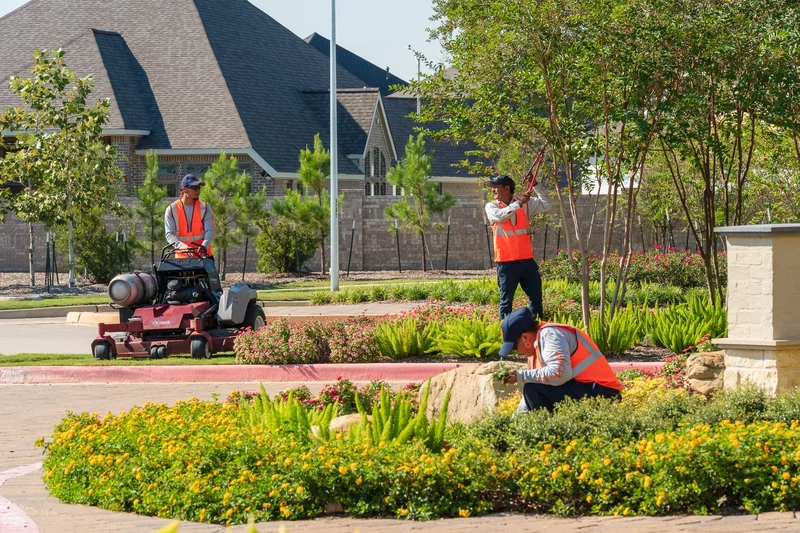
Turf maintenance on Houston commercial properties encompasses mowing at the correct frequency and height for the specific grass variety, edging at all hardscape transitions and bed borders, blowing clippings from hardscape surfaces after mowing, and string trimming around obstacles that mowing equipment cannot reach. The details within these standard line items matter more than the line items themselves. Mowing frequency — the number of mowing events per month during Houston's peak growing season — directly determines whether the commercial turf maintains a groomed appearance between visits or grows to an unkempt height that requires scalping to return to standard. Houston's peak growing season typically demands 4 to 5 mowing events per month to maintain commercial appearance standards. Contracts that specify monthly visits or vague language about mowing "as needed" without defined frequency minimums are contracts that will under-deliver on turf appearance during Houston's active growing season.
Mowing height specification for Houston commercial turf is a detail that separates contractors who understand the grass from those who simply mow it. St. Augustine turf on Houston commercial properties should be maintained at 3.5 to 4 inches — the height that shades the soil, suppresses weeds, and supports the root depth that makes the turf resilient during Houston's dry periods. Commercial turf consistently mowed below 3 inches in Houston becomes thin, stress-prone, and weed-susceptible in ways that require remediation expenditures that far exceed the cost of correct mowing height maintenance from the beginning.
Ornamental bed maintenance on Houston commercial properties includes monthly edging at all bed borders to maintain clean lines between turf and planting beds, weed control through both pre-emergent applications and hand removal of established weeds, mulch condition monitoring and refresh as needed to maintain the 3-inch mulch depth that conserves moisture and suppresses weeds in Houston's conditions, and debris removal from bed surfaces after wind events and Houston's heavy oak leaf drop periods.
The frequency and quality of ornamental bed weeding is one of the most visible maintenance quality differentiators on Houston commercial properties. Bed edges that are clearly defined and weed-free read as actively maintained and well-managed. Beds with weed encroachment from the turf edge, established weeds competing with ornamental plantings, and mulch that has decomposed below functional depth communicate neglect that affects the overall property impression regardless of turf maintenance quality.
Seasonal color installation and maintenance on Houston commercial properties — the rotation of annual flowering plants in prominent entry, signage, and feature planting areas — is one of the highest-visibility aspects of commercial landscape maintenance and one of the areas where cost-cutting is most visible to property visitors. Houston's climate supports three seasonal color rotations annually — fall and winter color installed in October and November, spring color installed in late February and March, and summer color installed in May — with plant selection calibrated for Houston's specific seasonal temperature and humidity conditions at each rotation.
Seasonal color selection for Houston commercial properties needs to reflect Houston's specific performance data rather than generic recommendations. Petunias that perform excellently in Houston's spring color rotation become heat-exhausted and look poor by June in Houston's summer conditions. Pentas and vinca that thrive in Houston's summer heat would not survive the winter color rotation. Ornamental kale and pansies that excel in Houston's fall and winter color program are damaged by the heat of a late September installation before Houston's first cold front arrives. Knowing Houston's specific seasonal plant performance calendar and timing rotations to match Houston's actual season transitions — rather than national retail availability cycles — is the knowledge that separates quality Houston commercial seasonal color programs from mediocre ones.
Irrigation system management on Houston commercial properties is the maintenance component with the most direct impact on both the property's appearance and its water expense — and the component most consistently underspecified in Houston commercial maintenance contracts. Irrigation management scope on Houston commercial properties should include weekly system checks during the active growing season that confirm all zones are operating correctly, head-by-head inspection for breakage and misalignment after mowing events that frequently damage heads, controller reprogramming at seasonal transitions to match Houston's changing evapotranspiration demands, rain delay activation after Houston rain events, and prompt reporting of system issues that require repair.
Houston commercial properties without active irrigation management run on whatever schedule was programmed at installation — which in Houston means either overwatering during the wet season or underwatering during dry periods, depending on when the system was last adjusted. The water waste from an unmanaged Houston commercial irrigation system — running on a fixed summer schedule through Houston's rainy fall and mild winter — represents a real operating cost that proper irrigation management recovers. Large Houston commercial properties with significant irrigation systems can see water cost reductions of 20 to 40 percent from proper seasonal adjustment relative to unmanaged fixed-schedule operation.
Pest and disease monitoring as a defined maintenance responsibility — not simply responding to obvious problems after they are reported — is the component that most distinguishes proactive Houston commercial maintenance from reactive maintenance. A maintenance program that includes systematic pest monitoring walks every visit — looking specifically for chinch bug activity at the high-risk full-sun turf areas, white grub secondary signs in late summer and fall, take-all root rot symptoms at the spring and fall transitions, and scale insect and caterpillar pressure on ornamental plantings — catches problems at the intervention threshold rather than after significant damage has occurred.
The cost difference between treating a chinch bug infestation caught at 10 insects per square foot versus one caught after it has expanded to cover 5,000 square feet of Houston commercial turf is significant. The cost difference between managing take-all root rot at early symptom appearance versus replacing the turf after it has destroyed a prominent entry lawn area is even more significant. Proactive pest monitoring is maintenance spending that reduces reactive repair spending — and on Houston commercial properties with large turf and ornamental investments, the return on proactive monitoring is consistently positive.
Fertilization programs on Houston commercial properties should be calibrated for Houston's alkaline soil conditions rather than applying nationally generic fertilizer schedules. Houston commercial turf maintenance fertilization programs should incorporate acidifying nitrogen sources — ammonium sulfate rather than calcium nitrate — chelated iron for the iron chlorosis that Houston's alkaline clay produces, and pre-emergent herbicide applications timed for Houston's specific weed germination calendar. Programs that do not address Houston's pH baseline produce commercial landscapes that look chronically yellow and underfed despite regular fertilization — a visible quality problem that reflects poorly on both the property and the maintenance contractor.
Defining Performance Standards in Houston Commercial Maintenance Contracts
The gap between what a Houston commercial maintenance contract says and what the property actually receives often reflects the absence of defined performance standards rather than contractor bad faith. When a contract says "maintain landscape in good condition" without defining what good condition means, the contractor's interpretation of that standard will default toward what is achievable within the contracted budget — which may or may not match the property manager's expectations.
Performance standards that belong in Houston commercial maintenance contracts include specific mowing frequency minimums by season, defined turf height ranges for each grass variety on the property, edging frequency and appearance standards, response time requirements for reported irrigation issues, seasonal color installation timing tied to Houston's specific seasonal calendar, pest monitoring visit documentation requirements, and escalation procedures for issues that require expenditure beyond the contract scope.
Measurable performance standards allow property managers to evaluate contractor performance objectively rather than relying on general impressions — and they give the contractor clear targets that prevent the gradual service quality erosion that happens when performance expectations are left to interpretation. A Houston commercial maintenance contract that says "mow at 3.5 to 4 inches weekly during peak growing season, edge all bed borders and hardscape transitions at each mowing visit, and provide written documentation of pest monitoring observations monthly" is a contract where performance can be verified. A contract that says "maintain turf and landscape areas in neat and orderly condition" is a contract where the performance standard is whatever the contractor decides it is.
Site Walk Frequency and Communication Standards for Houston Commercial Maintenance
The most technically competent Houston commercial maintenance program delivers below its potential if the communication between the maintenance contractor and the property manager is inconsistent or reactive. Site walks, reporting, and proactive communication are the management components that ensure the technical work actually serves the property's needs.
Monthly site walks between the property manager and the maintenance contractor's account manager — not just the crew supervisor but the person responsible for the account — provide the regular touchpoint that catches emerging issues before they become visible problems, reviews seasonal program transitions, and maintains the alignment between the property manager's priorities and the maintenance program's focus. Houston commercial properties managed with monthly site walks consistently outperform those where the property manager's only contact with the maintenance contractor is the invoice and occasional complaint emails.
Written maintenance reports after each site visit documenting observations, work completed, issues identified, and recommended actions provide the property manager with visibility into the maintenance program's execution and the documentation trail that is useful for budget planning, vendor performance reviews, and the due diligence process when properties are sold or refinanced. Houston commercial properties with complete maintenance documentation records command more confidence from buyers and lenders than properties where maintenance history is informal or undocumented.
Proactive communication about Houston's seasonal landscape events — the approach of chinch bug season, the timing window for pre-emergent herbicide applications, the optimal window for sod repair or seasonal color installation — positions the maintenance contractor as a knowledgeable advisor rather than simply a service vendor. Property managers who receive proactive Houston-specific guidance from their maintenance contractor make better landscape investment decisions and develop higher confidence in the contractor relationship than those who receive only reactive responses to problems they have already noticed.
Evaluating Houston Commercial Landscape Maintenance Bids
Houston commercial landscape maintenance bids range enormously in price for ostensibly similar scopes of work — differences of 30 to 50 percent between the lowest and highest responsive bids on a single Houston commercial maintenance contract are common. Evaluating these bids requires understanding what drives the price differences rather than simply selecting the lowest number.
Crew staffing and visit time are the primary drivers of commercial maintenance cost — and quality. A maintenance contractor bidding a Houston commercial property at 40 percent below the market price for that property size is almost certainly bidding with a crew size and visit time allocation that is inadequate for the scope. Understanding how many crew members will be on site for each visit, how long each visit is expected to take, and what the supervisor-to-crew ratio is gives property managers the information needed to evaluate whether a bid price is realistic for the contracted scope.
Equipment quality and maintenance affects both the quality of the work and the contractor's reliability. Commercial turf maintenance requires well-maintained mowing equipment with properly sharpened blades — dull mower blades tear rather than cut Houston St. Augustine, producing the frayed, brown-tipped appearance that is visible on improperly maintained commercial turf. Asking about equipment age, maintenance programs, and backup equipment availability for breakdowns reveals the contractor's operational sophistication in ways that bid pricing alone does not.
Houston-specific knowledge — understanding of Houston soil conditions, weed species, pest pressure, and seasonal calendar — should be apparent in conversations with the contractor's account managers and in the specificity of their proposed program. A contractor who can explain their approach to Houston soil pH management, their Houston chinch bug monitoring protocol, and their seasonal color selection rationale for Houston's climate is demonstrating knowledge that produces better outcomes than a contractor who applies generic national maintenance standards to Houston's specific conditions.
References from comparable Houston commercial properties are the most direct evidence of a contractor's commercial maintenance performance. Asking for references from Houston commercial properties of similar size, type, and maintenance intensity — and actually calling those references with specific questions about service consistency, communication quality, and problem resolution — provides information that no amount of bid review can substitute for.
What Gulf Reserve's Commercial Maintenance Contracts Deliver
Gulf Reserve Landscape & Pools manages commercial maintenance contracts across Houston's office, retail, multifamily, and medical campus market with programs built around Houston's specific climate demands and the performance standards that Houston commercial property managers need.
Our commercial maintenance programs include defined mowing frequency by season calibrated for Houston's growing calendar, edging and bed maintenance at every visit, Houston-specific fertilization and pre-emergent programs that address alkaline soil conditions, systematic pest and disease monitoring with written reporting, irrigation system management with seasonal reprogramming and prompt issue response, seasonal color installation timed to Houston's actual seasonal transitions, and monthly site walks with the account manager responsible for the property.
We work with property managers across Houston's commercial districts — the Energy Corridor, Greenway Plaza, the Galleria area, the Medical Center, the Woodlands commercial corridor, and suburban retail and multifamily developments throughout Harris, Fort Bend, and Brazoria Counties. Every program is tailored to the specific property — its turf varieties, ornamental plantings, irrigation infrastructure, and appearance standards — rather than applying a standardized template that may not fit.

Gulf Reserve Landscape & Pools is accepting new commercial maintenance contracts across the Houston metro. If your current maintenance program is underdelivering on service quality, consistency, or Houston-specific expertise, we would like to walk your property and show you specifically what a properly scoped Houston commercial maintenance program looks like for your site.
Request your free estimate at gulfreservelandscaping.com — and let's get your Houston commercial property the maintenance program it deserves.


