




Chinch Bugs, White Grubs, and Take-All Root Rot — How to Identify What Is Killing Your Houston Lawn and What to Do About It
There is a specific and frustrating experience that a significant number of Houston homeowners go through every summer. A section of the lawn — usually in a sunny area, usually in July or August — starts looking off. The grass looks slightly stressed, then it starts turning yellow, then it dies in an expanding patch that keeps growing no matter how much you water it. The natural response is to water more. The patch keeps expanding. Eventually the homeowner tries a fertilizer application. The patch keeps expanding.
In most of these cases, the lawn is not dying from drought or nutrient deficiency. It is being destroyed by one of three Houston-specific lawn problems — chinch bugs, white grubs, or take-all root rot — each of which requires a completely different response. Watering more makes two of the three significantly worse. Fertilizing makes one of them worse. And treating for the wrong problem while the right one goes unaddressed means the damage continues until the affected area is beyond recovery.
At Gulf Reserve Landscape & Pools, damaged lawn diagnosis is one of the most common assessments we perform across Houston properties in the summer months. Getting the diagnosis right before recommending a treatment or a sod replacement is the difference between a lawn that recovers and one that requires complete renovation. Here is a definitive guide to identifying and responding to Houston's three most destructive lawn problems.
Understanding Why Houston Lawns Are Particularly Vulnerable
Houston's climate creates ideal conditions for all three of these problems simultaneously and for extended periods of the year. Chinch bugs thrive in the hot, dry conditions of Houston's peak summer. White grub populations build through Houston's warm spring and early summer before their most damaging feeding phase hits in late summer. Take-all root rot develops under the moisture and temperature conditions that Houston's spring and fall transitions reliably produce.
The Houston lawn most vulnerable to all three problems shares common characteristics. It is St. Augustine — the dominant Houston turf grass and the primary host for all three of these problems. It is maintained at an incorrect mowing height — scalped too short, which reduces the grass plant's vigor and stress tolerance. It has soil pH that has not been managed for Houston's alkaline conditions, reducing the grass's ability to access nutrients and maintain the root health that supports recovery from stress. And it has irrigation scheduling that is either producing chronically wet conditions or allowing extended drought stress — both of which favor pest and disease pressure over the desirable turf.
The starting point for reducing Houston lawn vulnerability to all three of these problems is the same regardless of which specific problem is present — healthy soil, correct mowing height, appropriate irrigation scheduling, and pH management that gives the St. Augustine the nutritional access it needs to maintain dense, vigorous growth. A healthy, dense Houston St. Augustine lawn recovers from chinch bug, grub, and fungal pressure that would devastate a thin, stressed lawn in identical conditions.
Problem 1 — Chinch Bugs: Houston's Most Destructive Summer Lawn Pest
Chinch bugs are tiny insects — adults are approximately 3/16 of an inch long — that feed on St. Augustine grass by piercing the grass blade and withdrawing plant juices while simultaneously injecting a toxin that disrupts the plant's water-conducting system. The toxin injection is what makes chinch bug damage so severe and so resistant to recovery — it is not simply feeding damage but a physiological disruption that kills grass tissue even after the feeding stops.
Houston's climate is ideal for chinch bug population development. Chinch bugs reproduce continuously through Houston's warm season — females lay eggs from spring through fall in Houston's conditions — and populations can build from undetectable levels to lawn-damaging densities within 4 to 6 weeks during Houston's peak summer heat. A Houston lawn that shows no sign of chinch bug pressure in June can have economically damaging populations by mid-July.
Identifying chinch bug damage in Houston lawns requires distinguishing it from drought stress — the misdiagnosis that leads to the watering-more response that does nothing to address the actual problem. The distinguishing characteristics are consistent once you know what to look for.
Chinch bug damage in Houston appears first in the hottest, driest areas of the lawn — south-facing sections, areas near heat-reflecting concrete and asphalt, and areas with full sun exposure through the peak afternoon hours. Drought stress, by contrast, affects the entire lawn relatively uniformly based on irrigation coverage rather than concentrating in the hottest microenvironments.
Chinch bug-damaged grass in Houston turns yellow and then straw-colored and dies in an irregular expanding pattern that follows the movement of the population outward from the initial infestation center. The border between dead and living grass in a chinch bug infestation is typically sharp — the transition from dead to apparently healthy turf happens over a few inches rather than the gradual fade of drought-stressed turf.
The definitive chinch bug identification test for Houston lawns is the flotation method. Cut both ends from a large coffee can, press it several inches into the soil at the edge of the damaged area, fill it with water, and watch for 2 to 3 minutes. Chinch bugs float and will be visible on the water surface if they are present in damaging numbers. A population of more than 20 to 25 chinch bugs per square foot in Houston St. Augustine is at the economic damage threshold and warrants treatment.
Treating chinch bugs in Houston lawns requires contact insecticides that reach the thatch layer where chinch bugs live and feed. Bifenthrin, imidacloprid, and clothianidin are active ingredients with proven efficacy against chinch bugs in Houston St. Augustine. Application timing and irrigation management after application are critical — chinch bug insecticides in Houston need to be watered in lightly after application to move the active ingredient into the thatch zone, but not so heavily that the product is moved below the thatch where it loses contact with the target pest.
The most important chinch bug management insight for Houston homeowners is calendar awareness. Monitoring Houston St. Augustine lawns for chinch bug activity every two weeks from May through September — specifically in the high-risk full-sun areas — allows detection and treatment before populations reach the densities that cause the rapid, extensive damage that drives sod replacement conversations. A chinch bug infestation caught at 10 insects per square foot in June is a treatable problem. The same infestation caught at 50 insects per square foot in August after three weeks of expanding damage has often caused irreversible turf loss that requires sod renovation.
Houston St. Augustine variety selection affects chinch bug vulnerability. Floratam — the most widely planted Houston St. Augustine variety — was originally selected partly for chinch bug resistance, but that resistance has broken down as Houston chinch bug populations have evolved. Palmetto and Raleigh St. Augustine varieties show meaningfully lower chinch bug pressure than Floratam in current Houston field conditions and are better choices for Houston properties with a history of chinch bug problems.
Problem 2 — White Grubs: The Houston Lawn Problem That Hides Underground
White grubs are the larval stage of several beetle species — primarily masked chafers and June beetles in the Houston market — that spend the damaging phase of their lifecycle below the soil surface feeding on grass roots. The above-ground symptoms of white grub damage in Houston lawns appear weeks after the feeding that causes them, which is why the damage seems to appear suddenly and why the connection between the symptom and the cause is less intuitive than with above-ground pests like chinch bugs.
The lifecycle of white grubs in Houston follows a consistent annual pattern. Adult beetles emerge in Houston in late spring and early summer, fly at night, and lay eggs in the soil of Houston lawns — preferring well-irrigated, healthy turf, which is one of the counterintuitive aspects of grub management in Houston. Eggs hatch in late summer and the young larvae begin feeding on grass roots through August, September, and October — the period when most grub damage in Houston lawns becomes visible. Larvae overwinter deep in Houston's soil and pupate the following spring, completing the cycle.
Identifying white grub damage in Houston lawns requires distinguishing it from chinch bug damage and drought stress, both of which can produce similar above-ground symptoms. The distinguishing feature of grub damage in Houston is what happens when you pull on the damaged turf. Grass with severe root feeding damage from grubs pulls up like a loose carpet — the root system has been so thoroughly destroyed that the sod lifts from the soil with minimal resistance. This spongy, detachable quality is the definitive field identification for grub damage in Houston and does not occur with chinch bug damage or drought stress where root systems remain intact.
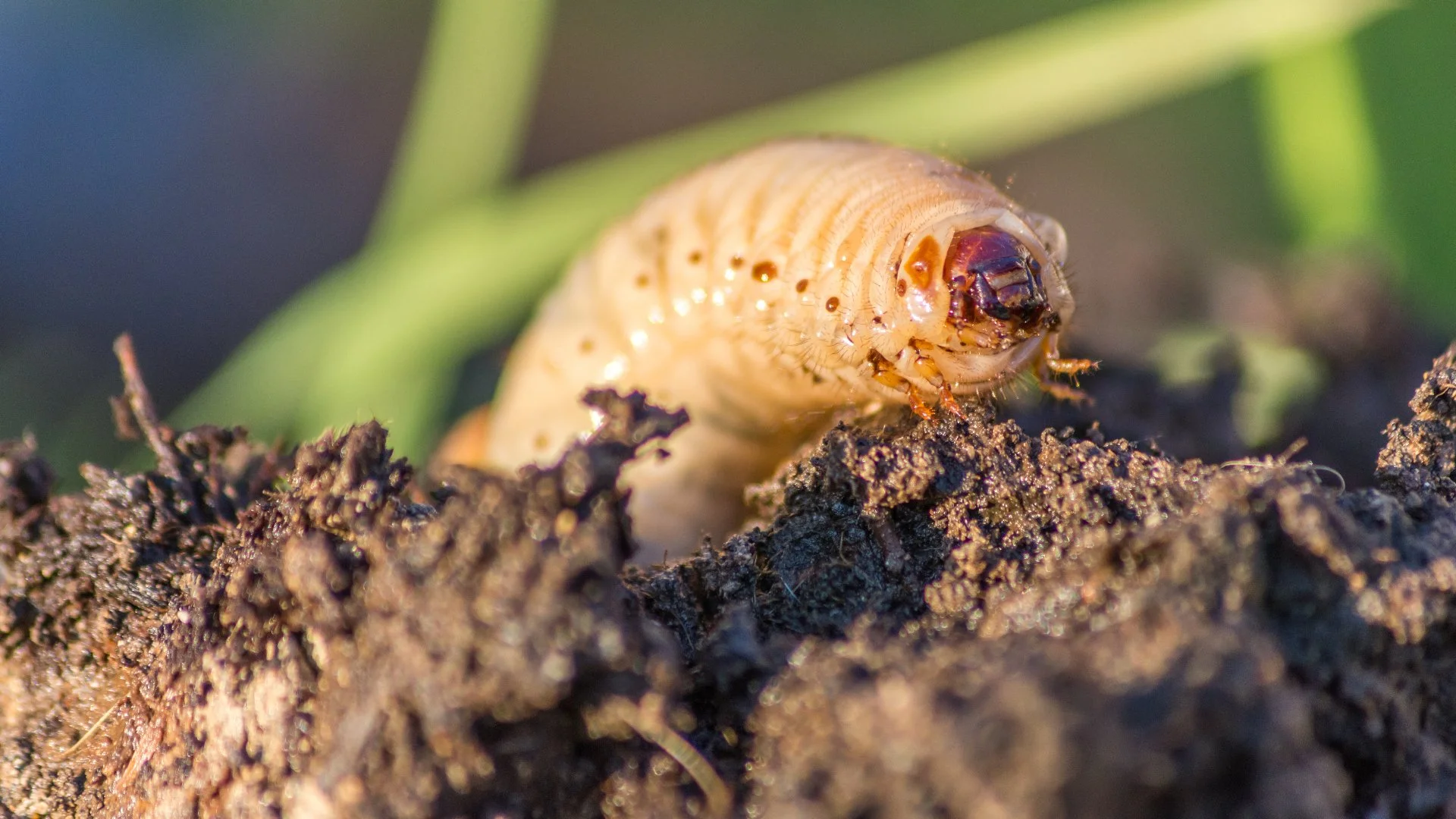
Secondary signs of white grub activity in Houston include increased bird foraging activity in the lawn — birds, armadillos, and raccoons all dig for grubs and their foraging activity on Houston lawns in late summer is often the first indication of a significant grub population below the surface. Digging into a suspect area and examining the soil to a depth of 3 to 4 inches reveals the grubs directly — white, C-shaped larvae with tan-colored heads and three pairs of legs near the head. More than 5 to 6 grubs per square foot in Houston lawn soil is at the economic damage threshold.
Treating white grubs in Houston lawns is most effective as preventive treatment applied before egg hatch rather than curative treatment applied after grubs are already feeding. Preventive grub treatments in Houston are applied in June and July — after adult beetles have laid eggs but before eggs have hatched and grubs have begun root feeding. Imidacloprid and chlorantraniliprole are the active ingredients with the best preventive grub control performance in Houston conditions. Preventive treatments need adequate irrigation after application to move the active ingredient into the root zone where eggs are located.
Curative treatment of active grub infestations in Houston lawns — treating after grubs are already feeding in August, September, and October — is less reliable than preventive treatment but can reduce further damage when properly timed. Trichlorfon provides faster curative activity than systemic products and is the most appropriate choice for Houston homeowners dealing with active late-season infestations. Curative treatments in Houston require heavier post-application irrigation than preventive treatments to move the active ingredient to the feeding depth of established grubs.
The important honest assessment about severe grub damage in Houston lawns is that extensive root system destruction may require sod renovation regardless of how effective the insecticide treatment is. Grass that has had its root system consumed by grubs to the point of detaching from the soil surface cannot recover regardless of what is applied. Once the grub population is addressed, the bare areas in a Houston lawn with severe grub damage need to be evaluated for sod repair or complete renovation based on the extent of the damage and the condition of the surrounding turf.
Problem 3 — Take-All Root Rot: Houston's Most Misunderstood Lawn Disease
Take-all root rot is a fungal disease caused by the soilborne pathogen Gaeumannomyces graminis that attacks the root systems and lower stem tissues of St. Augustine grass in Houston. It is one of the most economically damaging lawn diseases in Houston's market and one of the most consistently misdiagnosed — because its above-ground symptoms appear during drought or heat stress periods in Houston's summer while the actual infection and root damage occurred weeks or months earlier during the cool, moist conditions that the fungus requires to develop.
This timing disconnect between infection and visible symptoms is the core reason take-all root rot is so frequently misdiagnosed in Houston lawns. The homeowner sees a lawn declining in July heat and attributes it to summer stress or irrigation failure. The actual fungal infection developed in March, April, or May when Houston's cool, moist spring conditions provided ideal conditions for the pathogen. By the time above-ground symptoms appear during Houston's summer heat, the root system damage is already extensive and the fungus may no longer be in active growth.
Identifying take-all root rot in Houston lawns requires attention to several characteristics that distinguish it from chinch bug damage and drought stress.
Take-all root rot damage in Houston St. Augustine appears as irregular, roughly circular patches of yellowing and dying turf that do not respond to irrigation. Unlike chinch bug damage, which concentrates in the hottest, driest Houston lawn areas, take-all root rot patches can appear in any area of the Houston lawn regardless of sun exposure or irrigation coverage. The patches may appear anywhere from 1 foot to 20 feet in diameter and tend to have a yellow outer ring of declining turf surrounding a dead center — the classic target or donut pattern of fungal lawn disease in Houston.
Pulling affected Houston St. Augustine reveals the definitive diagnostic characteristic — the roots are short, dark brown to black, and rotted rather than the white to light tan of healthy roots. Healthy St. Augustine pulled from a Houston lawn should have roots extending 3 to 6 inches from the stolon. Take-all root rot victims have roots truncated to less than an inch, dark colored, and with a mushy texture when squeezed. This root examination is the single most reliable way to distinguish take-all root rot from chinch bug damage and drought stress in Houston lawns.
Treating take-all root rot in Houston lawns is one of the areas where Houston-specific knowledge matters most because the standard fungicide-first response to lawn disease is less effective than the soil management approach that actually produces results for this specific pathogen.
Azoxystrobin and thiophanate-methyl are fungicides with activity against take-all root rot in Houston St. Augustine. However, fungicide applications alone provide incomplete control of established take-all root rot because the pathogen lives in the soil and thatch rather than on the leaf surface where contact fungicides are most effective. Fungicide applications are most valuable as preventive treatments in Houston lawns with a history of take-all root rot, applied in late winter and early spring before the cool, moist conditions that trigger infection development.
The most important take-all root rot management intervention for Houston lawns is pH correction. Take-all root rot is significantly more severe in alkaline soil conditions — which describes virtually every unamended Houston lawn. The fungus that causes take-all root rot is suppressed by soil acidity and favored by the alkaline conditions Houston's native clay produces. Elemental sulfur applications and acidifying fertilizer programs that bring Houston lawn soil pH toward the 6.0 to 6.5 range optimal for St. Augustine simultaneously improve the grass's nutritional status and reduce the soil pH advantage that the take-all root rot pathogen exploits.
Peat moss top-dressing — applying a half-inch layer of sphagnum peat moss over Houston lawn areas affected by take-all root rot — is a practice supported by Texas A&M turfgrass research for Houston conditions. Peat moss top-dressing reduces soil pH in the immediate root zone, improves soil structure in Houston's clay, and has shown measurable suppressive effects on take-all root rot pathogen populations in treated Houston plots compared to untreated controls. The application is labor-intensive on larger Houston lawn areas but is one of the most effective non-chemical interventions available for Houston take-all root rot management.
Distinguishing Between the Three — A Houston Field Identification Summary
When you are standing in front of a dying patch of Houston St. Augustine and trying to decide what you are looking at, here is the practical field identification sequence.
First, pull on the affected turf. If it lifts cleanly from the soil like a carpet with minimal root attachment, white grubs are the most likely cause. If it does not lift easily but the roots when examined are short, dark, and rotted, take-all root rot is the most likely cause. If the turf does not lift and the roots appear normal, chinch bugs or drought stress are the most likely causes.
Second, if you have ruled out grubs and root rot, perform the coffee can flotation test at the margin of the damaged area. If chinch bugs are present at damaging densities they will be visible on the water surface within 3 minutes.
Third, consider the location of the damage. Hot, dry, full-sun areas damaged in July and August lean toward chinch bugs. Uniform decline across multiple lawn areas regardless of sun or irrigation coverage lean toward take-all root rot. Spongy, detachable turf in August through October with secondary animal digging activity lean toward white grubs.
Fourth, consider the season. Houston chinch bug damage is concentrated in June through September. White grub damage becomes visible in August through October. Take-all root rot symptoms appear in spring and summer but reflect infection that occurred in the preceding cool, moist period.
When Pest and Disease Damage Requires Houston Sod Replacement
Not all Houston lawn pest and disease damage requires sod replacement — but some does, and recognizing the threshold saves time and money compared to investing in recovery programs for turf that cannot recover.
The general threshold for Houston sod replacement rather than recovery is damage affecting more than 40 to 50 percent of the lawn area, or damage producing complete turf loss in areas larger than 200 to 300 square feet where the surrounding turf is too thin and fragmented to fill back in through natural spread within a reasonable timeframe.
For chinch bug damage in Houston, areas where the turf is completely dead and the stolons have desiccated beyond viability require sod repair. Surrounding areas with living stolons and some green growth can recover with correct treatment and irrigation management.
For white grub damage in Houston, areas where the root system has been completely consumed require sod repair regardless of what is done above ground — there is no root system left to support recovery. Areas at the margins of grub damage with partial root systems remaining can recover if the grub population is addressed and irrigation supports regrowth.
For take-all root rot in Houston, extensive damage areas where the root system has been largely destroyed require sod repair after the soil pH management and fungicide programs are underway. Attempting to recover heavily take-all root rot damaged Houston St. Augustine without addressing the soil pH conditions that favored the pathogen produces recurring disease in the replacement sod.

Gulf Reserve Landscape & Pools provides Houston lawn assessment, sod installation, and soil preparation services across Houston, River Oaks, Memorial, Katy, Sugar Land, Pearland, The Woodlands, and surrounding areas. We diagnose before we recommend — because treating the wrong problem in a Houston lawn is expensive and produces no results.
Request your free estimate at gulfreservelandscaping.com — and let's figure out exactly what your Houston lawn needs.


